Stop betting on the wrong value
Viveck P Kumar
CPO | Ex Amazon, Intuit, PayPal

Decide what's worth building, before you build it
Most product teams don't fail because they can't execute. They fail because they diagnosed the problem wrong before they started.
They picked a behaviour that looked like a problem. They built for acquisition and ignored retention. They launched with a value proposition that made sense to them but meant nothing to the customer on day one.
The cost is not abstract. It is wasted quarters on features nobody adopts. It is a retention curve that will not move no matter what you ship. It is walking into a leadership review without a clear answer to why growth has stalled. The execution was not the problem. The value selection was.
This workshop teaches the BELT+POLE framework — a diagnostic and design system for product managers who need to stress-test their bets before committing to them.
Before this workshop, you evaluate product bets with experience and instinct. After it, you run a diagnostic. You know what kind of problem you are solving and exactly where the architecture is failing. That shift does not wear off.
What you’ll learn
Know whether a product bet will drive adoption before you commit roadmap, budget, or team to building it.
Diagnose any product bet in under 15 minutes. Know exactly which value layer is missing before you commit roadmap or budget.
Design acquisition, switching, and retention value in sequence — four propositions that compound, not compete.
Defend product decisions in exec rooms and investor reviews with reasoning that is visible, structured, and hard to argue with.
Workshop agenda
Session 1: The Intuition
Why your product has four value propositions, not one. Pattern recognition across IndiGo, Warby Parker, and Wise. The 2×2 matrix. POLE introduced. Hot seat: place your product on the matrix.
Session 2: The Diagnosis BELT
BELT: the four-question diagnostic that runs before any design decision. Segmentation, the Despite Test, FUDU scoring, lock-in types, the full Wise walkthrough. Hot seat: full BELT on a live product.
Session 3: The Design
POLE : designing all four value propositions in sequence. HOW Audit, obstacle thesis, P types, O and L design, E-Delivered vs E-Accrued. Hot seat: design full POLE from the Session 2 diagnosis.
Session 4: The System
What breaks POLE and why. Four failure modes, the nine-stage value lifecycle, value currency. Hot seat: full teardown of a real product you are working on. Reference card and close.
Learn directly from Viveck

Viveck P Kumar
20 years in product. Ex-Amazon, PayPal, Intuit, PropertyGuru.



Who this workshop is for
Before this course, you're the PM who builds what the roadmap says. After it, you're the PM who decides what the roadmap should say
Founders & CPOs who have a working product but cannot articulate why customers stay, what the moat is, & how to design for it deliberately.
PMs building in fintech, productivity, health, or professional tools who want a diagnostic they can run on any product, any time.
Prerequisites
3+ years actively practising product
This is advanced material for working practitioners. If you've just entered the industry, build foundational skills first, then return.
What's included

Live sessions
Learn directly from Viveck P Kumar in a real-time, interactive format.
Lifetime access
Go back to course content and recordings whenever you need to.
Community of peers
Stay accountable and share insights with like-minded professionals.
The companion book
A full reference edition of the framework — chapters, exercises, and worked examples — yours to keep and use on every product decision after the course.
The BELT+POLE field guide
A 10-page practitioner reference covering every diagnostic question, design test, and quality gate. Built to use at your desk, not just in a classroom.
Maven Guarantee
Your purchase is backed by the Maven Guarantee.
Free resources
Testimonials
Viveck is a fabulous instructor and this course is so fundamental in its approach that it will unlock new ways of thinking about building right products from the beginning. This course offers deep insights on how to think in terms of defining right outcomes for your product and its value proposition from the get go. Will definitely recommend any mid career builder/PM to do this course.

Utsav
Principal PM, Service Now“The Apparent vs Discovered distinction should be mandatory reading for product teams. It explains why so many AI products struggle with acquisition despite strong retention mechanics.”
Mohak Nahta
CEO, Atlys“POLE is not another positioning model. It’s a lifecycle architecture. It forces trade-offs, clarifies segmentation, and exposes strategic drift.”
Mark Ashworth
Head of Product, Geniebook“Most teams build Embedded value before solving Obvious value. POLE names that failure mode. That alone can save months of misallocated effort.”
Prateek jain
VP PropertyGuru
✔ Take this course if any of these are true:
✔ Your product's adoption is weaker than the team expected
✔ You are debating what to build next and the answer isn't obvious
✔ Your team disagrees on what value your product actually delivers
✔ You are adding AI features and unsure whether they matter to users
✔ Your messaging isn't converting even though the product is genuinely useful
✔ You are preparing for a board, investor, or leadership review of product direction
✔ You have shipped features that looked right but didn't move retention
✘ This course is not for you if:
✘ You are in your first two years of product management , this material requires pattern recognition from real decisions
✘ You are looking for a step-by-step execution playbook POLE is a diagnostic and design framework, not a delivery process
✘ You want tactical AI prompting techniques. This course is about value clarity, not tooling
Frequently asked questions
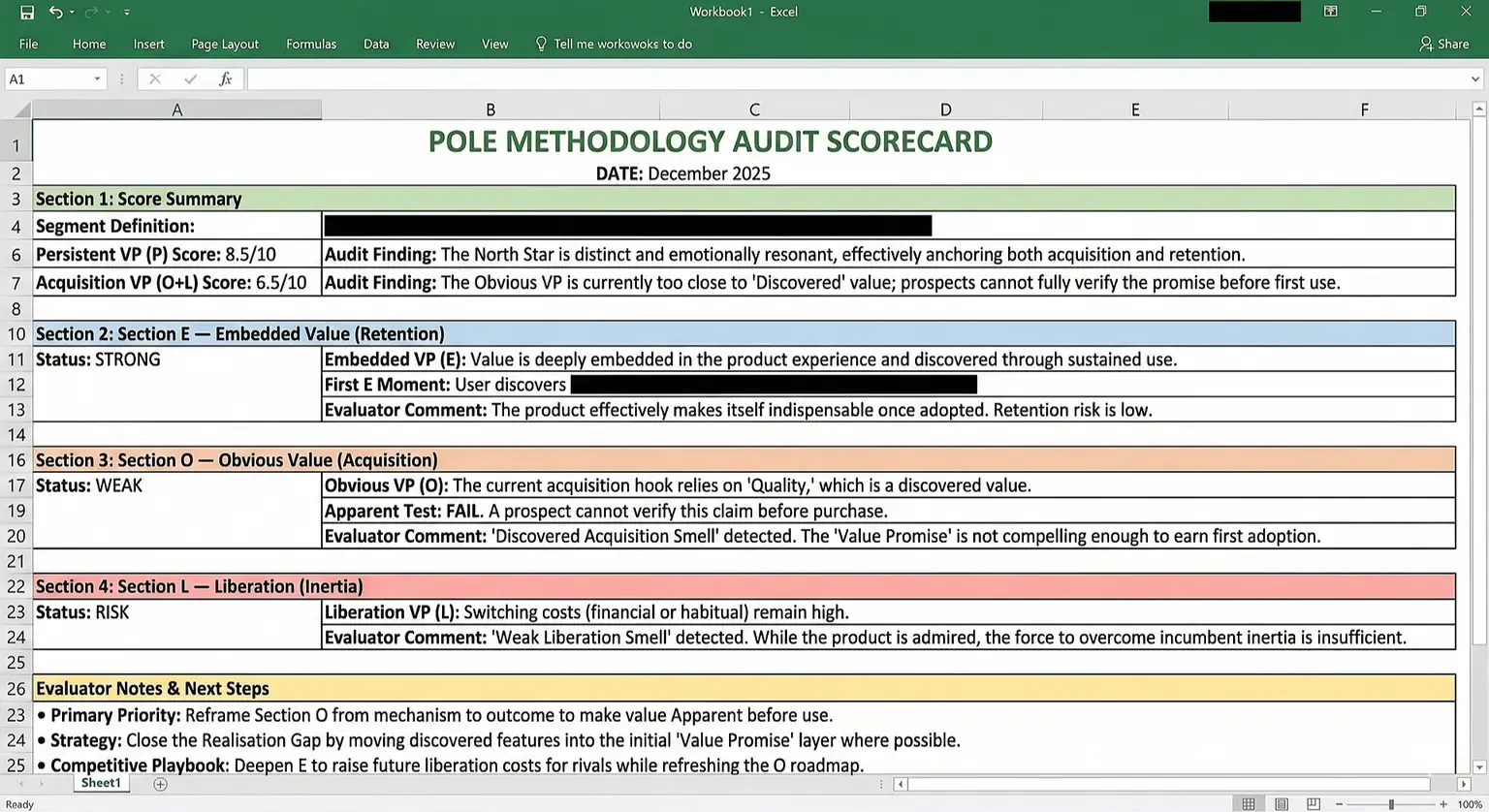
The POLE Method: Proof, Transformation & Results
Maven for Teams
Reimbursement
Get your company to pay
Everything L&D needs: email template, receipts, and certificate of completion.
Get reimbursedPrivate cohort
Run a cohort for your org
A dedicated cohort with a custom schedule and curriculum, tailored to your team.
Book a private cohort