Tue, Jun 23, 2026
4:00 PM UTC (30 minutes)
Virtual (Zoom)
Free to join
Go deeper with a course

Tue, Jun 23, 2026
4:00 PM UTC (30 minutes)
Virtual (Zoom)
Free to join
Go deeper with a course

What you'll learn
See Beyond the Product
Spot Service Problems Product Teams Miss
Shift from Feature Thinking to Service Thinking
Why this topic matters
You'll learn from
Frank Spillers
CEO at Experience Dynamics (award-winning UX & Service Design consultancy)
I’ve led AI-first service design across government, enterprise, and start-ups.
Founded award-winning Experience Dynamics, a global UX and Service Design consultancy.
Design leader with 25+ years redesigning complex products and services across channels, touchpoints and organisations.
I specialise in inclusive service design and in helping teams identify root causes and implement impactful interventions. I’ve led service design in enterprise, gov and startups end-to-end from problem framing to service blueprints and operational and org change.
I mentor at UX Inner Circle for brands like Google, Harvard, Accenture, Dell, Mercedes-Benz, Zappos, Netflix and FedEx.
BIG IDEA IN THIS LESSON:
A customer may complete a digital form but wait weeks for approval. A patient may use an excellent healthcare portal but struggle to coordinate appointments. A resident may navigate a website successfully but still receive conflicting information from different teams.
In these situations, improving the interface alone cannot solve the problem.
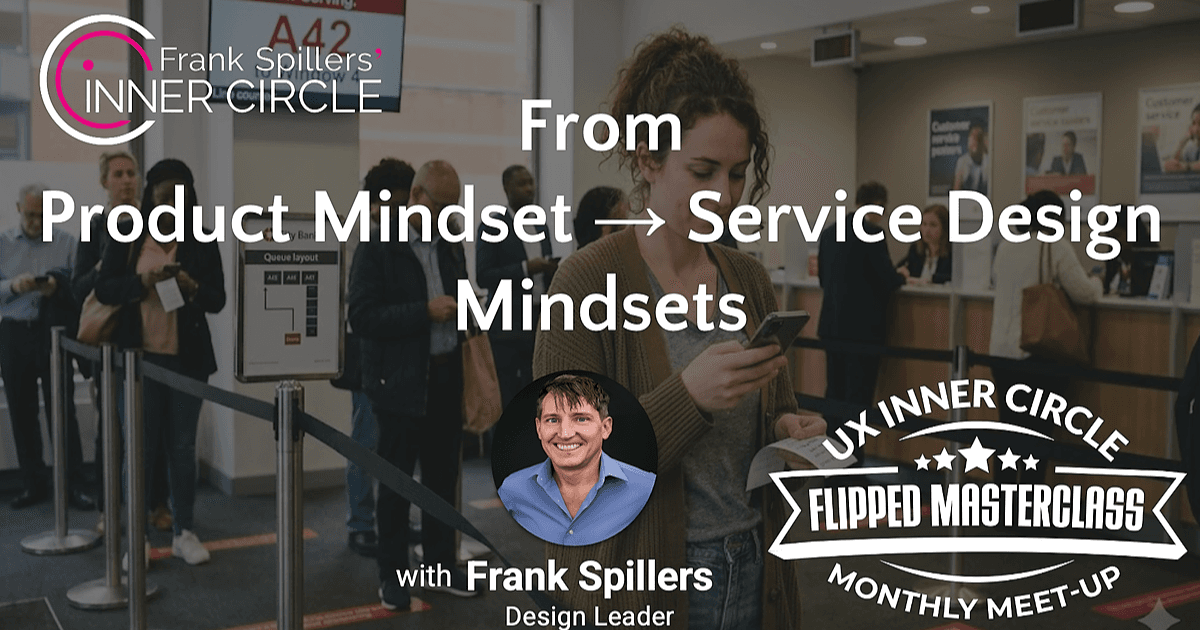
The challenge is that users experience services, not products.
When people apply for benefits, schedule healthcare, resolve billing issues, or access government services, they move across touchpoints, teams, processes, and channels. The product is often only one part of a much larger experience.
Service Design expands the scope of design beyond screens and transactions. It helps teams understand how experiences are shaped by people, processes, technology, policy, communications, and organizational behavior.
This shift matters because many experience problems are actually organizational problems that users happen to experience.
By adopting a service design mindset, teams can identify root causes instead of symptoms, reduce friction across journeys, improve trust, lower operational costs, and create better outcomes for both users and employees.
In this Lightning Lesson, you'll learn how to move beyond product-centric thinking and see experiences through a service lens. You'll leave with practical frameworks for understanding end-to-end journeys, uncovering hidden barriers, and identifying opportunities that remain invisible when teams focus only on products.
Previously at