.jpg&w=768&q=75)
The people ahead aren't reworking AI's output. They're directing it.
You use it every day, but lately everyone seems to be doing something with it that you're not: someone with AI running half their work in the background while they focus, people who just sound three steps ahead. You can't tell what's real, but it nags at you.
Here's the thing. You're not behind, and you're not bad at this. You've just never been shown how to use it well. The people ahead didn't find a smarter prompt. They built a real system underneath for themselves, and over five weeks you build your own.
The gap was never knowledge. You probably know more of the theory than you use. You just never built it on your own real work. So you let AI run without directing it, then rework most of what it hands back. You might just miss a few missing pieces to connect it all. To build your system. No code required.
The people who go furthest stop calling it a faster workflow. They say it changed their relationship with AI: not another tool in the stack, but a different way of working. You leave with it running on your real work. Your personal Chief of Staff. That is what we are building here from scratch.
What you’ll learn
How to build a system that handles the work you shouldn't be doing and sharpens the work only you can do.
Start from a prepared workspace you own and control, in plain text files, no code.
Load it with your real projects, your decisions, and the standards you hold work to.
Point it at one real project you're working on now, so everything you build runs on your actual work.
See the difference live: default AI agrees with you; an advisor is built to challenge you.
Build your own from a simple four-part template (who they are, what they know, how hard they push, when they refuse).
Test it against a real decision you're facing, so it pushes back like your boss or your toughest client, before the real meeting does.
Research first: load what AI needs and give it a clear standard before you ask.
Read what it hands back and push it, instead of accepting the first plausible version.
Run a verify pass that flags what's assumed versus confirmed, so thin work doesn't slip through.
Write a short spec for what your morning should do, then have AI build it for you.
It asks the one thing you're committing to today and looks back at yesterday's.
It reads your week's priorities against your calendar and points you at what matters.
Do one weekly review by hand first, so you feel what goes stale and why.
Build your own weekly review that updates the system as you work (this is the capstone, built on your real work).
Walk me through your build and the decisions behind it, the proof you can run and grow it after the course.
Add identity and a decision log so it's clear who decided what, and why.
Set up index files that onboard a teammate (or a fresh AI session) into your work.
Run the handoff test: open a clean session, and watch it explain your project back.
Learn directly from Myles
.jpg&w=384&q=75)
Myles Sutholt
I will help you escape the AI build trap and start getting actual value from it.




Who this course is for
You get decent output but re-explain context every session. You want AI that knows your work and challenges your thinking.
Ms, designers, engineers, operators. Whether you're solid with AI or already advanced, you'll find the level that's new for you.
You want to walk into meetings having already stress-tested your arguments. You want documents that survive the first round of review.
Prerequisites
Use tools like Claude or Cursor regularly (not just tried once)
You already use AI regularly. This isn't a first-intro to ChatGPT or Claude. It's for people who use it a lot and want to use it well.
Can install software
You need to install tools like Claude Code or Cursor. Some company laptops block this. If you are unsure, check with your IT team.
A Claude or Cursor subscription
A Claude or Cursor subscription (around $20/month). You won't need it in week one, but you'll want one by week two.
What's included
.jpg&w=1536&q=75)
Live sessions
Learn directly from Myles Sutholt in a real-time, interactive format.
A Working AI System Built on Your Real Work
You leave with a fully functional AI system built on your actual projects, priorities, and stakeholders. It is yours to keep and runs on your machine
AI Advisors Modeled on Your Real Stakeholders
Advisors that challenge your documents, prepare you for meetings, and find what you missed. They are modeled on the people you actually work with and they are yours to keep.
Pre-Built Starter Workspace
You start building on day one, not week two. Plug-and-play templates and proven workflows so you reach working-system status from the first session.
Personal feedback on every submission
Not automated. Myles reviews your work and provides detailed feedback on what to improve and how to strengthen your AI system.
Lifetime access
Go back to course content and recordings whenever you need to.
Free Retake of Any Future Cohort
The system evolves between cohorts. Your access does too. Come back when you are ready to build the next layer.
Certificate of completion
Share your new skills with your employer or on LinkedIn.
Active cohort of ~20 students
Small cohorts, so that you can have enough face time with the instructor to level up your AI skills fast.
Continue Learning & Collaborating In Slack
As this space changes, so does your work with it. You will be invited into a Slack space, where alumni (and myself) share lessons learned for you to apply.
Full Refund If You Are Unhappy
If you attend the sessions, do the projects and feel like what you have learned did not make a meaningful difference, I will refund you 100%.
Maven Guarantee
Your purchase is backed by the Maven Guarantee.
Course syllabus
13 live sessions • 31 lessons
Week 1
Jul
10
GET IT RUNNING, TOGETHER.
Fri 7/103:30 PM—4:30 PM (UTC)
Setting up your AI Chief of Staff Foundation
Week 2
Jul
13
The Difference Between Using AI and Working With It
Mon 7/134:00 PM—5:30 PM (UTC)Jul
15
Let an Expert Agent Tear Your Plan Apart
Wed 7/154:00 PM—5:30 PM (UTC)
Engage your AI
Make AI Hold You Accountable Via Automations
Jul
18
Office Hours (Troubleshooting)
Free resources
Schedule
Live sessions
3-4 hrs / week
Sat, Jul 18
3:00 PM—4:00 PM (UTC)
Mon, Jul 20
4:00 PM—5:30 PM (UTC)
Wed, Jul 22
4:00 PM—5:30 PM (UTC)
Projects
2-4 hrs / week
Async content
1 hr / week
Testimonials
I managed Myles at Trafo. He's one of those rare people who thinks in systems. When he builds something, it actually works
and keeps working. If he's teaching a system for AI productivity, it's because he's already pressure-tested it himself.

Abraham
ex-General Manager @ WikimediaMyles and I were experimenting with ChatGPT integration at Talent.io before most people had even heard of it. He was already thinking about how to make AI actually useful for real work while everyone else was still playing with prompts. He's been doing this longer than most.

Amit
Co-founder talent.io and CruiseWise (acquired by TripAdvisor)As a Head of Product, this was the first AI approach that actually made my work easier. Treating AI like a teammate, automating the admin, and freeing my time for product decisions.

Sander
ex-Analysis Group (worked with Clayton Christensen)
Alumni come from these companies
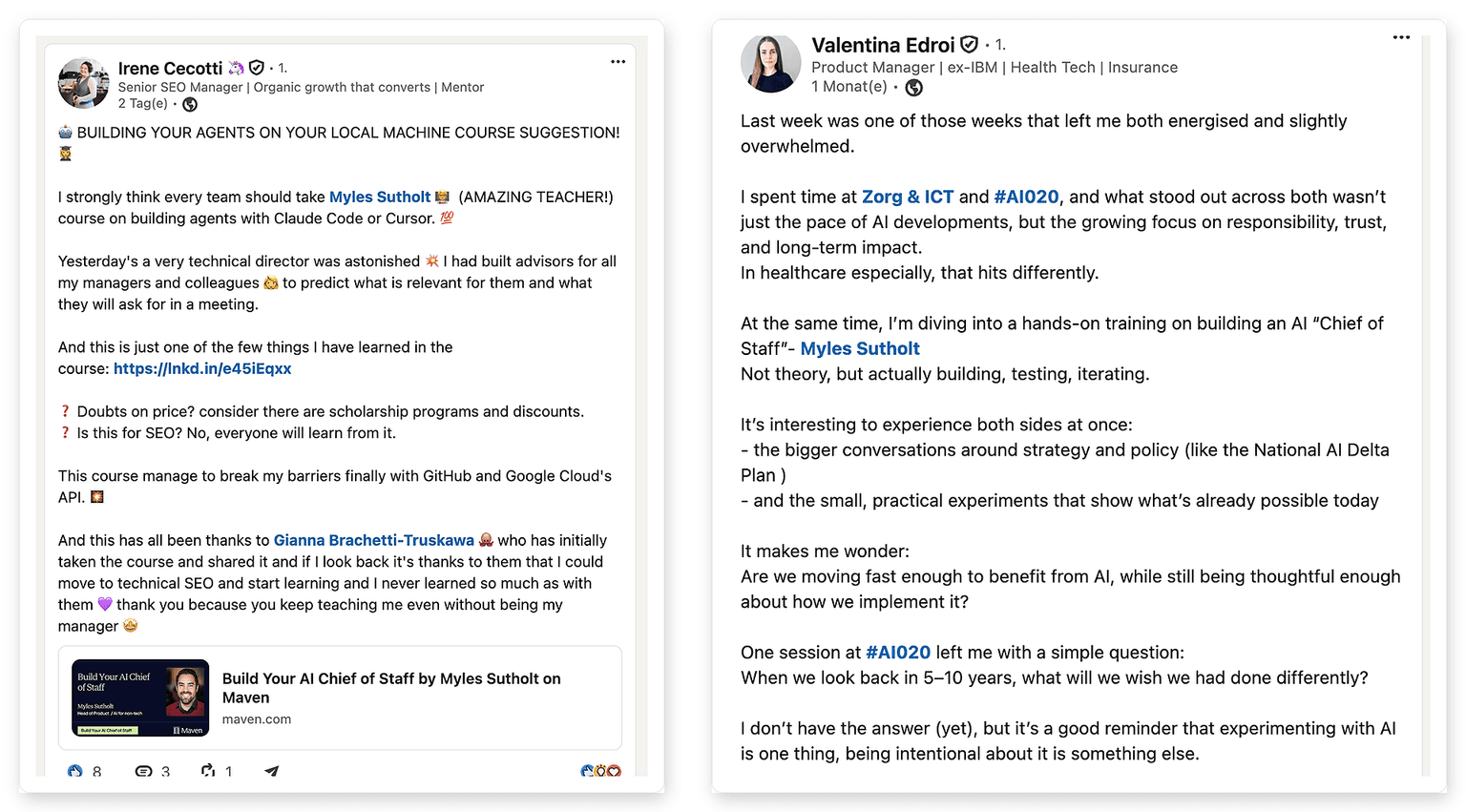
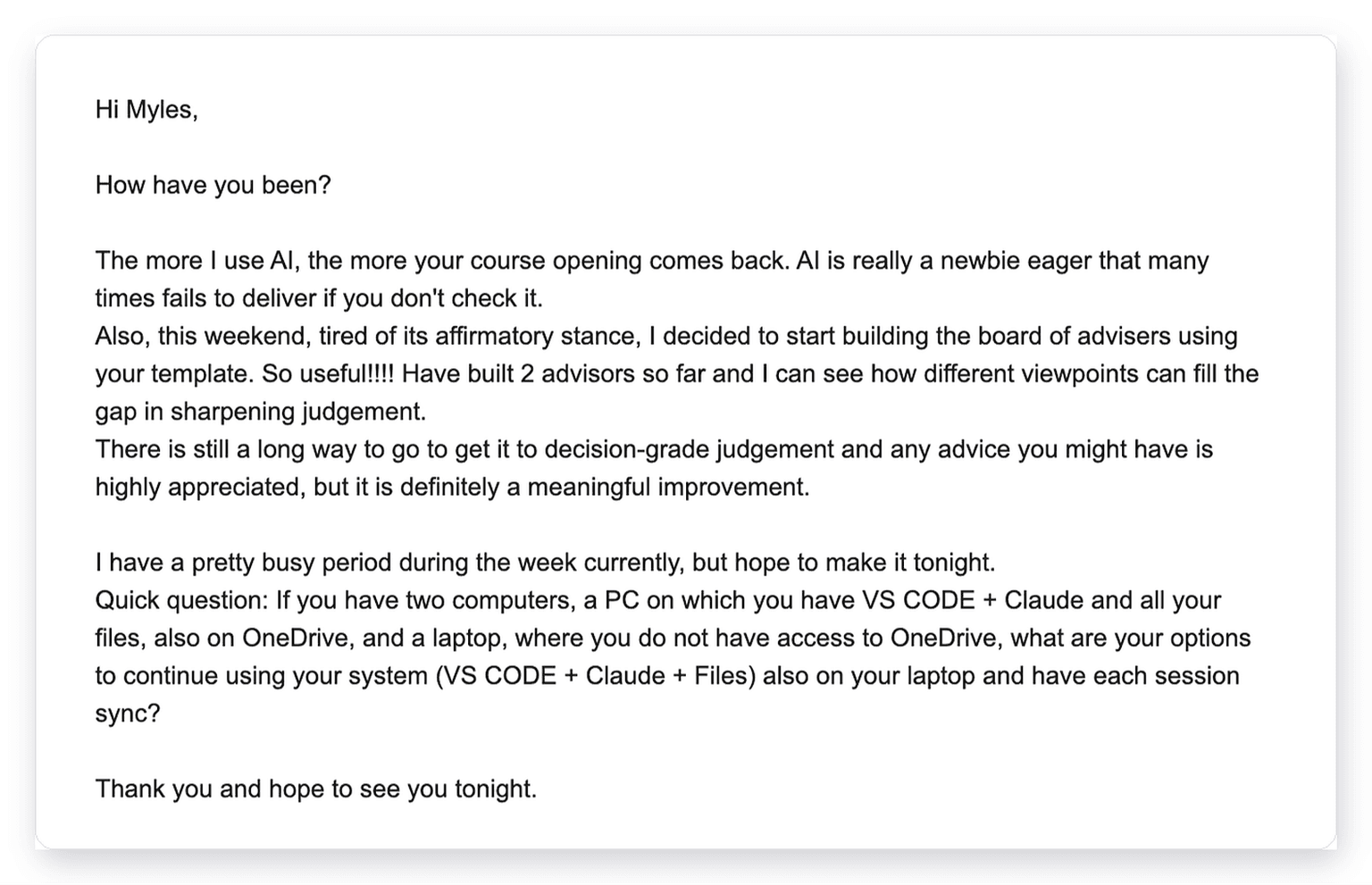
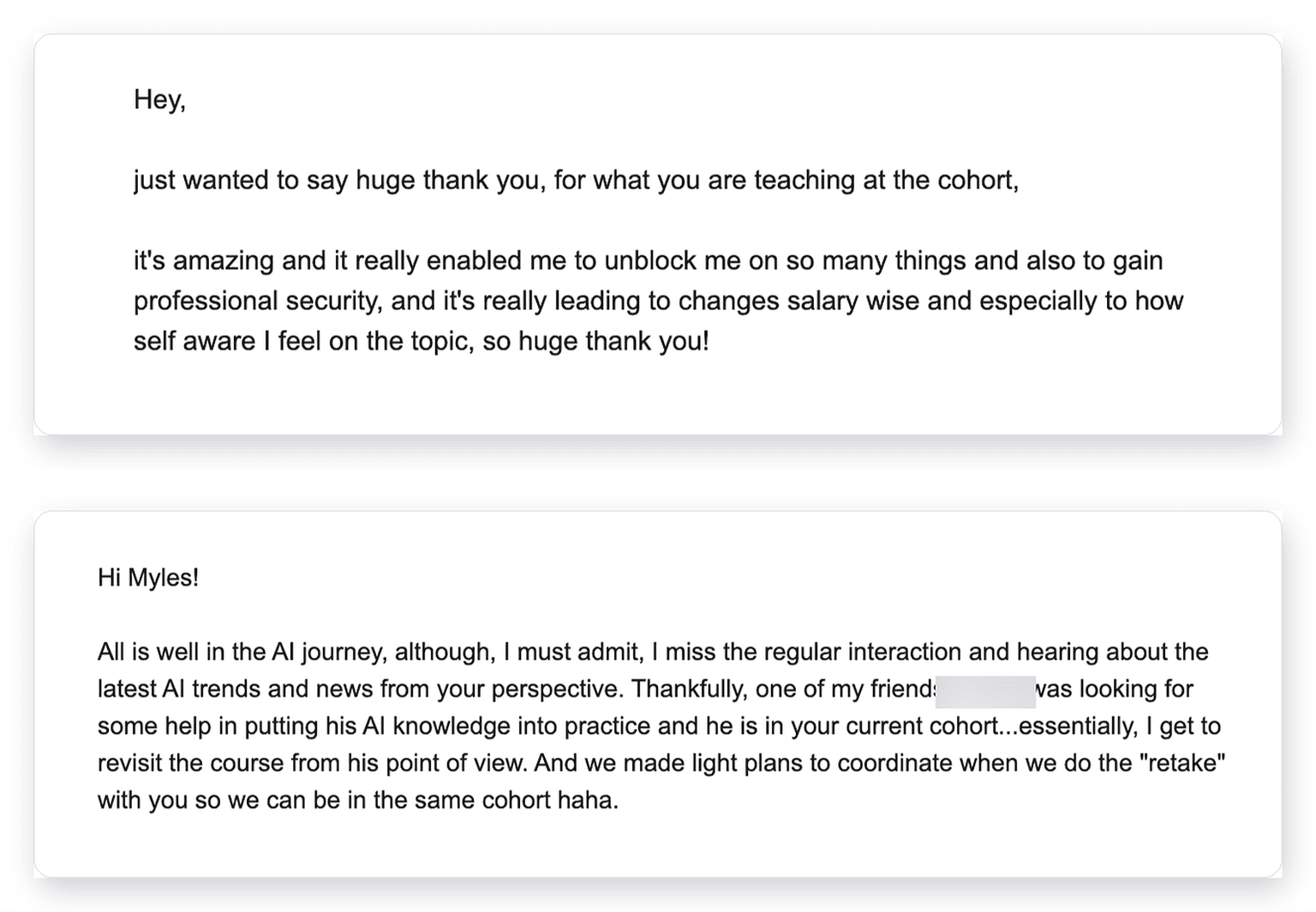
Real posts and messages I never asked for
Frequently asked questions
What Students Say
"This course humbled me in the best way. He shows you why everything you have been doing is still just scratching the surface." -Tim, UX Designer
"A system I use every single day. One that supports me in my daily work and has increased the quality of my work immensely." -Renata, Product Owner at desk.ly
"I liked the idea of thinking about creating a team of advisors to tap into and digital twins of people we meet." -Devin, Software Engineer at About You
"AI is like the most capable colleague you have ever hired, except they just walked in on day one. Limitless potential, but completely dependent on how well you onboard them." -Wole, Product Designer
"Just do it! You will get a lot of value out of it and might be able to onboard the rest of the team, too." -Gianna, Senior PM at DeepL
The Two Things You Build
The Automation Layer
Handles recurring work so you do not have to. Weekly reviews, priority sorting, meeting prep. Runs automatically. Roughly half a day back every week.
The Advisor Layer
AI advisors modeled on your real stakeholders. They challenge your documents, stress-test your plans, and prepare you for hard conversations. The system that makes your work visibly better.
How the Course Works
Week 1: Give your AI the right foundation.
Ask your AI a real work question and see what it actually knows about you. For most people, the answer is nothing. Then build the context that changes that: your projects, your priorities, what good work looks like. Everything you build after this week gets better because the foundation is right.
Week 2: Free up time. Use it for the work that matters.
You describe what you want in plain English. AI writes the code. By the end of the week, you ship an automation that handles something you currently do by hand. The time you get back is real. Use it for the thinking AI cannot do for you.
Week 3: Build AI advisors that challenge your thinking.
Build an advisor modeled on a real stakeholder. Someone who pushes back on your documents, stress-tests your plans, and prepares you for meetings before they happen. Then automate your weekly review so the system keeps learning without you maintaining it.
Week 4: Make it work for your whole team.
Learn how to collaborate with team members and see how the system compounds to a degree, where it catches quality issues of others as well. The AI has the same capability it had on day one. Your system is what changed.
Maven for Teams
Reimbursement
Get your company to pay
Everything L&D needs: email template, receipts, and certificate of completion.
Get reimbursedTeam discount
Learn with your teammates
Save 20%+ when 2 or more teammates enroll in the same cohort.
Save 20%+ with a teamPrivate cohort
Run a cohort for your org
A dedicated cohort with a custom schedule and curriculum, tailored to your team.
Book a private cohort$749
USD