
If you know ML, you already know most of QML.
If you understand training loops, kernels, and neural networks, you already know most of what quantum machine learning requires. The concepts map directly. The kernel trick becomes quantum kernels. Training loops become variational circuits. Neural networks become quantum neural networks. What's missing is the quantum layer, and that is exactly what this course teaches.
You will build every model in Qiskit 2.x and compare it with a classical baseline. You will also learn what QML cannot do yet. That is the first question your team or your clients will ask.
What is included
9 live sessions of 75 minutes, all recorded
11 Jupyter notebooks with end-to-end QML pipelines on real clinical datasets
PDF slides with full derivations, written as a standalone reference
A guided capstone project for your GitHub or freelance portfolio
A certificate of completion
Many employers cover course fees from learning budgets. A reimbursement request template is available on request.
Learners in developing countries: 30% off using code Outreach.
What you’ll learn
Go from ML to QML in 4 weeks. Build quantum models on real clinical data and finish with a capstone project you can show.
States, gates, and measurement taught as the linear algebra you already use
Superposition, interference, and entanglement as computational resources
Qiskit 2.x primitives, SamplerV2 and EstimatorV2, from day one
Basis, amplitude, and angle encoding, and when to use each
Design quantum feature maps as feature engineering
See how encoding choices shape what a model can learn
Extend the kernel trick to quantum feature spaces
Train QSVMs on leukemia and breast cancer datasets
Cluster data with quantum k-means
Variational circuits as the quantum version of a training loop
Choose ansätze, cost functions, and optimizers that work
Diagnose barren plateaus and other trainability failures
Submit jobs to IBM quantum computers with Qiskit Runtime
Simulate hardware noise and measure what it does to your model's accuracy
Compare quantum results with a classical baseline
Design, run, and defend your own QML experiment
Publish the code on GitHub with a clear write-up
Use it in job applications, client proposals, or as the seed of a research paper
Learn directly from Muhammad
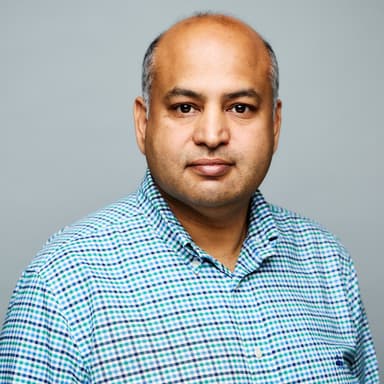
Muhammad Faryad
Associate Professor of Physics, LUMS · Tier-2 IBM Qiskit Advocate




Who this course is for
AI/ML engineers — You want to add quantum ML to your skill set and be the person on your team who can prototype and evaluate it.
Freelance data scientists and developers — You want a rare niche that sets your profile apart, backed by a real portfolio project.
Graduate students and researchers — You want to start research in quantum ML with solid theory and working code.
Prerequisites
Core machine learning
You are fluent in supervised and unsupervised learning, SVMs, and neural networks.
Python with NumPy, scikit-learn, and pandas
You have written ML code in Python before. We build on these tools from day one.
Basic linear algebra
You are comfortable with vectors and matrix multiplication. Exposure to eigenvalues and complex numbers helps you go deeper.
What's included
Recordings of every session
Every live session is recorded and posted right after it ends.
11 Qiskit notebooks
Each notebook is shared before its session, so you can run along as models are built on real data.
Slides with full derivations
Shared before each session and written to work as a standalone reference.
Live Q&A in every session
Bring your questions, including how to turn your own ML projects into QML projects.
Practice notebook with solutions
A practice assignment with full solutions to check your Qiskit fundamentals.
Guided capstone project
Design and run your own QML experiment, and publish it on GitHub.
Certificate of completion
Issued to every participant who completes the course.
Maven Guarantee
Your purchase is backed by the Maven Guarantee.
Course syllabus
7 live sessions • 37 lessons
Week 1
Jul
14
Lesson 1. The linear algebra you already use, written in quantum notation — states, gates, Bra-Ket language, Hilbert spaces, and your first circuit in Qiskit 2.4
Jul
16
Lesson 2. The three computational resources classical ML doesn't have — superposition, interference, and entanglement, with the Qiskit SamplerV2 primitive
Slides
Jupyter Notebooks
Practice Assignment with Solutions
Quantum Algorithms Notes
Accessing IBM Hardware
Week 2
Jul
21
Lesson 3. How a quantum circuit produces a prediction — observables & expectation values with Qiskit EstimatorV2 primitive and transition to Quantum ML
Jul
23
Lesson 4. Feature engineering for quantum models — data encoding strategies and quantum feature maps from data space to exponentially big Hilbert spaces
Slides
Jupyter Notebooks
Free resources
Alumni
Alumni in 14 countries, from Chewy and Teradata to the University of Chicago and Queen's University.
Industry Alumni
Staff Machine Learning Engineer, Chewy, Florida, USA
Senior Data Scientist, Teradata, Pakistan
Solution Advisor, Omnicell, Texas, USA
Data Scientist, Acorn Bioenergy, London, UK
Software Engineer, HSS, New York, USA
QC Coordinator, Amerisci, New York, USA
Founder, quantum computing company, USA
Research Assistant, quantum computing company, South Korea
Actuary, Sompo Insurance, Mexico
AVP Retail & Projects, Valiram Group, Malaysia
Senior AI/ML Engineer, PITB, Pakistan
Data & AI Engineer, Measurebit, Maharashtra, India
Architect, L&T, Telangana, India
Software Engineer, Innovate for Consulting and Technology, Cairo, Egypt
Software Engineer, Kaung Sein Tech, Myanmar
Freelance software developers, UK and France
Academic Alumni
Informatics Researcher, University of Chicago, USA
Postdoctoral Researcher, Saint Louis University, USA
Research Assistant, Binghamton University, New York, USA
Graduate Student, UC Riverside, California, USA
PhD Student, Queen's University, Ontario, Canada
Lecturer, Aston University, UK
Lecturer, Northern Border University, Saudi Arabia
Quantum Physics Faculty, Mohammed V University, Morocco
Faculty, Ibn Zohr University, Morocco
Faculty and students, LUMS and QAU, Pakistan
Students, IISER Mohali and IIT Kottayam, India
Student, Çanakkale Onsekiz Mart University, Türkiye
Student, Universidad Anáhuac México Norte, Mexico
Frequently asked questions
Maven for Teams
Reimbursement
Get your company to pay
Everything L&D needs: email template, receipts, and certificate of completion.
Get reimbursedPrivate cohort
Run a cohort for your org
A dedicated cohort with a custom schedule and curriculum, tailored to your team.
Book a private cohort