Build a Connected AI System Around Your Knowledge and Judgment
Vicky Zhao
ex-Google/LEK, AI x PKM + frameworks

There's so much in your head, yet so little is reusable.
You’ve put years into honing your skills, judgement, and experience. But so much of that thinking gets left behind in old notes and finished projects. It's time-consuming and frustrating to find it and explain it. But it's also inefficient to start from scratch. By the end, you have less energy left to think through the new variables. We want your experience to show in the ideas you bring and the decisions you make.
In this 3-week cohort, build a simple AI system that draws on your past work and applies your methods, so you can build on what you already know and bring a stronger point of view to your next project. You’ll set up your agent to help keep your knowledge base up to date, find what’s relevant, and remind you what needs attention, so you can focus on developing your ideas.
We’ll keep it practical: work through use cases together, then help you apply them to one useful question from your own work. Start with a few relevant notes or what’s already in your head, and add only what helps. The goal is not a perfect system, but a useful one from Day 1. No organized archive or previous agent experience needed!
What you’ll learn
Start with real work. Let your agent find, organize and update information so you can focus on ideas and decisions.
Give AI your standards, so you’re not explaining what good looks like every time.
Test it on real work, so you know where to trust it and where to step in.
Have your agent save the corrections you approve as reusable instructions, then test whether the next attempt improves.
Ask your agent to find relevant notes and show the sources, starting with a small set of material you can check.
Connect past lessons to today’s problems, so your hard-earned experience keeps paying off.
Check the evidence behind each connection, so you’re building on something solid.
Put your accumulated knowledge to work on a real decision, with less context to rebuild.
Turn the same work into a team brief or action plan, with less to explain again.
Have your agent save useful learning and help you set reminders to revisit open questions, so the next task has somewhere to start.
Learn directly from Vicky

Vicky Zhao
Helping you do better work, faster, by building on what you already know.





Who this course is for
Leaders and senior individual contributors who want AI to use their knowledge and standards without explaining everything again.
Consultants and independent experts who want each client project to build on their methods and experience.
Professionals new to AI agents who want a practical start with their own work, without sorting every note or building a complex system.
What's included
A knowledge base built from a few useful starting points.
Have your agent help organize relevant notes and experience, retrieve what matters, and show the original sources. Add material as your work needs it.
Reusable skills built from your methods and standards.
Start with a method you trust, test it on actual work and have your agent capture the corrections you approve. Check whether those changes improve the next attempt.
Practice using the same knowledge for different work.
Work through a question, then use the same thinking for a brief, recommendation or next steps. You’ll check what the new audience needs and what can carry forward.
Agent-assisted upkeep and reminders.
Practice having your agent add new material, save useful corrections and help you set reminders for open questions. Check that you can find and use the work again in a fresh session, so keeping it useful fits into the work you’re already doing.
Maven Guarantee
Your purchase is backed by the Maven Guarantee.
Free resource
Make Your AI Agent Think Critically: 3 md files + sub-agent
3 markdown files that give your AI agent better judgement
You'll create a simple 3-file system that gives your AI agent clear rules for better thinking and execution.
Spawn a reviewer sub-agent to notice & fix output issues
You'll add a reusable reviewer that audits outputs against your rules and catches weak evidence or skipped assumptions.
Turn your judgment into reusable frameworks
You’ll build a system for stronger memos, analysis, writing, decisions, and quality-critical workflows.
By continuing, you agree to Maven's Terms and Privacy Policy.
Testimonials
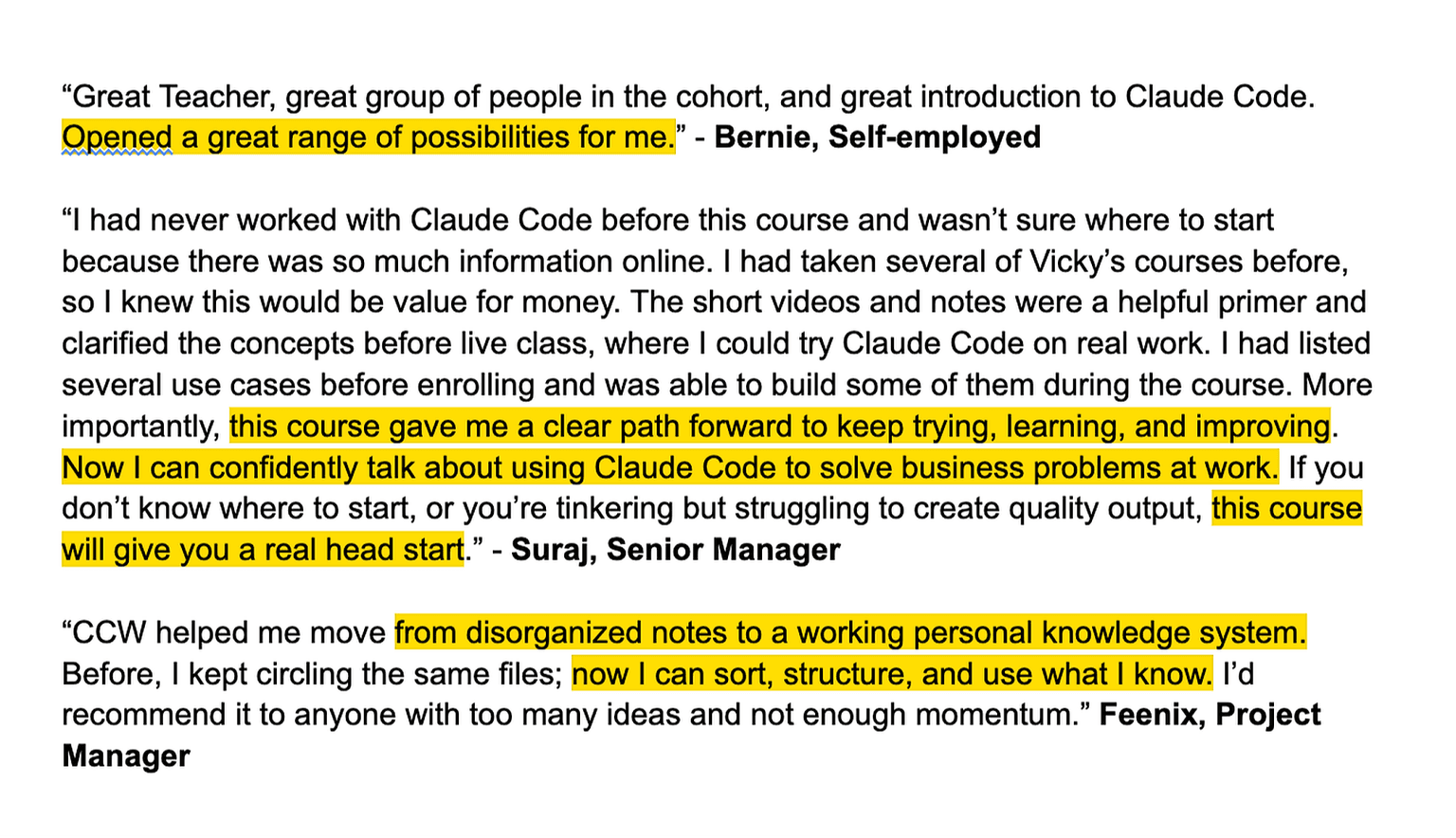
A week ago, I wouldn’t touch the Claude Code button. Today I’m code-curious: eager to try, fail, and learn. What changed wasn’t my technical skill. It was finally getting my own expertise out of my head. In change management, facilitation, leadership development, and coaching, our magic touch is often felt but not explicit. Vicky’s framework helped me articulate what I actually do, see, and notice. Then Claude Code gave that expertise a place to live and compound through skills, md files, and routines. AI now frees me to do what I love most: be fully present with clients, while Claude Code helps with notes, organizing, and synthesis. You don’t need to be technical. You need to be curious and willing to let your expertise become something playful, meaningful, and yours.

Yvonne Yam
Change Facilitator and Executive CoachI went in with high expectations for CCW, and it honestly exceeded them. Before this, Claude Code felt like a black box; now it feels like a real thought partner. The turning point was Vicky’s framework for exploring problems laterally and going deeper than the initial problem statement. The mix of pre-recorded sessions, daily nudges, live discussions, and community made the experience genuinely joyous. I now use Claude Code to build PowerPoint slides and visuals that reflect my taste and standards from 15 years in finance and tech. More importantly, it helps me go deeper on insights I normally would not have had time to think through. Go in with a beginner’s mindset. Don’t just learn CC mechanics. Treat it as upgrading your brain’s software. Big shift: I think in outcomes now, not inputs.

Deepak Talwar
Director, Corporate TechnologyVicky demystifies AI. Information about AI piles up and overwhelms me. Where do you start? Who do you follow? Who do you learn from? True to her philosophy, Vicky distills it to the essentials. Before this cohort, I used AI like Google search. Learning the Claude Code fundamentals changed everything. I was able to start a foundation that helped put everything else into place. I was unable to attend all the sessions. Still, my knowledge exploded. While the cohort uses Claude, the core knowledge and skills transfer to another AI tool. I haven’t finished the course yet, but I’m learning so much. If you use AI daily but don’t truly understand it, take this course. Good stuff!

Daniel Ng
Director, NDTV Technical Operations
Live Cohort Takeaways
What this could look like in your work
We’ll work through concrete use cases, then help you choose a question relevant to your work. Start with enough context to try it, and add more when it helps. For example:
Review a project plan using a method you trust.
Start with one project plan and explain what you look for when reviewing it. Turn those criteria into a skill your agent can use to check the plan and revise what falls short before bringing it to you. You review the reasoning and unresolved issues, then have the agent save the corrections you approve for the next review. Those same criteria can help your team check their work before handing it over.
Bring past experience and stakeholder context into a complex decision.
A difficult decision involves what matters to you and what matters to everyone affected. Your agent can draw on past projects, meeting notes and stakeholder context in your knowledge base to help you work through those competing priorities. You have less to hold in your head and a clearer way to explain how your decision accounts for the concerns around the table.
See what scattered information reveals about what needs attention next.
The reason a project keeps stalling may become clearer when you connect feedback with meeting notes. Your agent can bring those sources together and flag recurring concerns, contradictions or unanswered questions. You check its interpretation and decide what deserves attention, then have it help you set a reminder to revisit what’s still unresolved.
Your 3 weeks
Week 1: Put one of your methods to work.
Follow a worked example, then choose a useful question from your own work. We’ll help you explain your approach, turn it into instructions your agent can use and test it on a small piece of work. Start with only the setup you need to try it.
Week 2: Connect the knowledge that helps.
Bring in a few relevant notes, examples or lessons from past work. Have your agent help organize them and retrieve useful context for your question. Check its connections against the original sources before adding more. You’re building something you can use, without reorganizing your whole archive.
Week 3: Reuse the work and share the upkeep.
Use the same knowledge and methods for a related task, such as a decision brief or next steps for your team. Practice having your agent save useful learning, help update the material and set reminders for open questions. Return in a fresh session to check what it can retrieve and use, so you know how to keep going.
Student comments from Zoom chat
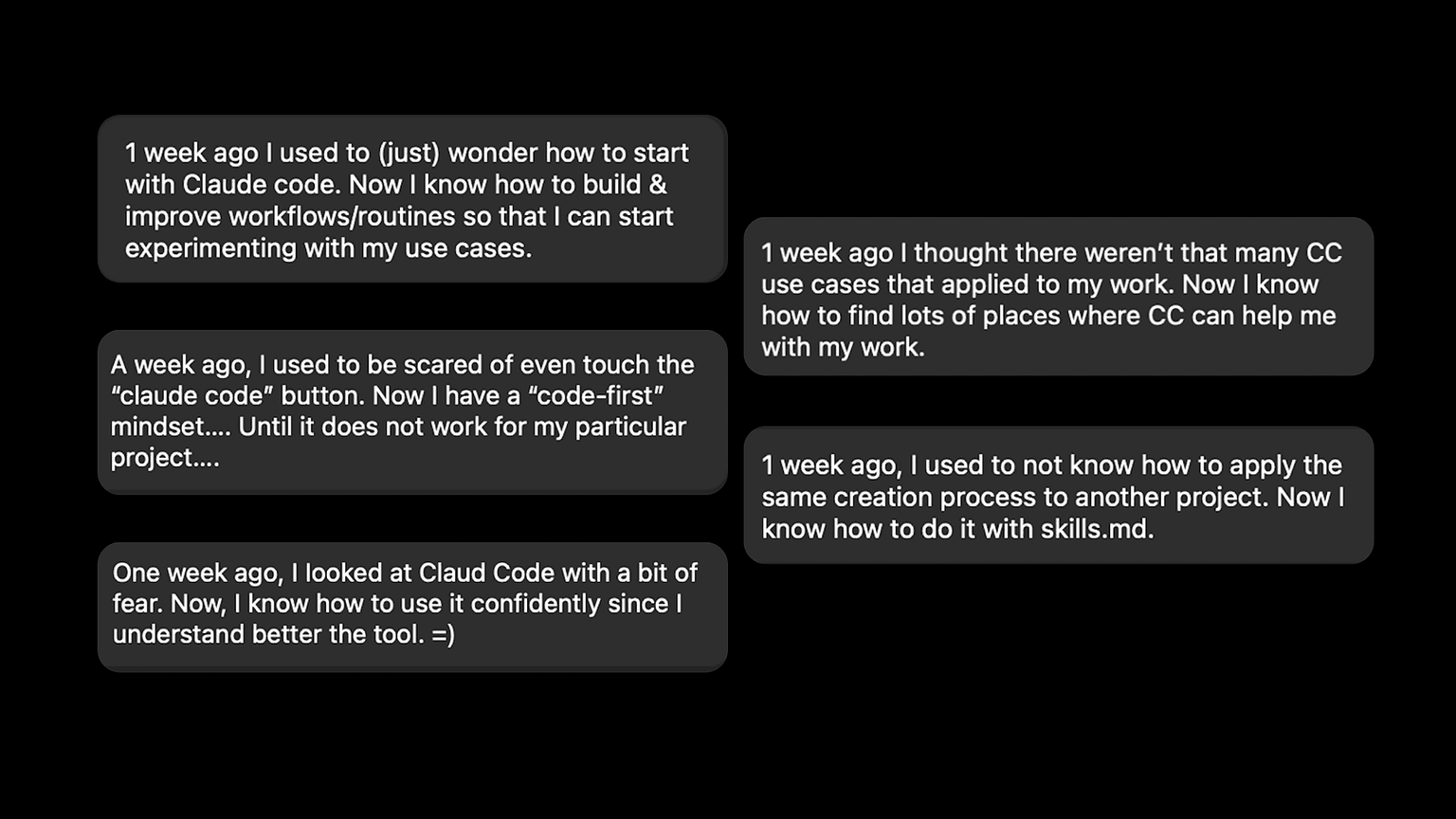
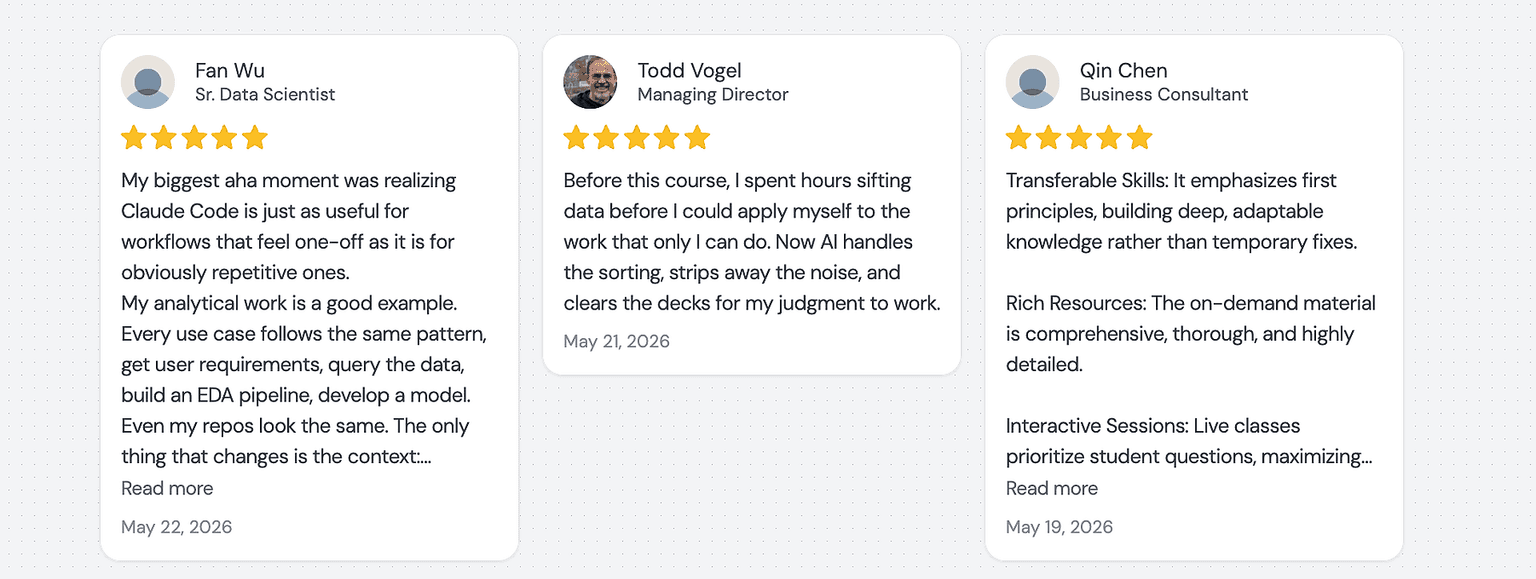
See what people are saying
Frequently asked questions
Maven for Teams
Reimbursement
Get your company to pay
Everything L&D needs: email template, receipts, and certificate of completion.
Get reimbursedPrivate cohort
Run a cohort for your org
A dedicated cohort with a custom schedule and curriculum, tailored to your team.
Book a private cohort