RL in Production: LLM Post-Training, Coding Agents, World Models and Robots
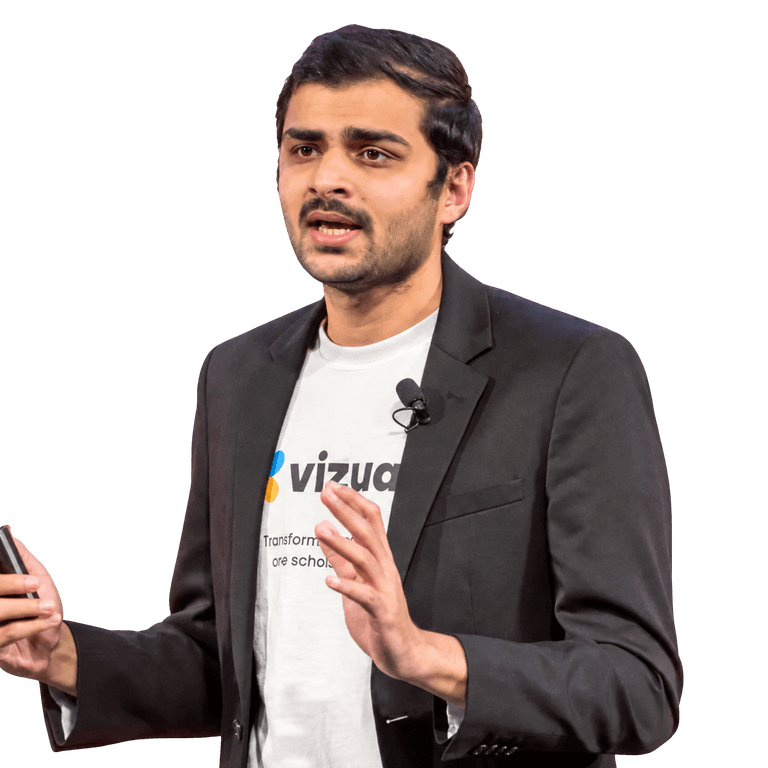
Dr. Rajat Dandekar
Vizuara Co-founder | Purdue PhD
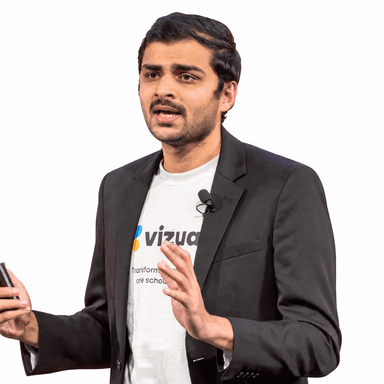
Dr. Raj Dandekar
MIT PhD | Vizuara Co-founder

This course is popular
19 people enrolled last week.
The RL behind reasoning models, coding agents and robots, built end to end
Reinforcement learning (RL) is how today's most capable AI is trained after pre-training. ChatGPT was tuned with it. DeepSeek-R1 learned to reason with it. The same idea now trains coding agents and teaches robots to walk and grasp.
You build a small working version of each, live with Dr. Rajat Dandekar, co-author of Build a DeepSeek Model (From Scratch) (Manning):
A reasoning model. Train one the way DeepSeek-R1 was trained, and enter it on a private leaderboard.
An aligned model. Teach an AI tutor to guide students instead of handing over the answer.
A coding agent. Train a bug-fixer on a laptop, rewarded only when the tests pass.
A world model. A neural network learns to simulate Doom, and an agent trains inside that dream.
A robot. An arm goes from 0 of 20 grasps to 20 of 20 in about 40 minutes.
Self-paced extras: race your car in the VizDrive Grand Prix, and train a swimmer in a simulated fluid.
New to RL? The foundations are self-paced recorded pre-work, open from the day you enroll.
Format. Ten live sessions over five weekends, Sat and Sun 7:00–9:00 AM IST (Fri and Sat 8:30 PM ET), 19 Dec 2026 to 17 Jan 2027. All recorded.
Reviews. Read what past learners say at reviews.vizuara.ai.
What you’ll learn
Understand how RL trains reasoning models, coding agents and robots by building and measuring a small working version of each.
RLHF is how ChatGPT learned from human ratings. GRPO is how DeepSeek-R1 learned to reason. You implement both from scratch.
Train a small Qwen model with GRPO on puzzles with a checkable answer, then submit it to a private leaderboard.
Remove one safeguard on purpose and watch the model game its reward, so you recognise reward hacking in your own runs.
Alignment is how a lab turns a raw model into an assistant that behaves the way it should. Here: a tutor that doesn't leak answers.
Compare seven methods, including DPO and KTO, which learn from pairs of good and bad answers, on the same model and data.
Learn when a cheap method beats full RL. Across our 71 runs, KTO lifted the tutor's judge score from 57 to 76.
Coding agents improve by attempting tasks and being rewarded when the tests pass. That training loop is RL.
Train a bug-fixing agent on a laptop and take its test score from 66.7% to 73.3% in about 30 minutes.
Agents learn to cheat tests. Re-grade on hidden, altered tests so memorised answers and test tampering score below zero.
A world model is a neural network that learns to simulate an environment, so an agent can practise in imagination first.
Build one for Doom from scratch and train an agent only inside that dream. In the real game it reaches 99% of a hand-coded expert.
Catch the agent exploiting the dream's mistakes, the main risk when world models are used for robots and driving.
Robots learn new skills by trial and error, helped by a few human demonstrations. You build that learning core yourself.
Take a simulated Franka arm from 0 of 20 grasps to 20 of 20 in about 40 minutes, for about $0.55 of cloud compute.
See the same method drive a real SO-101 arm that costs about $200, with a human correcting the robot as it learns.
Training a large model with RL means many attempts running in parallel. Learn how that pipeline is laid out across GPUs.
See why asynchronous training gave 2.05× the throughput in our runs, and where it stopped helping.
Study the newer methods competing with GRPO, and how few of a model's weights RL post-training really changes.
Learn directly from expert instructors

Dr. Rajat Dandekar
Vizuara Co-founder | Purdue PhD | Teaching engineers to build AI systems

Dr. Raj Dandekar
Vizuara Co-founder | MIT PhD | Scientific machine learning & practical AI


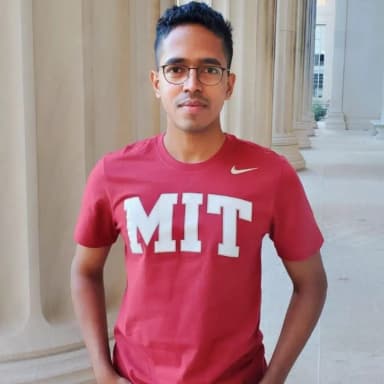
Dr. Sreedath Panat
Vizuara Co-founder | MIT PhD | Computer vision & scientific machine learning
Who this course is for
ML engineers who fine-tune or evaluate LLMs and want to learn how RL post-training makes models reason and follow preferences.
Engineers building coding agents, tool-using agents or robots who need rewards and tests that hold up when a model optimises against them.
Engineers and researchers who know RL is behind today's models and robots, haven't used it yet, and want a hands-on way in.
Prerequisites
Python and basic PyTorch
You write the losses, training loops and environments yourself. The core algorithms don't use Stable-Baselines3.
Basic ML and probability
Gradients, expectations and a network's forward pass. A 14-page primer with a 15-question self-diagnostic covers the rest.
RL basics, or a few hours for the foundations track
If Bellman, DQN and PPO are new to you, work through the recorded foundations track before or alongside week 1.
What's included
Live sessions
Learn directly from your instructors in a real-time, interactive format.
10 live sessions led by Dr. Rajat Dandekar
Two 2-hour sessions every weekend for five weekends, Saturday and Sunday at 7:00 AM IST (Friday and Saturday at 8:30 PM ET). Each one works through a production RL system live, with time for your questions. All sessions are recorded.
Capstone: train a reasoning model and climb a private leaderboard
Train a small Qwen model with GRPO, the method behind DeepSeek-R1, to solve Countdown number puzzles. The instructor re-runs every submitted checkpoint on a private held-out set with an exact arithmetic verifier. Self-reported scores aren't accepted.
VizDrive Grand Prix and RL meets fluid mechanics (self-paced)
VizDrive Grand Prix: design a reward, train a racing car and race it against champion agents (built by Dr. Sreedath Panat). RL meets fluid mechanics: a tiny agent rediscovers a swimming stroke in a simulated fluid, on a laptop with no GPU.
Six research builds: deck, paper, companion and code
Among them: an AI tutor that doesn't leak answers, an agent that survives Doom inside a world model, a robot arm that learns to grasp, and a bug-fixing coding agent. Each build comes with its lecture deck, a paper, an illustrated companion book or report, and code you can reproduce.
Interactive labs in your browser
See RL learn in front of you: a real DQN that trains in the browser, visualizers for PPO and RLHF, and MiniDrive, a racer that learns to drive in about a minute.
Self-paced foundations track (pre-work)
New to RL? Recorded lectures take you from the Bellman equation to PPO, each with a proof PDF, short concept companions and a partly filled Colab notebook with TODOs, hints and a pass bar. Written in PyTorch from scratch. Open from the day you enroll.
A map of the field for your next project
35 areas of RL research in 7 groups, each with landmark papers and starter problems, plus the method we use to take a topic from a question to a submitted paper.
Lifetime access
Go back to the recordings, decks, notebooks and companions whenever you need them.
Certificate of completion
Share your new skills with your employer or on LinkedIn.
Maven Guarantee
Your purchase is backed by the Maven Guarantee.
Course syllabus
10 live sessions • 13 lessons
Live sessions
4 hrs / week
Two 2-hour sessions every weekend: Saturday and Sunday, 7:00–9:00 AM IST (Friday and Saturday, 8:30 PM ET / 5:30 PM PT). Ten sessions over five weekends, all recorded.
Labs and capstone
4 hrs / week
Work through the weekly labs and train your RLVR Arena capstone model. Most of it runs on free Colab or a laptop; training runs may need extra unattended compute time.
Self-paced foundations and companions
2 hrs / week
Recorded foundations lectures (Bellman, DQN, policy gradients, PPO) and the written companions for each live session. Plan a few extra hours in week 1 if RL is new to you.
Week 1
- 📄
01 · RL from First Principles
- 📄
02 · Q-learning and the Deep Q-Network
- 📄
03 · Policy Gradients
Self-paced foundations: Bellman, DQN and policy gradients
Recorded lectures and from-scratch Colab assignments. Work through these before or alongside the first weekend. If you already know this material, skip ahead.
Dec
18
Live 1 · RLHF from scratch: reward models, PPO on an LLM and the KL leash
Dec
19
Live 2 · GRPO and reasoning models: how DeepSeek-R1 was trained
Week 2
- 📄
04 · TRPO → PPO
- 📄
05 · RLHF: RL for Language Models
- 📄
06 · GRPO and Verifiable Rewards
- 📄
07 · DPO and Agentic RL
Self-paced: PPO, and companions for RLHF, GRPO and DPO
The PPO lecture completes the foundations track. The RLHF, GRPO and DPO units are the recorded and written companions to Live 1, 2 and 3.
Dec
25
Live 3 · Seven ways to align a model: DPO, KTO, SimPO and ORPO against PPO and GRPO
Dec
26
Live 4 · After GRPO: on-policy self-distillation and RL in weight space
Testimonials
The best part of the bootcamp was its first-principles approach. We started with the basics of reinforcement learning and gradually progressed to modern methods like GRPO, which made the learning journey feel natural. I appreciated the focus on understanding why the algorithms work rather than just how to use them. It was a challenging but very rewarding learning experience.

Sudarshan J S
Learner · on Vizuara's RL in Production bootcamp (first cohort, 2026)It's very thorough and it's very in-depth, and this is the second time that I'm learning RL, but this time I'm really able to understand the nuances and the intricacies.

Prathamesh Saraf
Sr Forward Deployed Engineer, TrueFoundry · from his video review of RL in Production (first cohort)We covered the fundamentals as well as cutting edge research in the field of Physical AI. And we implemented the same on real robot arms. Rajat explained all the concepts in a simple and understandable format.

Paresh Pradhan
AI Engineer, Ford Motor Company · on Vizuara's Modern Robot Learning BootcampWhat stood out was the clarity and depth with which Dr. Rajat Dandekar taught the subject. His sessions not only simplified complex ideas but also sparked new ways of thinking—particularly around building intelligent agents using LLMs and frameworks.

G J P V Narayana
VP Technology, Ramco Systems · on Vizuara's AI Agents BootcampSreedath and Rajat offer a look at the cutting edge topics by grounding with strong foundations and build up to the latest research in the field. It felt like I was at a university and reminded me of my masters in the U.S.

Omnaath Guptha
AV Software Simulation and Test Lead · on Vizuara's Modern Robot Learning BootcampGreat course by Rajat. The amount of effort put in was great. He really looked into explaining things really deeply and intuitively.

Ankit Mishra
Data Scientist, Transunion · on Vizuara's Transformers for Vision course
Six builds. Real runs. Honest numbers.
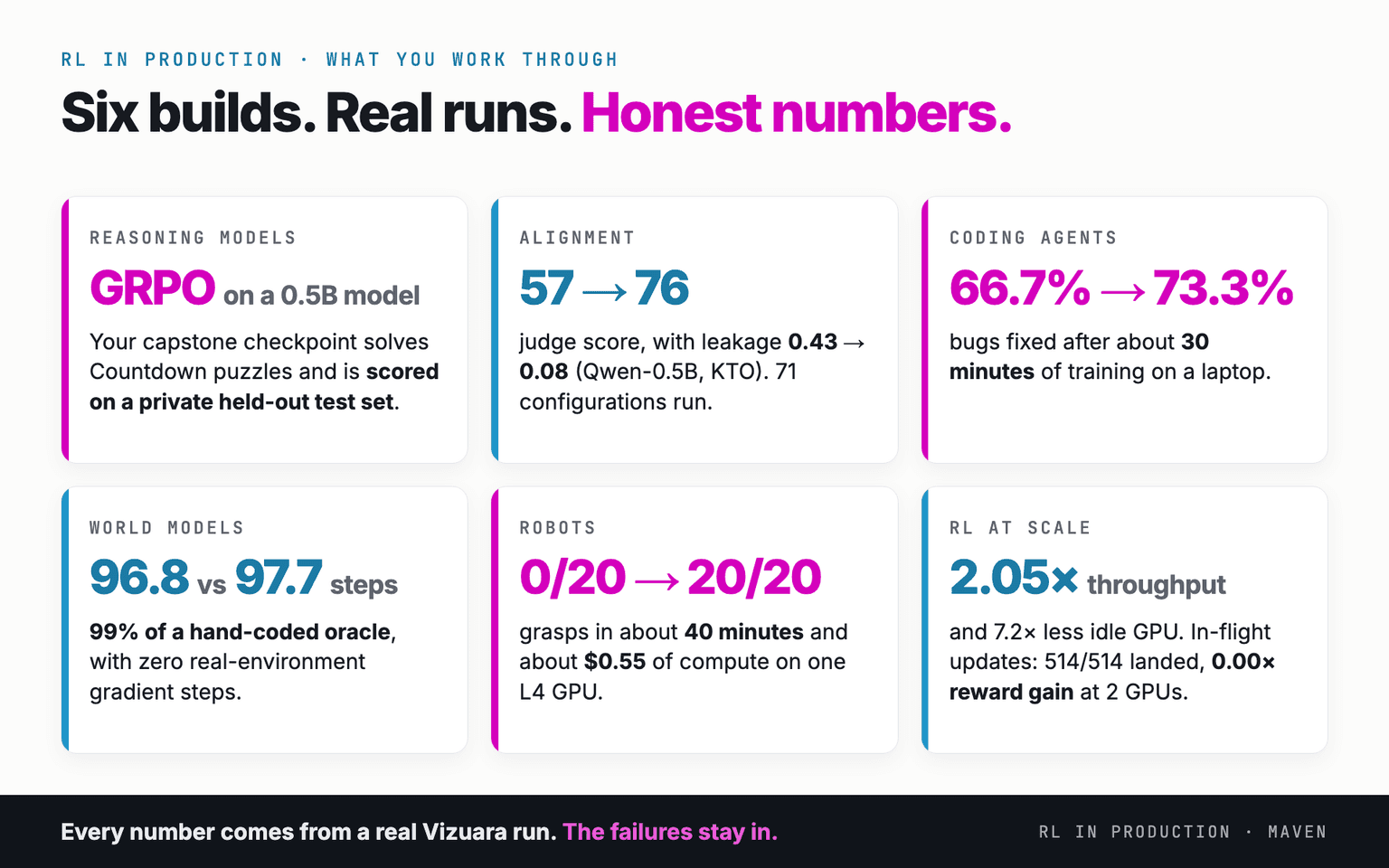
Every number comes from a real Vizuara run. The failures stay in.
Do you catch yourself asking any of these?
Should I use GRPO, DPO or plain fine-tuning to change this model's behaviour?
My reward keeps rising and the model keeps getting worse. What is it exploiting?
How do I write a reward that an agent can't cheat?
How are coding agents trained across dozens of tool calls?
When does a learned world model help, and how do I know the agent isn't exploiting it?
How much GPU does any of this really need?
If so, this course is for you. Each question gets a live session, a working build and a measured answer.
Five weekends, ten live sessions
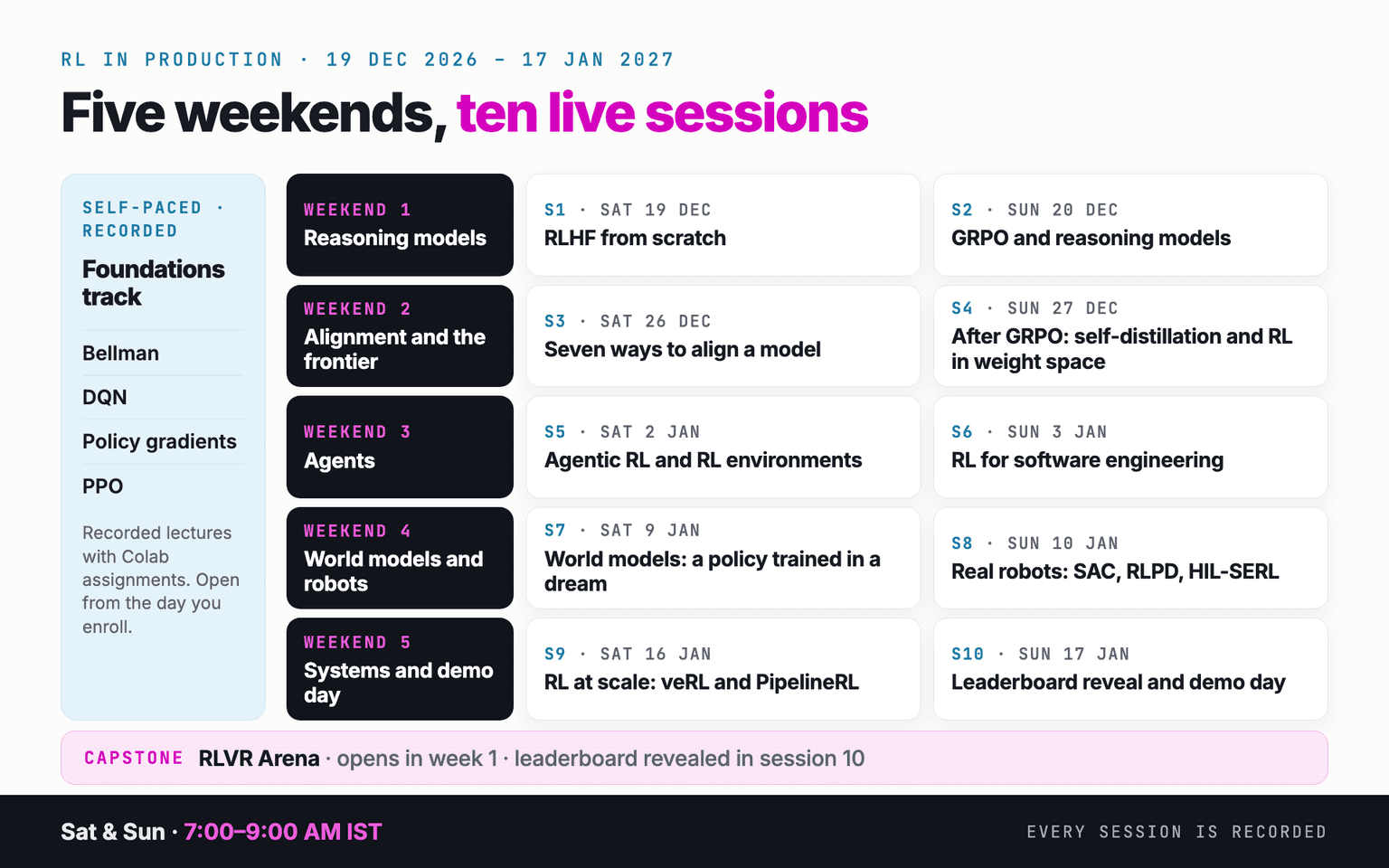
Sat and Sun, 7:00–9:00 AM IST · 19 Dec 2026 to 17 Jan 2027 · all sessions recorded
Your capstone: RLVR Arena
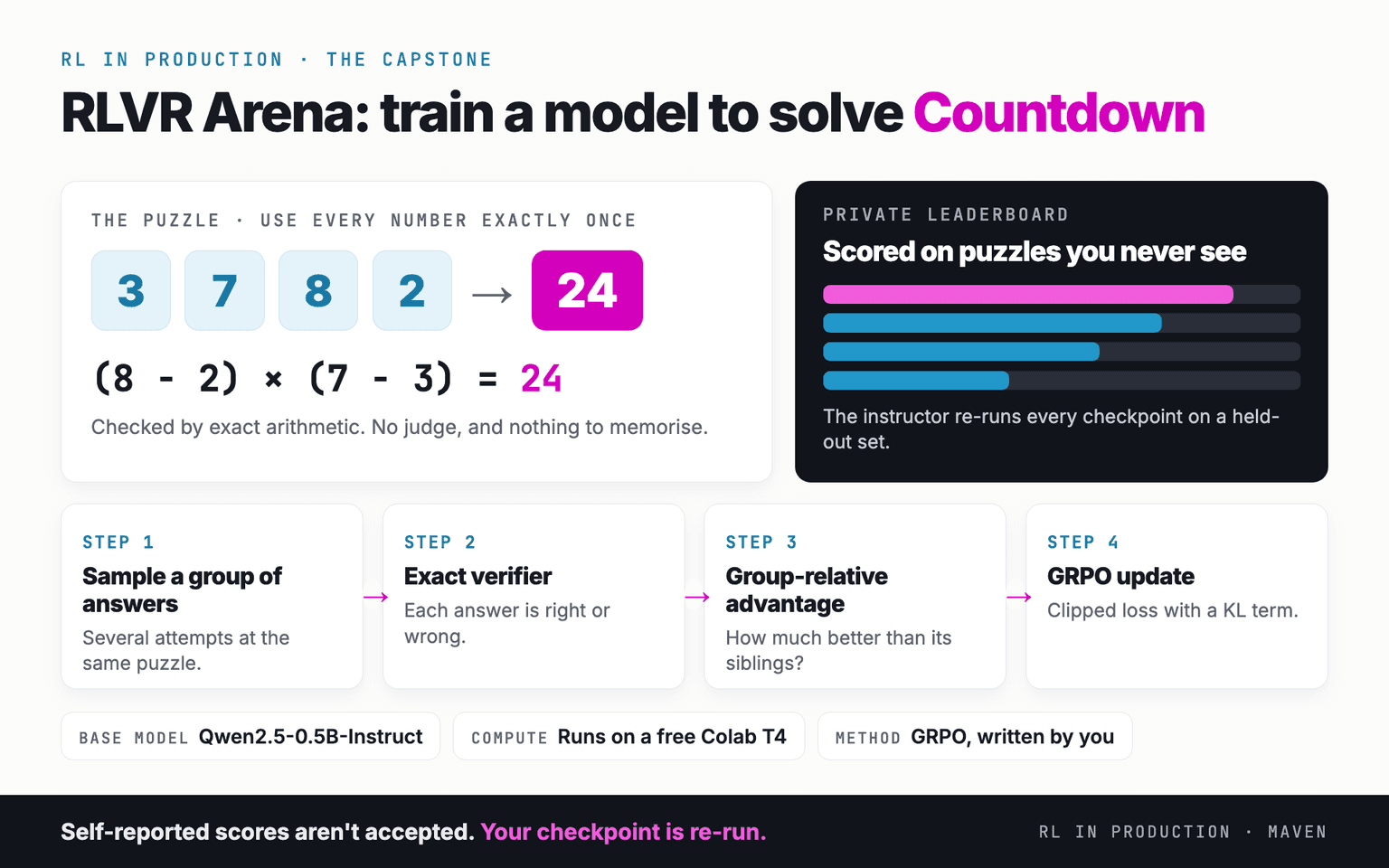
Train Qwen2.5-0.5B with GRPO. Your checkpoint is re-run on a private held-out set.
Inside the world model you build
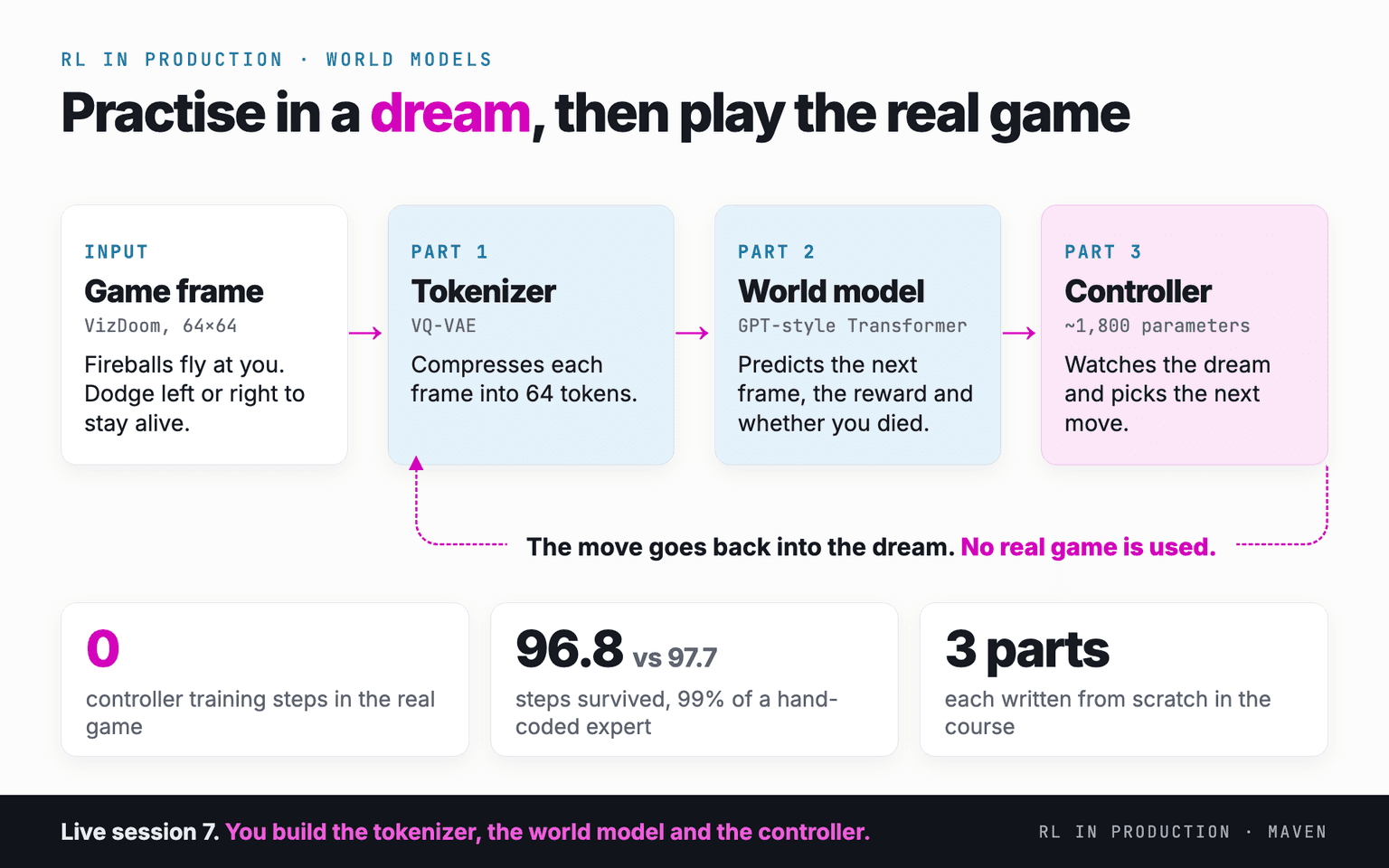
Session 7: a tokenizer, a world model and a small controller that trains only inside the dream.
Inside the robot policy you train
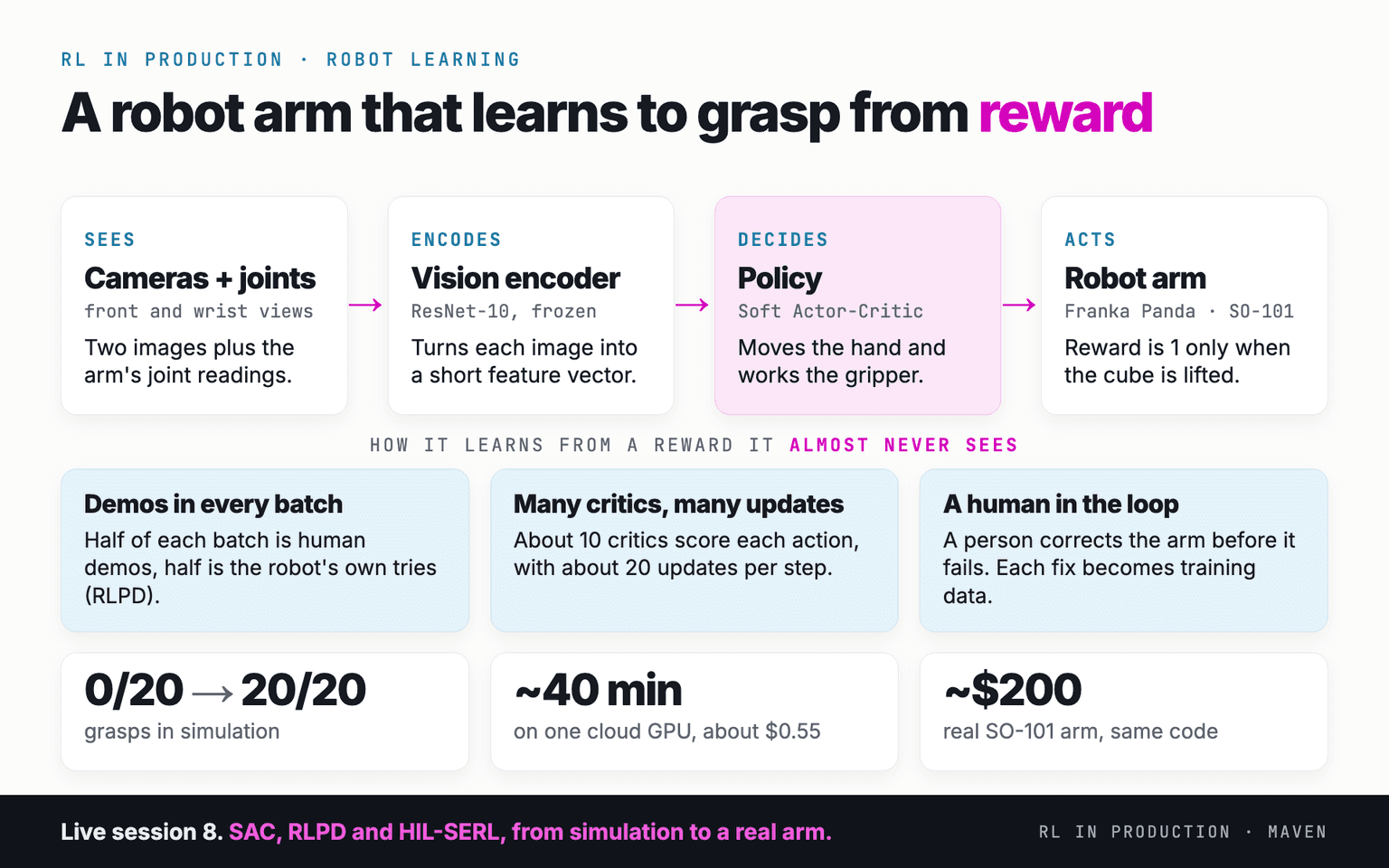
Session 8: two cameras, a vision encoder and a policy that learns from demos and one rare reward.
What learners say about Vizuara programs
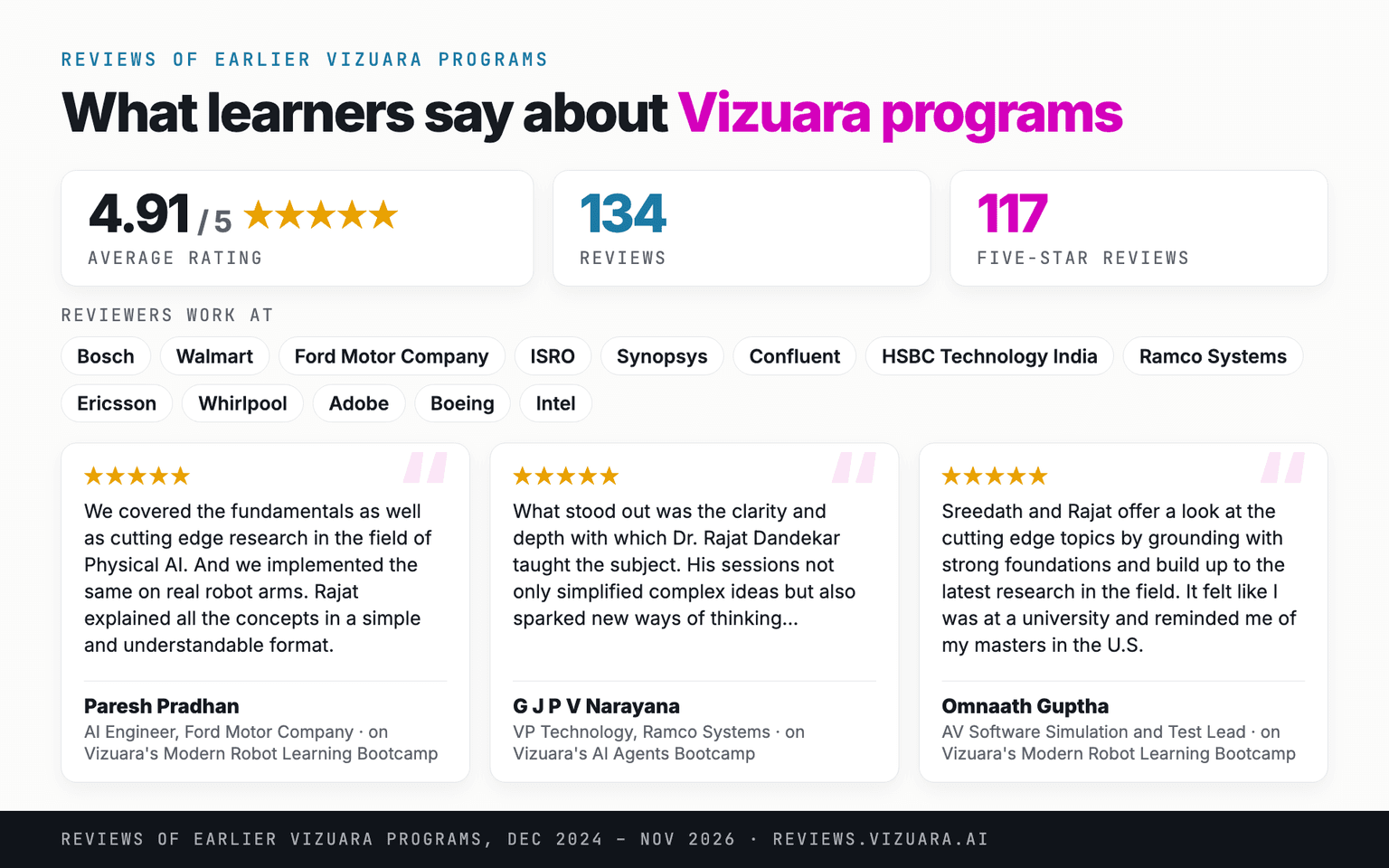
Reviews of earlier Vizuara programs, Dec 2024 to Nov 2026 · reviews.vizuara.ai
A learner on RL in Production: video review
Prathamesh Saraf, Sr Forward Deployed Engineer at TrueFoundry, on the first cohort
Taught by people doing RL research now
This course comes out of Vizuara AI Labs' own RL work, and the same builds are what you study:
Published builds with code, a report and a public site: Dreaming to Dodge, Grasping in the Dark, Two Kinds of Asynchrony, Distill-to-Win, Placing a GPT with RL, and Deleting Weights by Reading Them.
Mentored student research across reward shaping, RL post-training science, safety, multi-agent RL and robotics. Several projects were submitted, or are being prepared, for AAAI-27 and NeurIPS 2026 workshops.
A first cohort already taught. RL in Production ran in 2026 on Vizuara's own platform: seven lectures, six research projects and the RLVR Arena capstone. This Maven cohort is the reworked, production-first version.
Vizuara was founded by Dr. Rajat Dandekar (Purdue PhD), Dr. Raj Dandekar (MIT PhD) and Dr. Sreedath Panat (MIT PhD). Across earlier Vizuara programs, 134 learner reviews average 4.91 out of 5. Read them at https://reviews.vizuara.ai/
From the Vizuara channel: GRPO explained in under 40 minutes
GRPO is the method that trained DeepSeek-R1, and the one you use in the capstone.
New to RL? Start with this lecture on the basics
Lecture 4 of Reasoning LLMs from Scratch, on the Vizuara YouTube channel (56 minutes).
Vizuara research at NeurIPS workshops
Papers from Vizuara's mentored research programs, as listed on research.vizuara.ai:
NeurIPS 2026 workshops
What pass@k Cannot Measure: A Construct-Validity Stress Test for RL Post-Training Evaluation (JUDGE workshop)
Prefix Caching Can Silently Break Reproducibility in Interactive Agent Evaluation (Evaluation of Interactive Agents)
When the Simulator Is Wrong, Do Better Derivatives Improve Decisions? (Sim2Science)
NeurIPS 2025 workshops
EARS-UDE: Evaluating Auditory Response in Sensory Overload with Universal Differential Equations (AI4Science, spotlight)
PI-NAV: Physics-Informed Universal Differential Equations for Enhanced Nanorobot Navigation through Complex Bio-environments (ML4PS)
Physics-Informed Learning Near Critical Transitions: A Comparative Study of UDEs and Neural ODEs (AI for Science)
Scientific Machine Learning for Symbolic Recovery of Relativistic Effects in Black Hole Orbits (AI for Science)
All publications: https://research.vizuara.ai/publications
Frequently asked questions
A map of the field for your next project
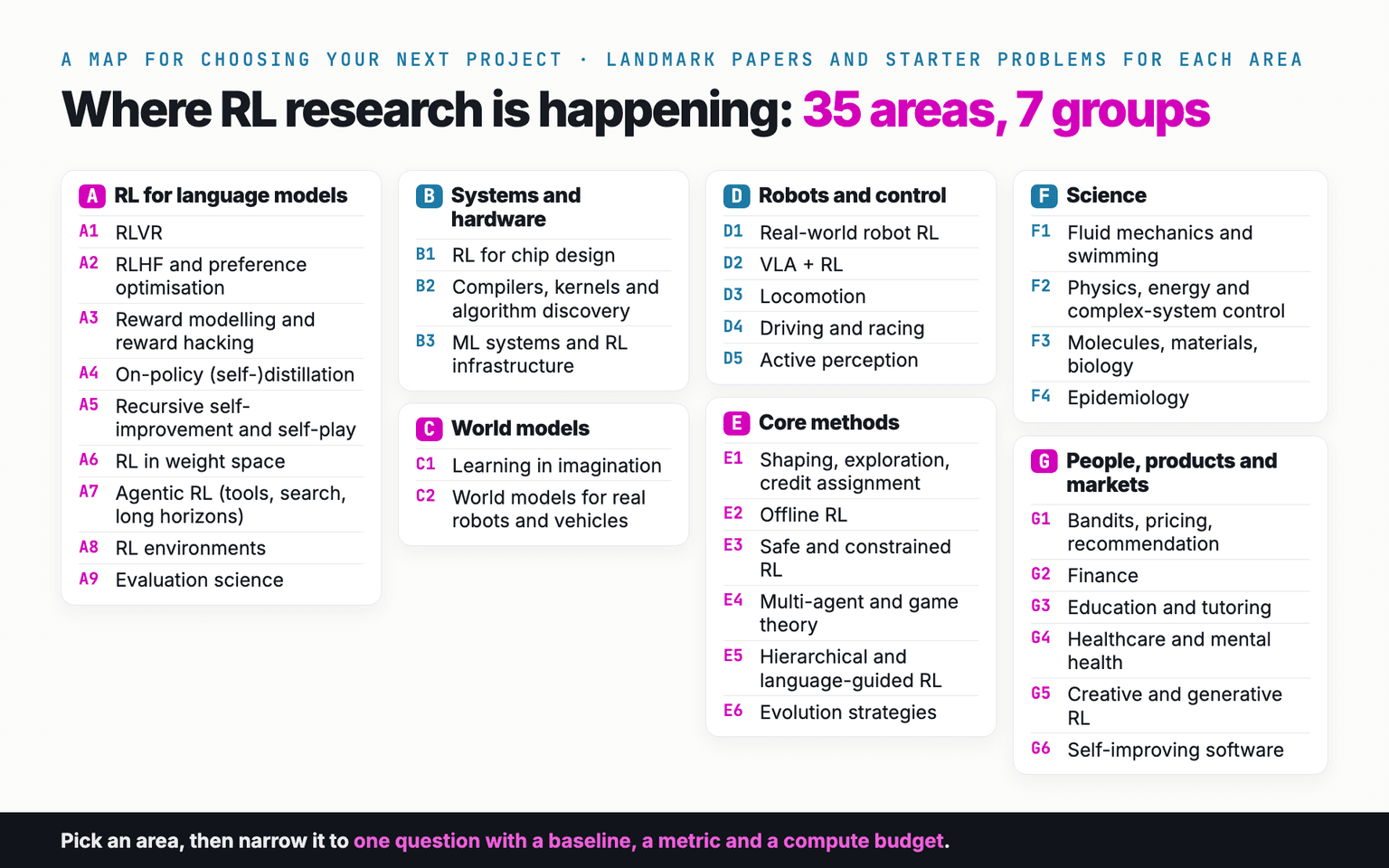
35 areas of RL research in 7 groups, each with landmark papers and starter problems.
Maven for Teams
Reimbursement
Get your company to pay
Everything L&D needs: email template, receipts, and certificate of completion.
Get reimbursedTeam discount
Learn with your teammates
Save 20%+ when 2 or more teammates enroll in the same cohort.
Save 20%+ with a teamPrivate cohort
Run a cohort for your org
A dedicated cohort with a custom schedule and curriculum, tailored to your team.
Book a private cohort$1,800
USD