AI Chief Of Staff: Become an AI systems builder
Myles Sutholt
AI startup co-founder | AI that works

Learn how to build your own AI team that tackles hard tasks without babysitting
You already use AI every day at work, and you're good at it. But you're still steering the ship: nothing moves until you've told your AI what to do. You want to hand over whole pieces of work and put your name to the result.
The people who work like that don't have a better toolset, and they didn't buy someone's operating system. They built their own system around their AI: rules of engagement, guidelines, decision frameworks, written down. So their AI thinks like them and decides like them.
That skill has a name. The World Economic Forum's employers name systems thinking among the skills on the rise, essential for working with autonomous technology. In essence it means not mastering tools that keep changing, but designing the systems around them.
That's what this course teaches. You learn it by building your own AI Chief of Staff on your real work, over five weeks, no code. It's your own system, not a tweaked copy of someone else's, and when the tools change, you can adapt it yourself. Show up, do the work, and if it didn't make a difference, you get your money back. And you can retake any cohort for free.
What you’ll learn
Six things you'll be able to make your AI do that you can't today, each built on your own real work, in five weeks.
Your AI follows the guidelines you set and checks its own work against them before it sends you anything.
You hand over a whole piece of work and get back something you can put your name on, without babysitting your AI to get it there.
Your AI knows your work on every project without being told again, and everything it tells you traces back to a source.
Your AI makes the routine calls the way you would, within the line you drew, and brings you only the decisions that need you.
Your AI reports to you on your terms and at the time you chose: what it did, what it decided alone, and what needs you.
When your AI gets something wrong, you don't fix that one document. You make sure it never gets that wrong again.
Learn directly from Myles

Myles Sutholt
I'll help you take the AI you already use every day at work to the next level.


Who this course is for
You already use AI every day at work, and you can see how it will change your job. You want to be ready for that, not collect more tools.
PMs, designers, engineers, operators, founders. Staying in your role, not switching into an AI job. Not a first intro to AI.
You want to take on bigger work with AI, without steering every step or lowering the standards you hold your work to.
Prerequisites
You use AI at work regularly (not just tried once).
This isn't a first intro to ChatGPT or Claude. It's for people who already use AI every day at work and want to take it further.
You can install software.
You install the Claude desktop app. Some company laptops block this. If you're unsure, check with your IT team.
A Claude Pro plan (or higher), before the course starts.
Pro is $20 a month, or $200 a year paid up front, plus tax where it applies. The part of the app the course runs in isn't on the free plan.
What's included

Live sessions
Learn directly from Myles Sutholt in a real-time, interactive format.
The skill to build your own systems around AI
The skill to make your AI follow your rules, trace what it tells you to a source, and take on whole pieces of work you can trust it with. You build it on your real projects, so when the tools change you can adapt your system yourself. What you build stays on your machine.
AI Advisors Modeled on Your Real Stakeholders
Make your AI push back the way a real person would, before the meeting: an advisor you build from someone you actually work with, and yours to keep.
Pre-Built Starter Workspace
Start with a prepared workspace, templates and workflows, then make them yours during setup week, with live help on Friday.
Personal feedback on every submission
Not automated. Myles reviews your work and provides detailed feedback on what to improve and how to strengthen your AI system.
Lifetime access
Go back to course content and recordings whenever you need to.
Free Retake of Any Future Cohort
The system evolves between cohorts. Your access does too. Come back when you are ready to build the next layer.
Certificate of completion
Share your new skills with your employer or on LinkedIn.
Active cohort of ~20 students
Small cohorts, so that you can have enough face time with the instructor to level up your AI skills fast.
Continue Learning & Collaborating In Slack
As this space changes, so does your work with it. You will be invited into a Slack space, where alumni (and myself) share lessons learned for you to apply.
Full Refund If You Are Unhappy
If you attend the sessions, do the projects and feel like what you have learned did not make a meaningful difference, I will refund you 100%.
Maven Guarantee
Your purchase is backed by the Maven Guarantee.
Course syllabus
14 live sessions • 8 lessons
Live sessions
3-4 hrs / week
Projects
2-4 hrs / week
Async content
1 hr / week
Week 1
Jan
22
Set up the foundation we build on
Fri 1/2212:30 PM—1:30 PM (EST)- 📄
How this course runs
- 📄
How this week works
- 📄
Before the course: get Claude running on your computer
- 📄
Get your workspace in, and keep it whole
- 📄
Open your workspace, and see what your AI already knows
- 📄
Bring your first project in, from its own material
- 📄
Bring your second project in, and check you're ready
- 📄
What your AI knows about you now, and where it keeps it
Jan
18
Orientation
Set up the foundation we build on
Telling your AI about your work in every chat is the normal way. A system builder's AI reads it from one place. This week: the install, your workspace opened, two of your real projects brought in from the documents you already have, and what your AI now knows about you and where it keeps it.
Week 2
Jan
25
Have your AI know your work, so you never explain it twice
Mon 1/2512:30 PM—2:00 PM (EST)Jan
27
Have your AI reach your expectations, consistently
Wed 1/2712:30 PM—2:00 PM (EST)
Your AI knows your work, so you never explain it twice
Every new chat starts from zero, so you explain your work again and keep copies that drift apart. A system builder keeps every fact once, where their AI finds it, so it knows the work before the question is asked.
Your AI reaches your expectations, consistently
You know good work when you see it, so you end up looking at everything your AI makes. A system builder gives their AI a goal and the guidelines to reach it, and a check against them, so the work meets the bar without them in the loop.
Jan
30
Office hours
Free resources
Testimonials
I managed Myles at Trafo. He's one of those rare people who thinks in systems. When he builds something, it actually works
and keeps working. If he's teaching a system for AI productivity, it's because he's already pressure-tested it himself.

Abraham
ex-General Manager @ WikimediaMyles and I were experimenting with ChatGPT integration at Talent.io before most people had even heard of it. He was already thinking about how to make AI actually useful for real work while everyone else was still playing with prompts. He's been doing this longer than most.

Amit
Co-founder talent.io and CruiseWise (acquired by TripAdvisor)
Alumni come from these companies
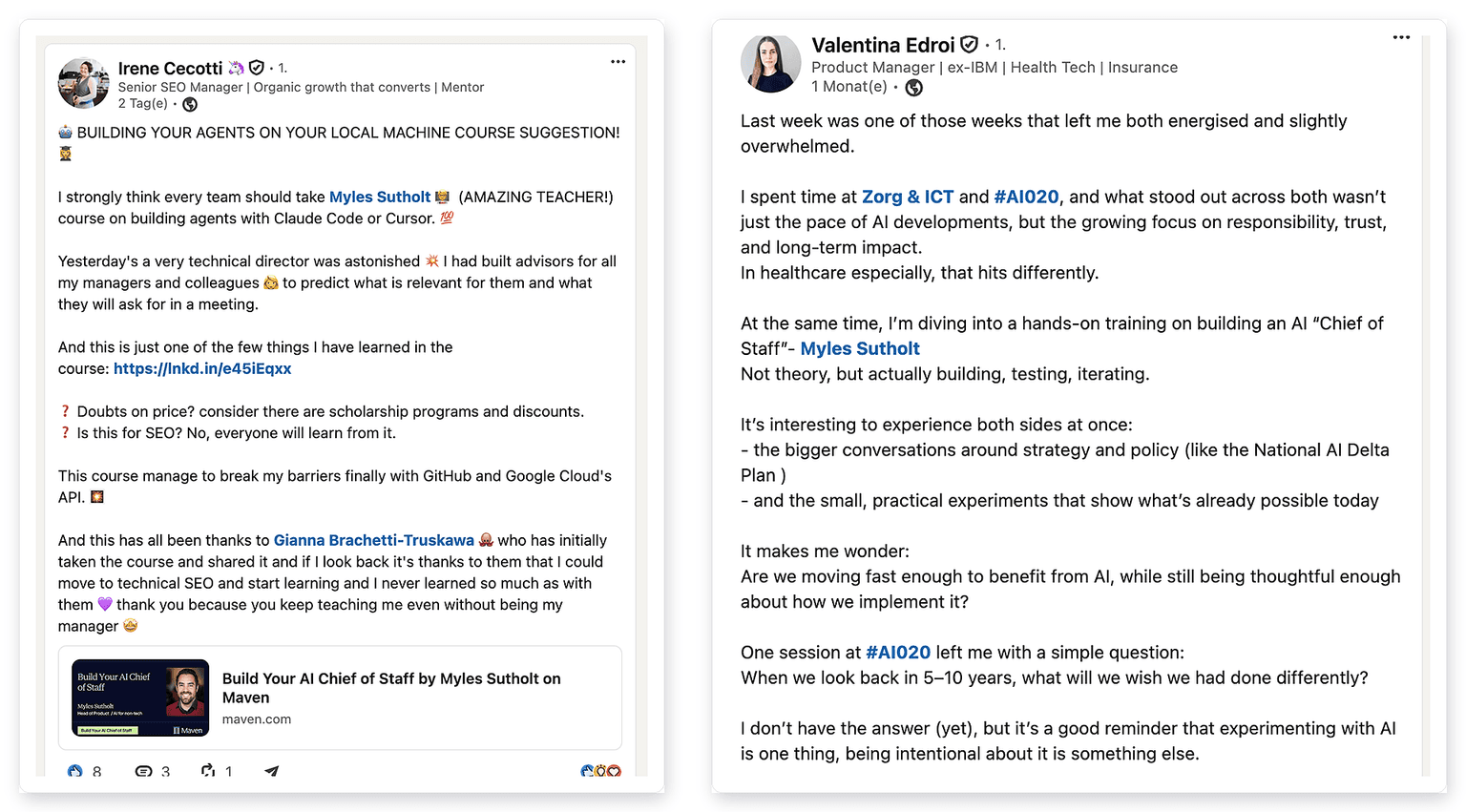
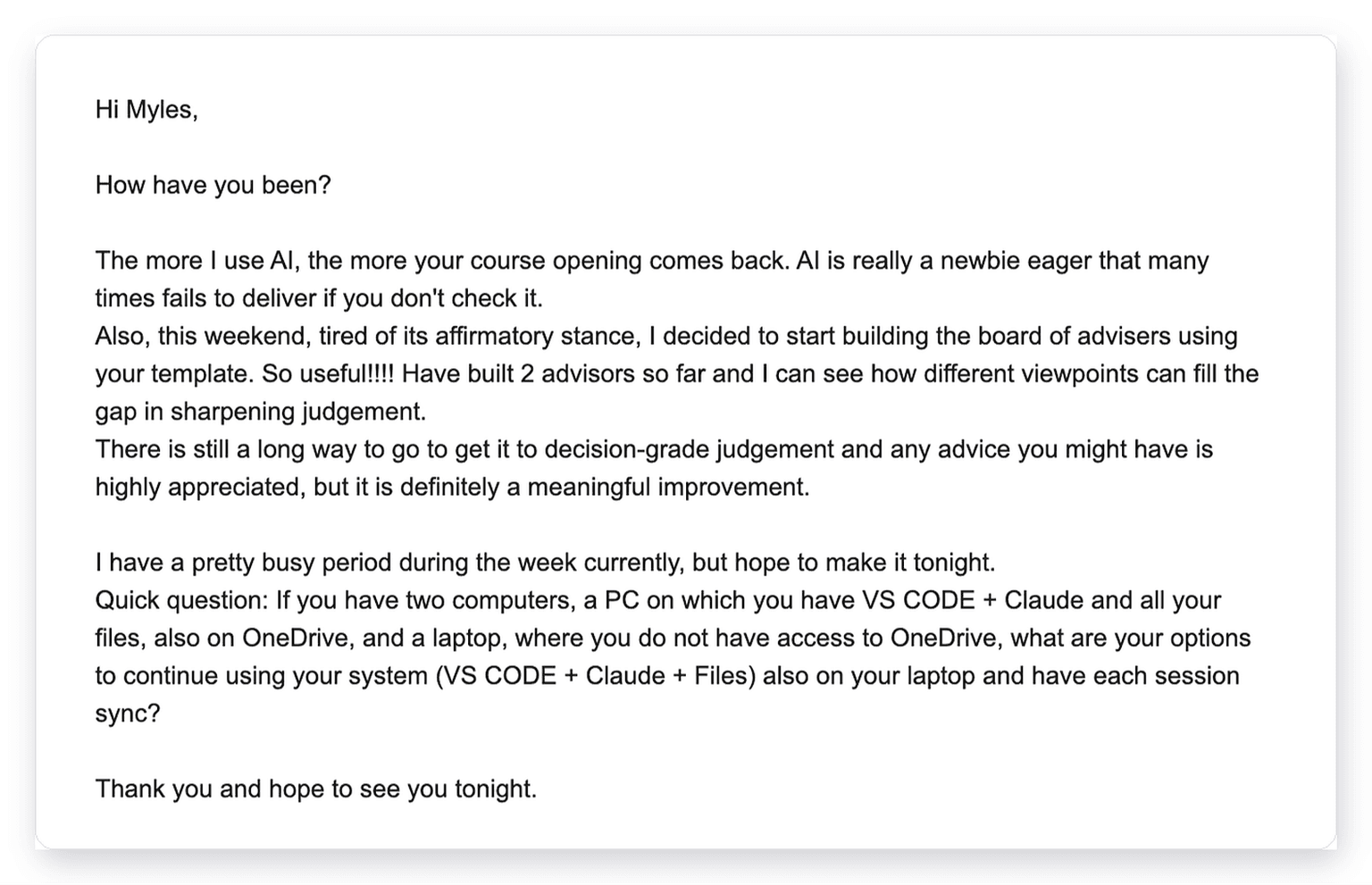
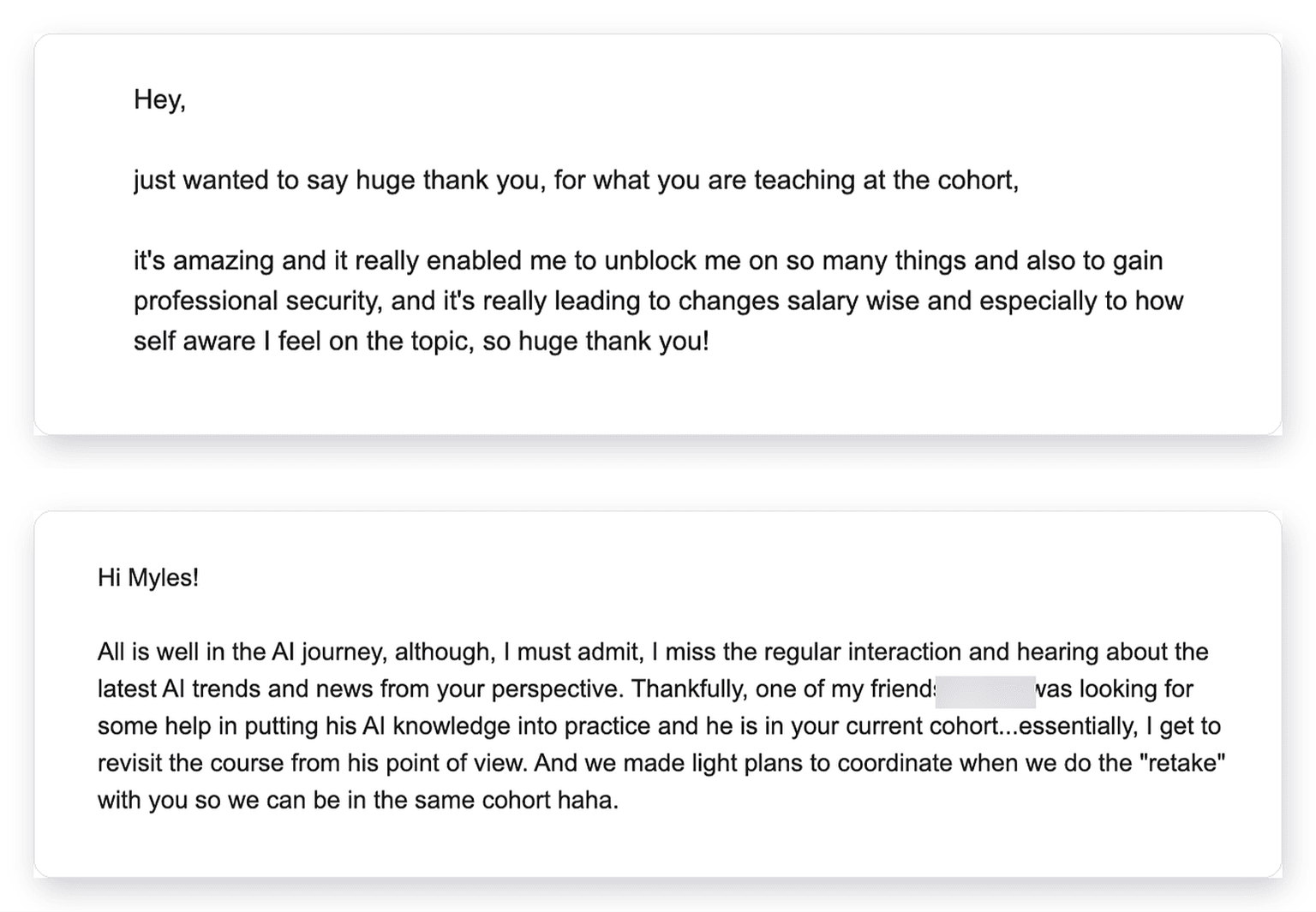
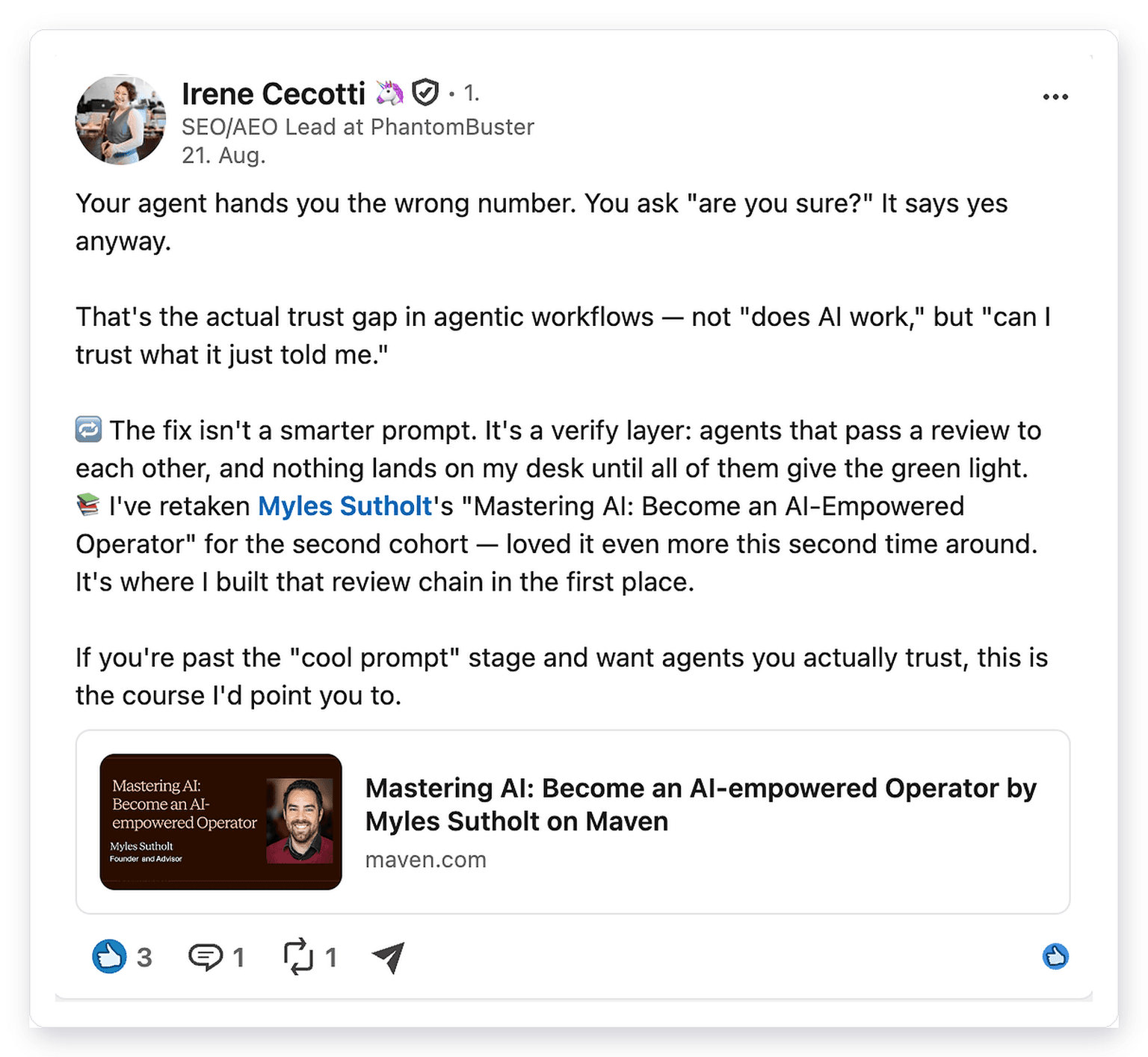
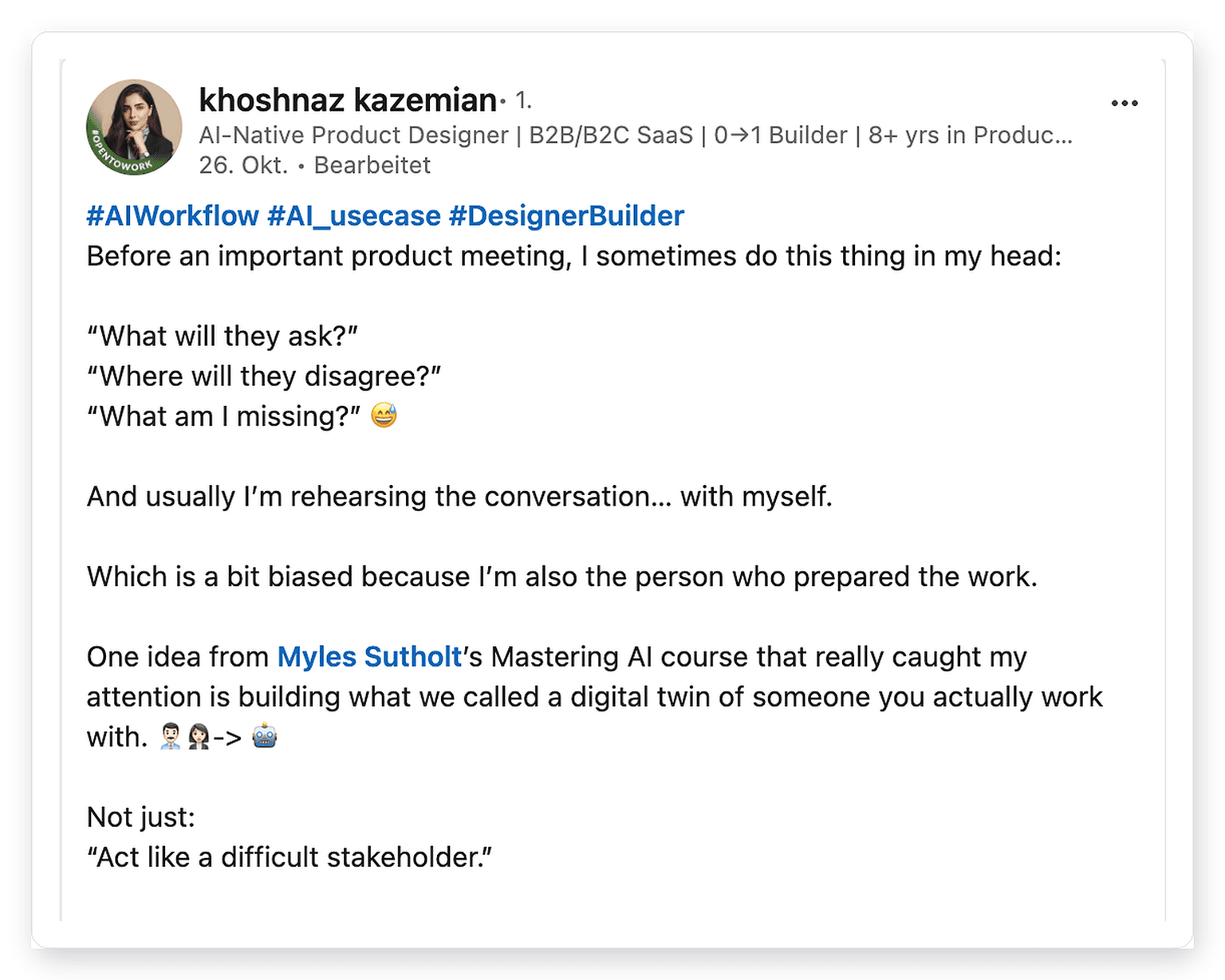
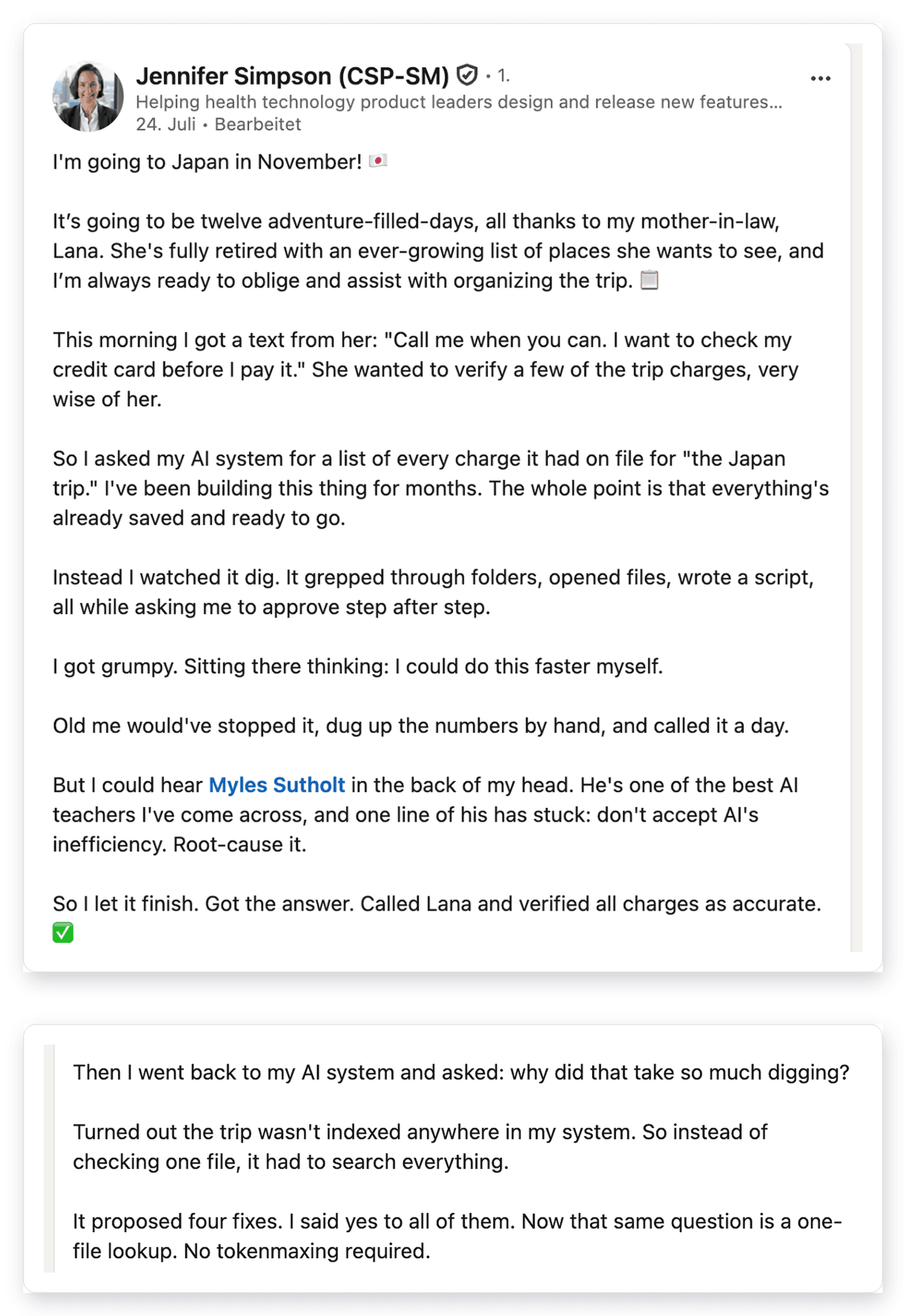
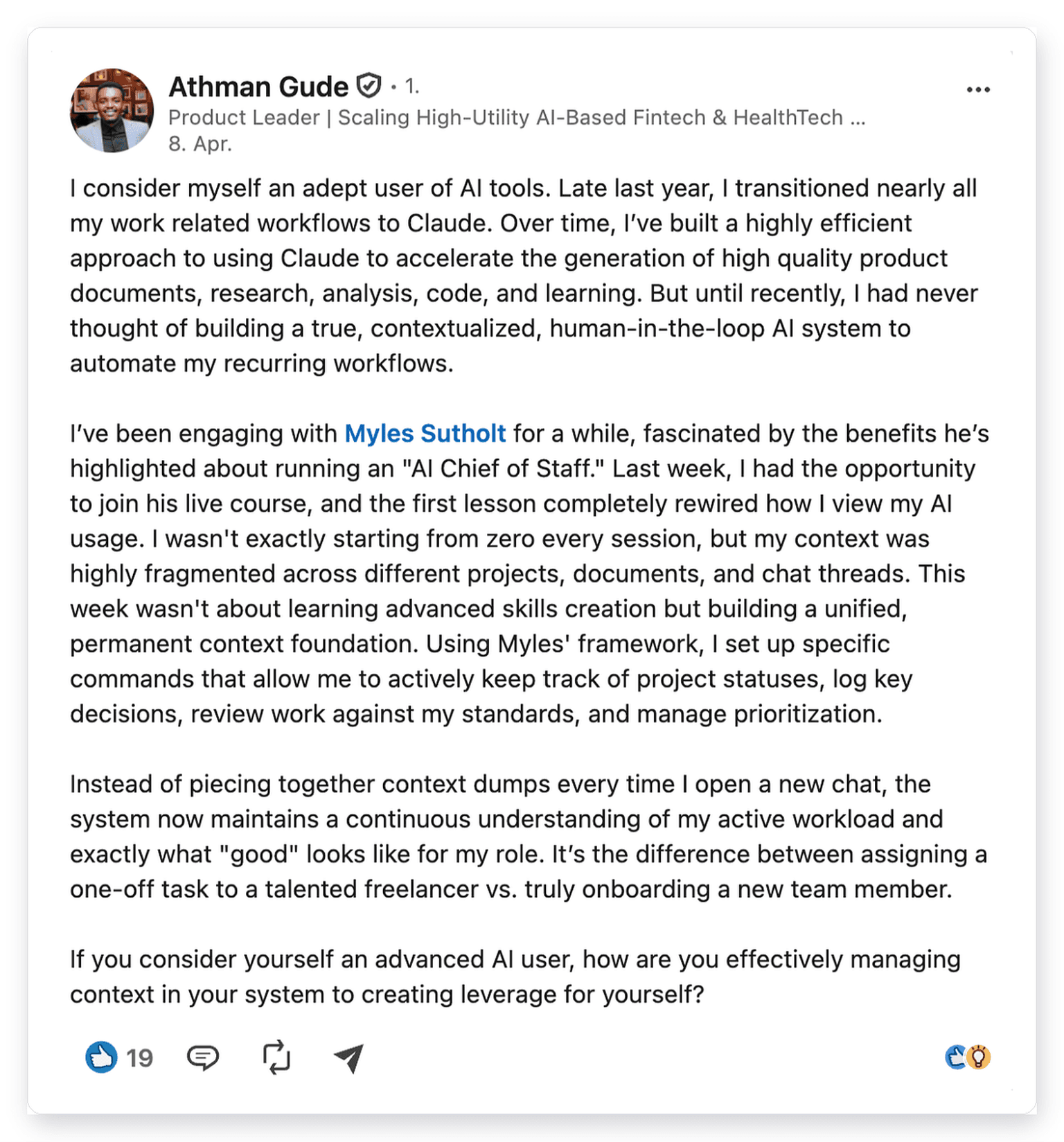
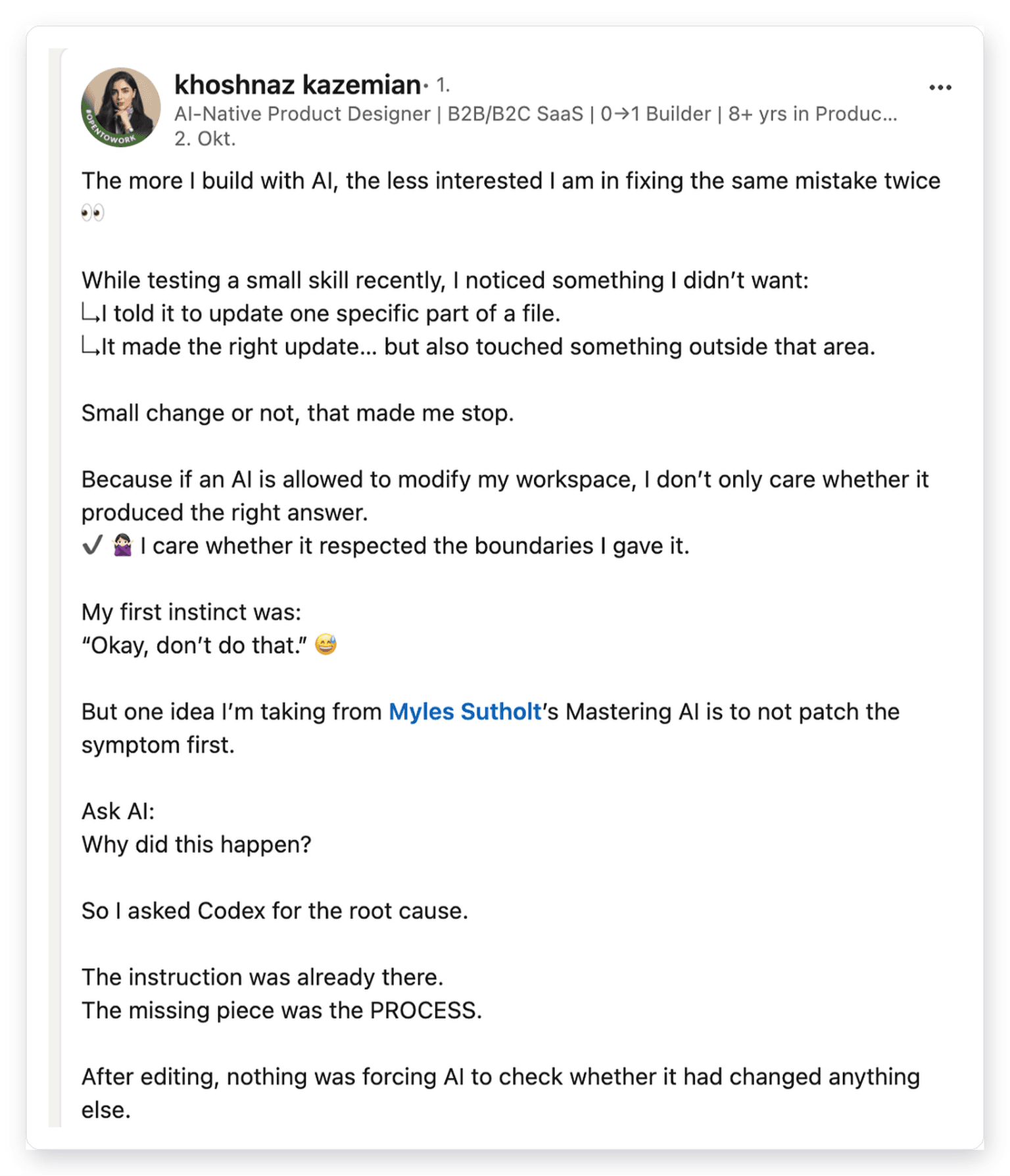
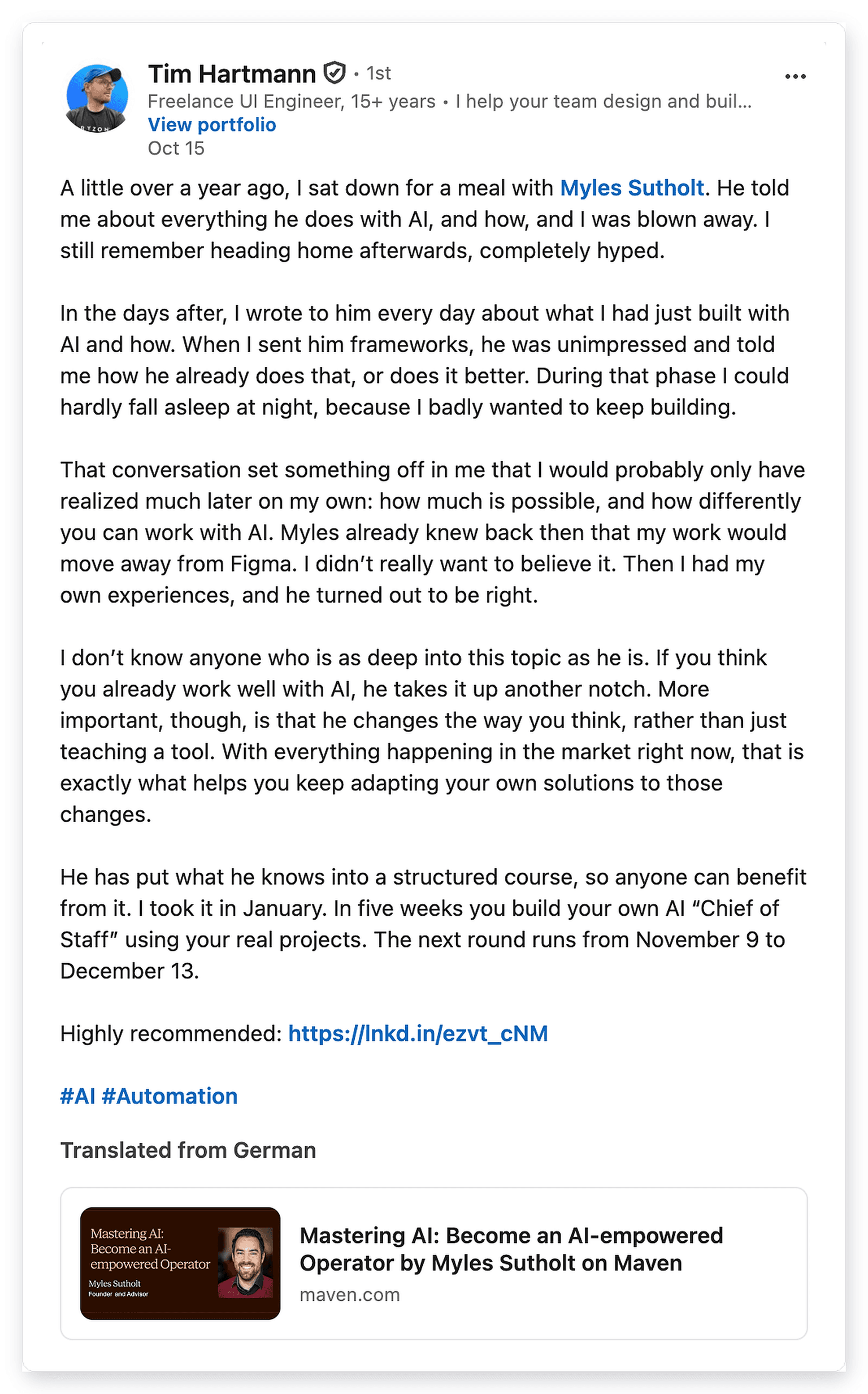
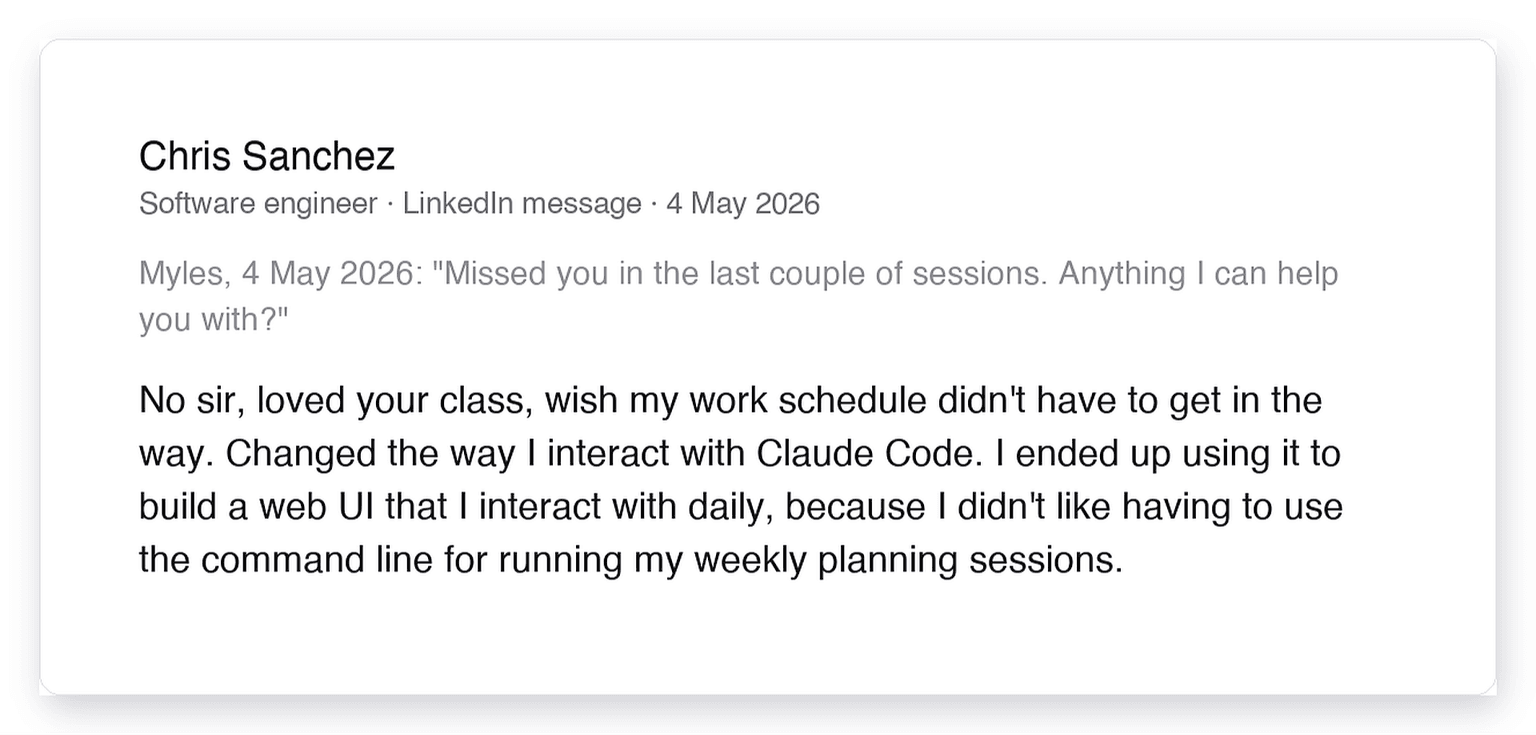
Real posts and messages I never asked for
Frequently asked questions
What Students Say
"This course humbled me in the best way. He shows you why everything you have been doing is still just scratching the surface." -Tim, UX Designer
"A system I use every single day. One that supports me in my daily work and has increased the quality of my work immensely." -Renata, Product Owner at desk.ly
"That helped me to prepare very difficult conversations with my boss AND it actually worked." -Michael, Senior Software Engineer
"The difference in output quality is immediate and visible." -Wole, Product Designer
"I got a new job doubling my salary thanks to the course." -Irene, SEO Lead
"The course helps you setup your AI system so that conversations build up on each other and you are not restarting from scratch each time. The context is and stays there in your workspace. No magic - all there in md files that you own and can see." -Yves, Owner, ClearSquare
What changes
Today, everything waits on you. After the course, your AI follows your rules and your company's, everything it tells you traces back to a source, and you can hand it whole pieces of work and trust what comes back. It makes the routine calls the way you would and reports to you on your terms, out of the chat window. When it gets something wrong, the fix goes into the system, so you're not correcting the same mistake next week. And when the tools change, you change the system yourself and keep it yours. That's system building: the skill you keep when the work and the tools change.
How the Course Works
Week 1: Your AI knows your work. You set up your workspace, and your AI writes your profile with you: who you are, what you're working on, what good looks like for you. You point it at one real project. Two live sessions get everyone's setup working.
Week 2: What good looks like, written down. You brief your AI before you ask and check what it hands back. Then you say what done looks like, in writing, and something that didn't write your plan tears it apart before anything gets built.
Week 3: Fix the system, not the output. Something you do every week becomes a process your AI runs your way. When it goes wrong, you find the cause and change the rule once. And you decide how and when your AI reports to you.
Week 4: A check built on a real person. An advisor you built from what your boss or a tough client really says pushes back on your plan. You rehearse the hard conversation with a twin. Then you put one real decision to a panel of advisors, and decide.
Week 5: Decide what your AI decides. At your weekly review your AI proposes, you commit, and you write down what only you rule on. You show your system on your real work and pick the next thing you'll build, on your own.
Maven for Teams
Reimbursement
Get your company to pay
Everything L&D needs: email template, receipts, and certificate of completion.
Get reimbursedTeam discount
Learn with your teammates
Save 20%+ when 2 or more teammates enroll in the same cohort.
Save 20%+ with a teamPrivate cohort
Run a cohort for your org
A dedicated cohort with a custom schedule and curriculum, tailored to your team.
Book a private cohort$795
USD