The CARE AI-Ready Classroom Starter Kit

Matt Hutson
Educator, Writer, & Founder of Learning to Learn Well & The CARE Teaching Method
About the CARE AI-Ready Classroom Starter Kit
AI can produce an answer in seconds. The harder question for teachers is what happens to the learning that should come before that answer.
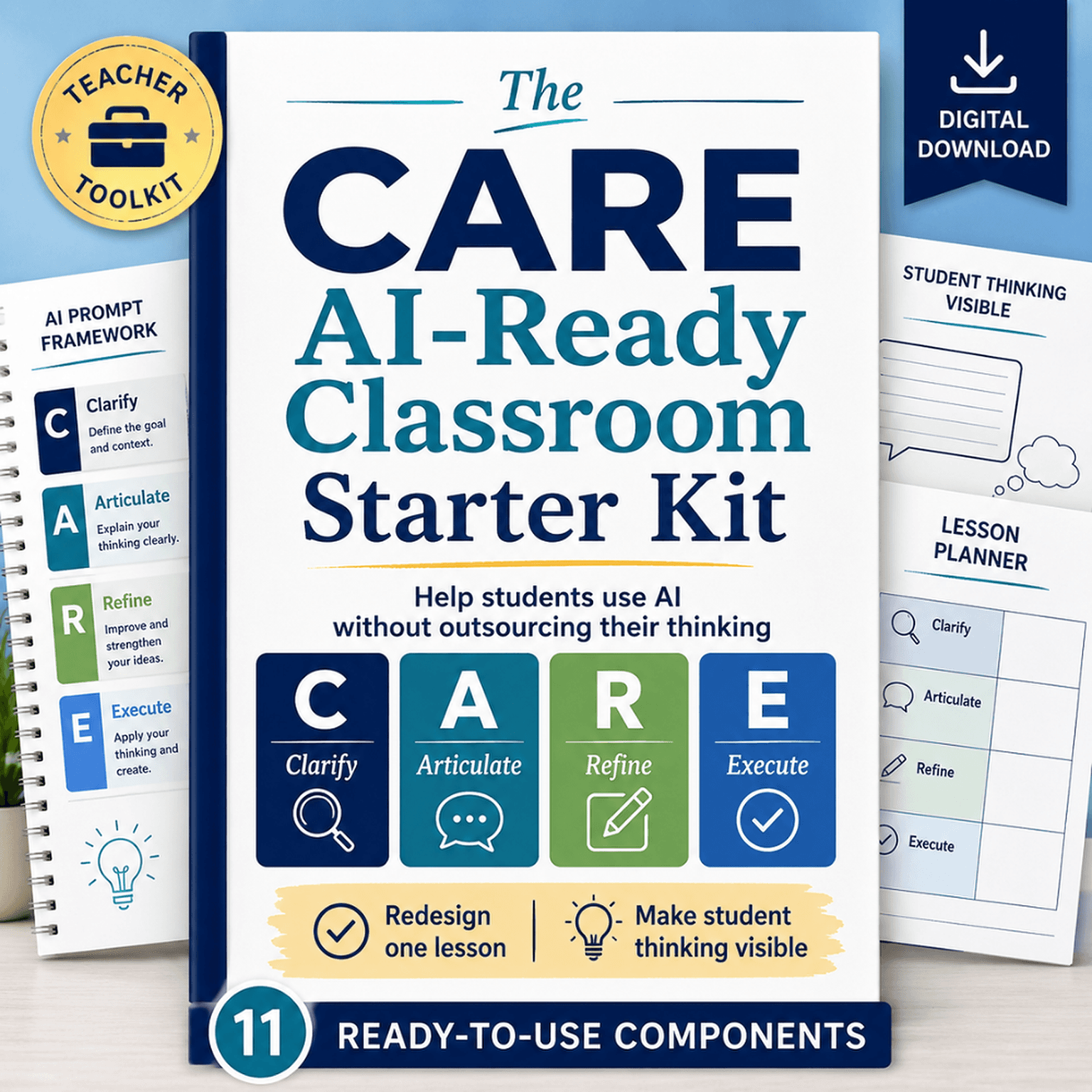
The CARE AI-Ready Classroom Starter Kit is a practical lesson-design toolkit for teachers who want to use AI thoughtfully without giving away the thinking students need to do for themselves.
At the center of the kit is The CARE Teaching Method:
Clarify — What am I trying to understand, solve, question, or notice?
Articulate — Can I explain the idea clearly in my own words?
Refine — Can I challenge, test, connect, and improve the idea?
Execute — Can I turn the idea into action, writing, teaching, conversation, creation, or practice?
CARE gives teachers a repeatable way to design learning while giving students a process they can gradually learn to use for themselves.
Think first. Develop the thinking. Then use the tools.The goal of CARE is not to ban AI, detect AI, or bolt a few AI activities onto an existing lesson.
Instead, it helps teachers design a visible path of learning in which students begin with their own thinking, develop and explain their ideas, connect and challenge what they know, and ultimately do something meaningful with their understanding.
AI can enter that process where it genuinely helps, but it stays downstream of human thinking.
Students might use AI to question an explanation, test an argument, explore another perspective, identify gaps, or generate feedback. They still have to decide what to accept, reject, adapt, or verify.
And CARE works without AI too.
The framework is designed around learning, not around a particular technology.
What’s inside the Starter Kit?The kit gives you practical tools for redesigning an existing lesson rather than starting from scratch.
You’ll explore:
The complete Clarify → Articulate → Refine → Execute learning loop
A lesson re-design process for turning existing activities into more intentional learning experiences
My Thinking First prompts that protect student-owned thinking before outside help enters
Quick Capture strategies for notebooks and rough thinking
Source Notes, Thinking Notes, and Action Notes for developing ideas instead of merely storing information
A notebook-to-second-brain-to-action workflow
A Mental Model Selector for choosing thinking tools that fit the learning challenge
AI thinking-partner prompts that encourage questioning, comparison, testing, and revision
The Accept, Reject, Adapt, Verify process for helping students retain ownership of AI-supported decisions
Cross-curricular examples and different levels of CARE implementation
Tools for planning, testing, and reflecting on a CARE lesson in a real classroom
You do not need to use every tool in every lesson.
One of CARE’s most important principles is to choose the smallest version that makes the important thinking visible.
A ten-minute CARE routine may be enough for one lesson. Another lesson might use CARE across several days or an entire project.
From note-taking to meaningful actionCARE also treats notes differently.
A notebook is not supposed to become a warehouse full of information students never use.
Students can begin with quick, imperfect notes, select ideas worth developing, explain those ideas in their own words, connect them with evidence and other ideas, refine them through feedback or further investigation, and eventually turn them into something.
That “something” might be an essay, presentation, experiment, discussion, decision, design, performance, explanation, project, or real-world action.
Execute is not submit-and-forget.
What students create becomes evidence. That evidence can reveal what they understand, where their thinking changed, and what question should begin the next CARE cycle.
Designed for real classroomsCARE is not meant to become another layer of paperwork for teachers or students.
You can adapt the process to your subject, grade level, learning goals, available time, technology policies, and student needs.
The central question is always the same:
What thinking matters here, and how can I design the lesson so students actually do it?
The Starter Kit gives you a structure for answering that question.
AI gives us access to more information than ever, but CARE gives us a way to slow down and actually work with that information.
Teachers use CARE to design the learning. Students use CARE to learn how to learn.