The Stacking Moats Playbook

John Gusiff
Managing Partner, Customer Centric Solutions LLC

Krzysztof Czubak
Behavior Systems Engineer, CEO UserMindful.Design
Who this is for
Founders fundraising or planning who need to articulate defensibility credibly to investors and operators
Operators choosing a strategy when AI is collapsing categories that used to feel safe
Heads of Growth and GTM building moats and loops that hold up to scrutiny, not just narrative
Strategy and product leads doing competitive analysis on companies, archetypes, or markets
Investors and analysts pressure-testing pitches against an explicit, repeatable framework
Anyone who has read about moats and wants a system that turns the concept into decisions
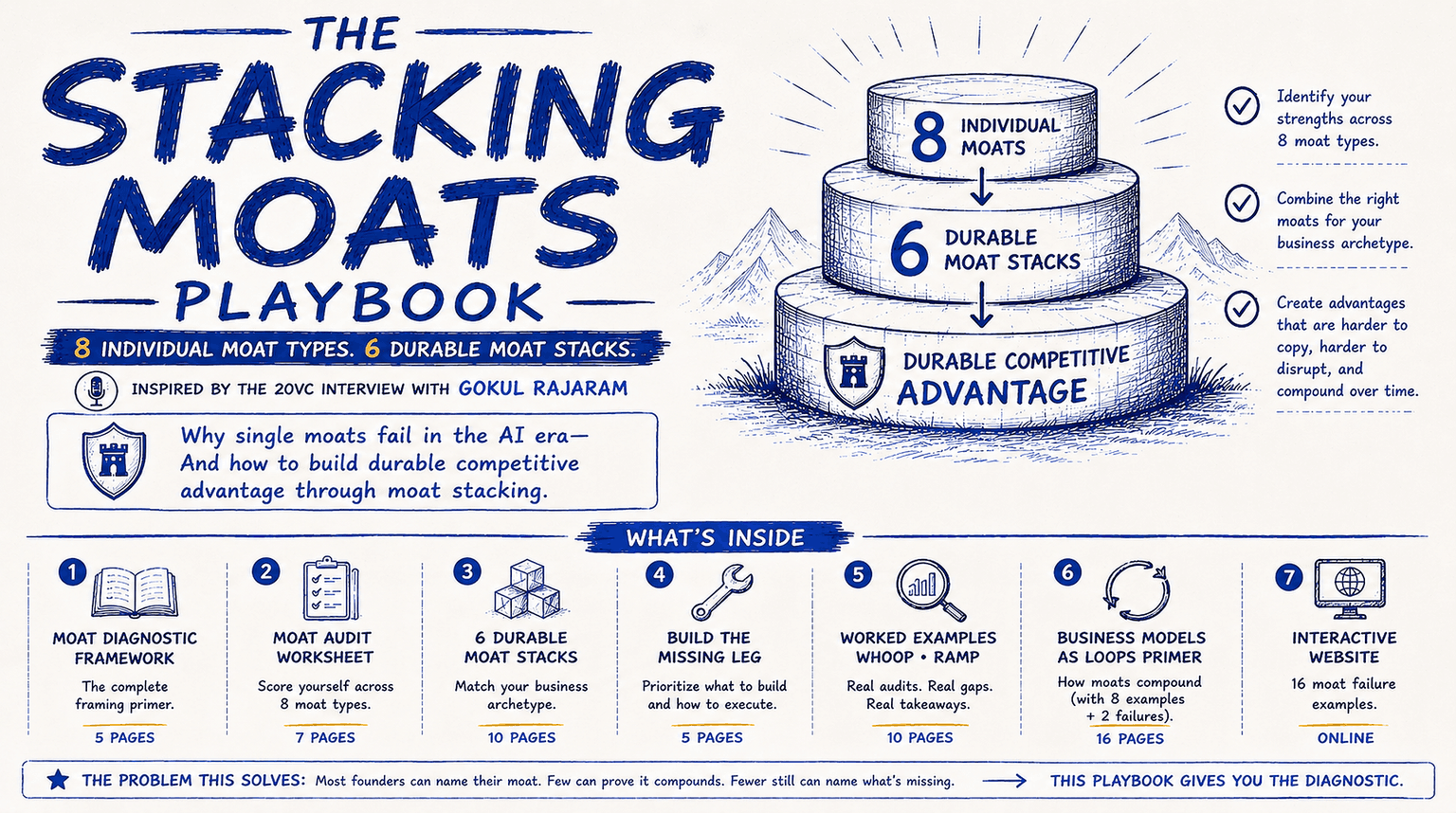
The problem this solves
Most founders can name their moat. Few can prove it compounds. Fewer still can name what's missing.
The result is pitches like:
"We have a data moat." "Our network effect is strong." "Switching costs lock us in."
Those answers are claims, not diagnoses. They sound durable, but they collapse under three questions: Does the asset accumulate? Does it matter? Does it reinforce itself? Most "moats" fail at least one.
Meanwhile, AI-native competitors are rebuilding entire categories around different defensibility stacks — and the businesses that don't know which legs they're standing on are the ones being routed around.
This kit gives you the diagnostic.
What's inside
The framing primer.
Learn why single moats fail, the 8 moat types, the 6 durable moat stacks, and the underlying business loops that drive compounding advantage.
2. Moat Audit WorksheetAssess your current moat portfolio.
Score your business across all 8 moat types using the 0-3 scale (Absent/Emerging/Established/Defining) to understand the real picture, not the picture you wanted.
3. Six Durable Moat StacksFind your archetype.
Match your business to the 6 archetypes for stacked moat combinations that create durable advantage in your category. Determine which of them AI-Native System of Work - Category Defining Platform - Data Intelligence Layer - Regulated System of Record - Demand Aggregator - Infrastructure Backbone you should lean into moving forward.
4. Build the Missing LegPrioritize what to build next.
Once you know your archetype and your audit gaps, this worksheet helps you identify the missing leg and what to build next. What to focus on for the next two quarters.
5. Worked ExamplesSee the framework in action.
Real moat audits, archetype assessments, and recommendations using actual companies. Examples from Whoop, Ramp, and others. Strategic findings to evolve each business model, making it more defensible.
6. Business Models as Loops PrimerUnderstand how different business loops support each moat type.
Explore the business loops that power growth, reinforce advantage, and explain why some moats collapse. Learn about the five core business loop types (user, content, trust, skill, capital). Examples from Notion, Strava, Shopify, TikTok, STrip, and others.
7. Interactive WebsiteExplore moat failures and moat stacking.
A searchable reference library showing how different moat combinations succeed or fail across B2B and B2C companies. Filled with case studies regarding the failure modes for individual moats. Bookmarkable, shareable, complements the other PDF resources.
What you'll be able to do
Score your business across all eight moats with honest numbers, not narrative
Identify which archetype you actually are (vs. which one you wish you were)
Name the missing leg in your stack and the next 90 days of work to build it
See the loops underneath your moats — and identify the trigger you don't control
Pressure-test any company's pitch (yours, a competitor's, a portfolio company's) against an explicit framework
Have a shared vocabulary with your team, board, and investors for what defensibility means in 2026