The Manual LinkedIn Pipeline: Book Qualified Meetings Without a Software Stack
Casey OToole
Founder at LinkyBot. Outreach since 2016

Tools run 1.5 of the 9 parts. This is the six you have to run yourself.
Most people running LinkedIn outreach are running three of the nine parts, each at about half strength. A profile, a rough list, and some messages. The other six are where the meetings come from. Automation tools run about 1.5 of the nine. The sending, and some of the scheduling. That is real and it is useful. Here is the rest of the bill they hand back to you: who to exclude, what a reply means, when to ask, when to walk away, and whether that meeting was real. Five judgment calls per reply, and no tool makes any of them. Month one your dashboard looks incredible. Month three you have inbox debt: dozens of warm hands raised, aging past the window where answering them still works. The tool did not fail. The assumption that sending was the job failed. I have run LinkedIn outreach as a business since 2016. On strategy calls, when someone has the hours to run it themselves, I tell them to run it themselves and send them on their way. Then I never find out whether they did. This is that conversation, prepared properly, with the templates attached. 3 hours. Six of the nine parts, the six you can run by hand. You will need LinkedIn and a spreadsheet, and that is the whole software list.
What you’ll learn
You leave running a pipeline you built by hand, with a written standard that tells you which meetings were real and which only looked it.
Every message you send points back at your profile, so your accept rate is decided by what a stranger finds when they check who you are.
You write your one-sentence ICP, then run the five-second test on your own headline and mark it pass or fail in the room.
You leave with your ICP line written and a headline you have actually tested, instead of one you assume works.
Software forgives a sloppy list because it just sends more. At the volume one person sustains by hand, there is no room for waste.
You build the suppression list before the target list, add inclusion filters, then hand-read a sample of ten before anything sends.
You leave with a targeting spec that has your own exclusions in it, built from your clients, your inbox and your open deals.
The request has one job. Every word past that job description lowers your odds, and a no from a stranger is permanent.
Three requests go up on screen, one strong and two broken, and the room votes on them before the reasons get explained.
You leave with three variants under 200 characters, each naming something only true of that reader, ready to A/B test.
An accept is permission, not interest. Most warm threads die because nobody asked inside the window where asking still works.
You write all four messages in your own voice, each giving before it asks, including the walkaway that keeps the door open.
You leave with an arc you can run Monday, and a rule for when to stop that gives you back hours every week.
An unwritten definition always bends toward whoever is invoicing. When you run this yourself, that person is you.
You adapt nine specific criteria to your own business, then score your last three booked meetings against them, live.
You leave with a written standard, and a pipeline that gets smaller that day and more honest every day after.
Every system that reports on itself drifts toward flattery. A month of gorgeous activity with zero held meetings is a failed month.
You name your source of truth, build the scorecard, and book the recurring fifteen minutes before the block ends.
You leave with a weekly pass that reconciles against your calendar, which is the one record that does not flatter anybody.
Workshop agenda
The software floor, stated first
The whole software list, out loud, before anything gets taught: LinkedIn, a spreadsheet, Sales Navigator if you have it. Then one number in chat: hours a week you can really give this.
The nine-part map, with the boundary drawn early
Most advice hides the boundary until the end. You see it at minute fourteen: all nine parts, six lit and three greyed, so you know what you are getting before you invest another minute.
Part 1. Your profile as a launch gate
Every message you send points at your profile, so the accept rate is decided before you send. You write your one-sentence ICP and run the five-second test on your own headline.
Part 2. Exclusions before inclusions
One wrong message costs more than a hundred right ones. You build your suppression list first, add inclusion filters, then hand-read a sample of ten before anything sends.
Part 4. The connection request that has one job
The request has one job: earn a yes from a stranger. Three go up on screen, one strong and two broken, and the room votes. You write three variants, each under 200 characters.
Part 5. The arc. Ask by day 14, dead by day 21
The accept is permission, not interest. You write four messages with the ask landing by day 14 and the thread ending by day 21, each one giving before it asks, in your own voice.
Live build. Blank spreadsheet to first 25 sends
Watch the machine get built at speed: exclusions, filters, a live search, three profiles read out loud with one rejected, 25 rows queued. Then you pressure-test your own with a partner.
Part 8. Nine written criteria for a qualified meeting
If qualified is not written down, it bends toward whoever is invoicing. You adapt nine criteria to your own business, then score your last three booked meetings against them.
Part 9. The Friday fifteen, and the weekly cadence
Every system that reports on itself drifts toward flattery. You build the scorecard, then block the reply hour and the recurring fifteen minutes on your calendar before the block ends.
Parts 3, 6 and 7. Where the course ends and the software starts
The three parts I do not teach, named with reasons, and no workarounds because the workarounds do not work. Then the recap, and one exit question: hours a week you can put on outreach.
Learn directly from Casey

Casey OToole
LinkedIn outreach since 2016 · 1,500+ campaigns · $100M+ attributed pipeline


Who this workshop is for
Founders and agency owners with 15 to 20 hours a week who want pipeline from LinkedIn and would rather run it themselves than buy it.
Consultants and coaches selling $5K+ engagements who need every booked meeting to be real before it gets counted.
Solo operators who tried an automation tool and found the sending automated fine while every judgment call landed back in their inbox.
Prerequisites
Software floor, stated exactly: LinkedIn. A standard account is enough.
A spreadsheet. Google Sheets or Excel. Either is fine. Sales Navigator, optional. It helps with one step, and I mark exactly where.
What's included
Lifetime access
Go back to course content and recordings whenever you need to.
Community of peers
Stay accountable and share insights with like-minded professionals.
Certificate of completion
Share your new skills with your employer or on LinkedIn.
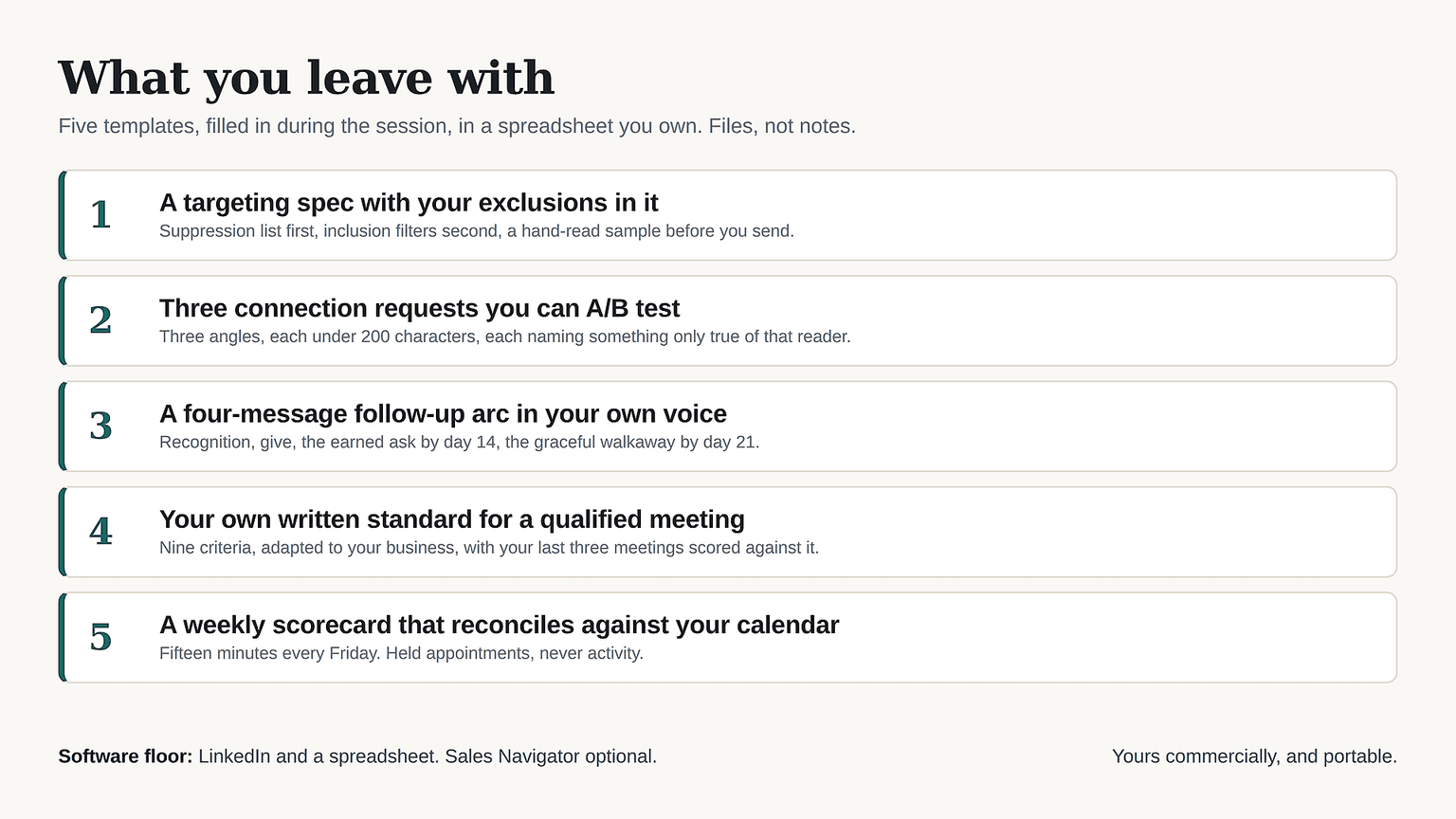
Five templates, filled in during the session
A targeting spec with your exclusions in it, three connection requests, a four-message follow-up arc, your own written qualification standard, and a weekly scorecard. You build all five in your own spreadsheet during the three hours. Files you own, not notes.
A software floor of LinkedIn and a spreadsheet
Nothing taught here needs a CRM, a sending tool, an automation platform, or a subscription. Sales Navigator helps with exactly one step and I mark where. That floor gets stated in minute one and held for all three hours, which is why what you build works the Monday after.
A live build from an empty sheet to the first 25 sends
Sixteen minutes of screen share, no slides. A real day-one campaign built end to end: exclusions, inclusion filters, a live search, three profiles read out loud with one rejected, 25 rows queued, and the first request written against a real profile.
The three parts I do not teach, named out loud
Nine parts make a working pipeline and I teach six. The other three need software, and I name them with reasons instead of selling you a workaround. Knowing exactly where that line sits is worth more than another message template.
Templates that stay yours, on or off this platform
The five templates are files in your own spreadsheet, usable commercially in your own business, and portable anywhere. Nothing you build in this session depends on keeping a subscription to anything, including this one.
Maven Guarantee
Your purchase is backed by the Maven Guarantee.
The three parts I'm not teaching
Nine parts make a working LinkedIn pipeline. I teach six of them. Here are the three I don't, and why. Part 3, sustained daily volume. You can hold the pace by hand. You cannot hold the ceiling. Past a certain point that is software, and no manual technique closes the gap. Part 6, a reply layer that answers in minutes while the prospect is still online. You can answer same-day yourself, and you should. Answering in minutes at 11pm is software. Part 7, a content pipeline aimed at the same people your outreach is warming. Two or three posts a week you can write yourself. A pipeline is a different thing. That is where the course ends and the software starts. I am not blurring that line, because the blur is how people buy a build project and call it an education.
What's included.
Frequently asked questions
Maven for Teams
Reimbursement
Get your company to pay
Everything L&D needs: email template, receipts, and certificate of completion.
Get reimbursedPrivate cohort
Run a cohort for your org
A dedicated cohort with a custom schedule and curriculum, tailored to your team.
Book a private cohort