
Stop panic-fueled drive. Start building a system your brain will actually use
You've probably already tried the planners, the apps, maybe even medication. Some of it helped for a while. None of it stuck.
That's not a discipline problem. It's a design problem.
Most productivity advice is built for neurotypical brains. When you use it and it doesn't work, it feels like a character flaw. It isn't. Spicy Brains Get Stuff Done is a 6-week live program for busy leaders whose brains are wired differently: entrepreneurs, managers, and professionals who are done with generic advice and ready to build systems that actually fit how they work.
There is no one path that works for every brain. This cohort gives you the accountability, structure, and community to find the right tools for yours.
Past participants say:
"I make decisions faster and with less second-guessing."
"Becca offered concrete techniques...that really helped me accomplish more in shorter blocks of time."
"My energy has returned and my spicy brain can now more easily get stuff done."
What you’ll learn
Tuesdays: learn why + design your experiment. Fridays: report back + adjust. Built around your real work, not added on top of it.
Spot the specific story your brain tells when you're stuck — and why it's probably wrong
Draft one reframe you can actually believe, with a plan to collect evidence so it can replace the old story
The reframe you build here compounds every week — past participants say it's what made the tools actually stick
Identify which of the 4 most common procrastination triggers is actually running the show for you
Design a micro-experiment for a real task you've been avoiding — in the Tuesday session itself
Example: "I'll start my overdue report in a coffee shop right after my standing Monday call so I can reduce the boredom dread that stops me"
Learn why "just get motivated" is neurologically useless advice — and what actually works instead
Identify which of your motivation foundations is most depleted right now
Design one low-effort experiment to shore it up before burnout hits
Map your personal distraction triggers — internal (thoughts, energy) and external (space, noise)
Pick one internal or external change to test this week — small enough to actually try, not a life overhaul
Example: "I'll start a 'mental bike rack' notebook & use it for those things I suddenly remember to do when I'm in deep work mode"
Learn 2–3 decision frameworks that work for ND brains — including one for when you're overwhelmed
Apply one to a real decision you're currently sitting on, and get group support making it
Example: "I'm going to use the mood meter this week to match my tasks to my level of energy and make changes where I need to"
Identify your blocks to maintaining momentum
Build a one-page personal toolkit: your triggers, your best strategies, your early warning signs
Leave with something you'll actually use — not a binder you'll open once and never touch again
Learn directly from Becca

Becca Block, PhD
Neurodivergent leader who bridges the gap between research + practice
Who this course is for
Managers, entrepreneurs, & working parents whose brains work differently and want strategies that fit both brain + busy life
Adults with ADHD, autism, anxiety, or other differences who are done with productivity advice that wasn't built for their brain
Anyone who's tried the apps, planners, or sub-reddits and is ready for something that doesn't require them to self-start their solutions
What's included

Live sessions
Learn directly from Becca Block, PhD in a real-time, interactive format.
Lifetime access
Go back to course content and recordings whenever you need to.
Community of peers
Stay accountable and share insights with like-minded professionals.
Certificate of completion
Share your new skills with your employer or on LinkedIn (alternate certificates with a more corporate-standard course name are available upon request)
Extra 1:1 session
Pick one challenge you want to go deeper on, and schedule a 1:1 with Becca to get custom support
Maven Guarantee
Your purchase is backed by the Maven Guarantee.
Course syllabus
11 live sessions • 6 lessons
Week 1
Sep
8
Rewriting your neurospicy story: workshop
Tue 9/84:00 PM—5:00 PM (UTC)Sep
11
Story revision check-in / Q&A
Fri 9/114:00 PM—5:00 PM (UTC)
Rewriting your story about your unique brain
Week 2
Sep
15
Handling procrastination & getting new projects started
Tue 9/154:00 PM—5:00 PM (UTC)Sep
18
Procrastination experiment check-in / Q&A
Fri 9/184:00 PM—5:00 PM (UTC)
Handling procrastination & getting started on big projects
Free resource
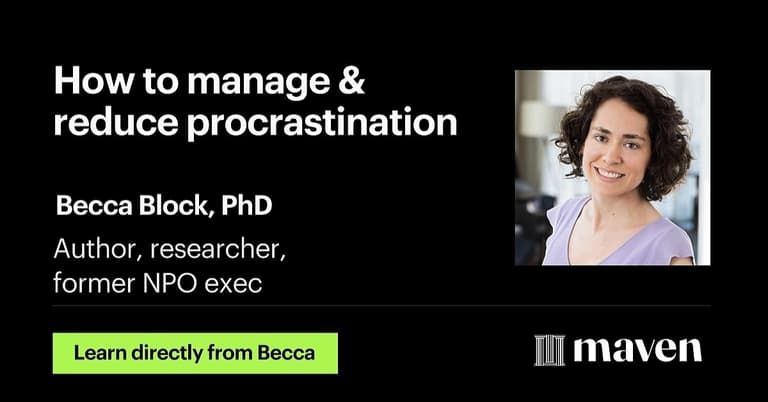
How to manage and reduce procrastination
Bad time management isn't the root cause of procrastination
You may also struggle with time management. But procrastination is a threat response, requiring different strategies
Laziness isn't the root cause either
In fact, studies correlate procrastination with perfectionism rather than laziness or apathy.
Shift the task, context, and response
To handle procrastination you need to change your view of the task, your view of yourself, and how you set up your work
By continuing, you agree to Maven's Terms and Privacy Policy.
Schedule
Live sessions
2 hrs / week
We use the live time for learning about root causes for challenges areas + strategies to address them, identifying what to change, planning individual experiments, and sharing results.
Tue, Sep 8
4:00 PM—5:00 PM (UTC)
Fri, Sep 11
4:00 PM—5:00 PM (UTC)
Tue, Sep 15
4:00 PM—5:00 PM (UTC)
Projects (aka Experiments)
1 hr / week
Those who decide to do more involved experiments to identify what results they get with specific strategies may spend up to an extra 1 hour per week. However, most participants design their experiments to fit with the work they're already doing that week, and using live time for both planning and reflecting on results.
Frequently asked questions
Maven for Teams
Reimbursement
Get your company to pay
Everything L&D needs: email template, receipts, and certificate of completion.
Get reimbursedPrivate cohort
Run a cohort for your org
A dedicated cohort with a custom schedule and curriculum, tailored to your team.
Book a private cohort