
Built AI and know it can go better? Let me show you how.
A structured process for AI practitioners who've built enough to be frustrated. You know the pain of underspecified projects, wrong turns, and results that underwhelmed.
I provide a method to frame the next problem, plus practical strategies for diagnosing and pivoting when things start to go off-track. Get the book and then join me to apply it to your work.
🚨 Winter cohort: Jan 4, 2027 🚨
Get 20% Off, with Code: Earlybird
---
What you get:
🔄 GOATS, a 5-step framework you'll use to think through every AI project
🕵️♂️ Diagnostic heuristics for your AI Projects
🛠️ Bring your own AI project and apply the frameworks each week (or use a provided case study)
🧑🏫 2 Live sessions per week plus office hours
📋 The full course reader plus worked examples, the alternatives catalog, and exercises across Agentic AI, GenAI, and ML
🎥 Lifetime access to all recordings
---
This course is for you if:
• You're shipping AI and worried it won't hold up in production
• You need a way to diagnose what's wrong with your AI solution
• You're responsible for ensuring AI projects are successful
You'll learn from 200+ AI reframes. You gain years of experience and recognize the scars. To learn more, go to aiframer.dev.
What you’ll learn
How to think through AI problems end-to-end: scoping, debugging, and knowing when to pivot.
A framework to start with: a 5-step GOATS framework (Goal, Operating Assumptions, Alternatives, Trade-offs, Signals)
Catch the underspecified setup that sinks projects: the wrong metric, the wrong atomic unit, the easy assumptions.
Tell a model problem (keep tuning) from a framing problem (rethink the setup) instead of guessing.
Spot the warning signs in ML, GenAI, and agent systems before they get expensive.
Learn how to set success and stop criteria for your AI projects
Reframe a stuck project into one that can actually work.
Question requirements before you build them. Push back with evidence: "I know you want a chatbot, but here's why search is better






Who this course is for
You've shipped AI and walked away frustrated. You know it could have gone better, and you don't want to run the next one on instinct.
You need a way to diagnose and reframe projects when they stall to get them moving again.
You're accountable for AI work but came up through engineering, product, or PM, and want a structured way to make the call.
Prerequisites
You understand what AI/ML is at a conceptual level.
We focus on framing and strategy, not explaining what models or training means. Basic vocabulary lets us go deeper faster.
You've shipped or led at least one AI project.
The frameworks click when you can map them to something you've actually built. Without that, they stay abstract and it's harder to learn.
No coding, and none taught.
This is about what to build and when to change course, not how to implement it. You'll do the thinking and let AI later do the coding.
What's included

Live sessions
Learn directly from Rajiv Shah in a real-time, interactive format.
Maven Guarantee
Your purchase is backed by the Maven Guarantee.
Course syllabus
68 lessons • 6 projects
Week 1
Lesson 1: Thinking from First Principles for AI
Bonus: AI Alternatives for Gen AI and Traditional ML
Week 2
Lesson 2: The GOATS Loop, A Framework for AI Problem Framing
Free resources
Why this matters
"The key question for enterprise AI is: what problem are you actually solving?" -- Alexandru Vesa, MLOps Engineer
"Tools go in and out of style quickly, but fundamental approaches to problem solving should last a bit longer." -- Chip Huyen, Stanford ML Systems Design
"The future of work is all of us becoming managers of AI." -- Richard Socher, former Chief Scientist at Salesforce
Course Map
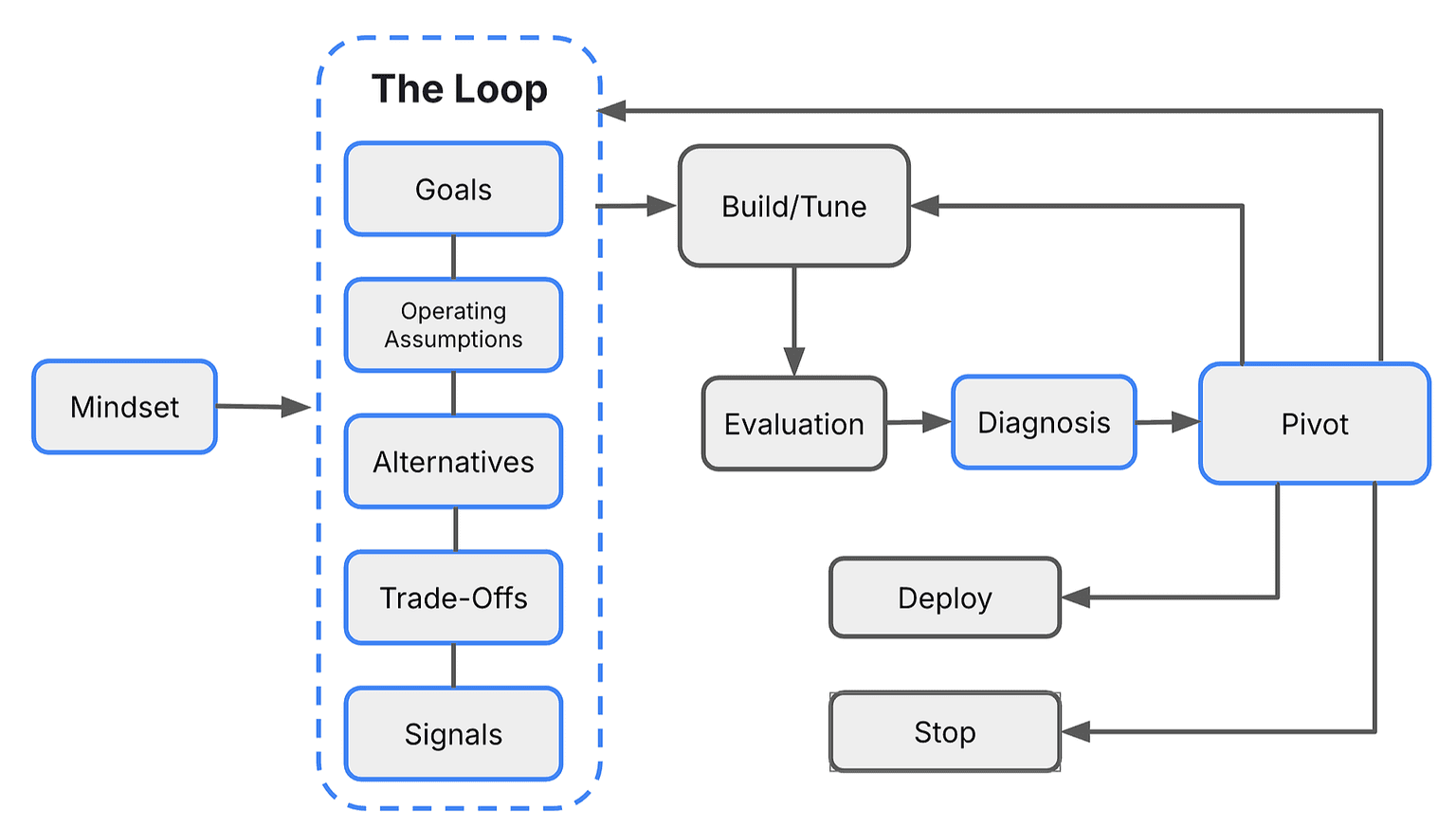
The Outer Loop for Reframing Your AI Projects
What You will Learn
The Strategy & Mindset
- The 5-Step frameworks: GOATS is structured engineering lifecycle for deconstructing and reframing complex AI problems before writing code.
- Thinking Methods: Inversion, De-escalation, and the Feynman Test. Break System 1 pattern-matching and catch bad framing before it becomes expensive.
The Diagnostics
- Diagnostic Tests: Figure out whether your agent problem is model capability, orchestration, task framing, or an alternative approach.
- Failure Funnel: Identify where errors are happening.
- Pivot Signals: Tests for recognizing when an approach has hit a dead end (and exactly what to do about it).
The Toolkit
- Canvases & Checklists: Course-exclusive worksheets for running strategy sessions, including the AI Problem Framing Questionnaire.
The Reference Library
- 200+ Case Studies: A searchable database of real-world pivots (Netflix, Uber, Stripe) mapped to the 18 architectures in the course.
- Manual: A 250 page book that puts all the lessons into an easily readable form
Participation & Code of Conduct
Participation Expectations
This is a practitioner-focused cohort built on trust and discussion.
Participants are expected to engage respectfully and professionally.
Disruptive behavior, bad-faith participation, or misuse of course materials may result in removal.
Course content, discussions, slides, and materials are for personal educational use only (I handle group corporate training differently)
If you have any questions, reach out. I spend a lot of time preparing and want to make sure we have a conducive environment for learning.
Frequently asked questions
Maven for Teams
Reimbursement
Get your company to pay
Everything L&D needs: email template, receipts, and certificate of completion.
Get reimbursedPrivate cohort
Run a cohort for your org
A dedicated cohort with a custom schedule and curriculum, tailored to your team.
Book a private cohort$980
USD