Role Redesign Coaching Package for Organizations in AI Transformation

Jory Des Jardins
AI Transformation Advisor | Frontier Tech Executive | 30+ Companies
Who this is for
Somewhere on your team there’s a role that doesn’t look the way it did a year ago. AI tools now draft the first version, summarize the inputs and handle the routine steps, but the job description, the career path and the headcount plan haven’t changed to match. Meanwhile someone is asking whether you still need the role at all.
If nobody redesigns that role on purpose, it gets redesigned by default: through a hiring freeze, an attrition backfill that never happens, or a cut that takes the judgment along with the busywork. This package is for leaders who want to make that decision on purpose.
This is a fit if you:
Lead a team or function, or partner with one as HR, People or Chief of Staff
Have watched AI change a role while its structure stayed exactly the same
Are under pressure to cut or freeze headcount and want a credible alternative on the table
Worry that the work junior people learn on is disappearing, and with it your future bench
Can bring one specific role or function, and access to the person who owns it
Why work with me. I’ve led teams inside large organizations, including AWS, and built them from scratch as a founder. Human Agency Architecture, my framework for deciding what AI handles and what people must keep deciding, was built for exactly this kind of choice.
Not quite right?
If you need to diagnose a whole AI rollout rather than one role or team see the AI Adoption Diagnostic.
If you’re redesigning decision rights across an entire function, see the HAA Sprint.
If you just want an hour of advice on a role question, book the Leaders open session.
What you walk away with
You leave with a redesigned role and a short memo you can bring to HR, finance or your leadership team.
A completed Role Application Worksheet for one role or function: which tasks AI handles, which stay with people, and which developmental work needs protecting.
A one-page memo setting out how the work should be engaged going forward: full-time, fractional, contract or a blend, and why.
Three working sessions over two to three weeks, plus my review of your drafts between sessions.
Why it matters: the memo puts a considered alternative on the table before the default decision (a cut, a freeze or nothing at all) gets made for you.
A look at the Human Agency Architecture (HAA) Framework
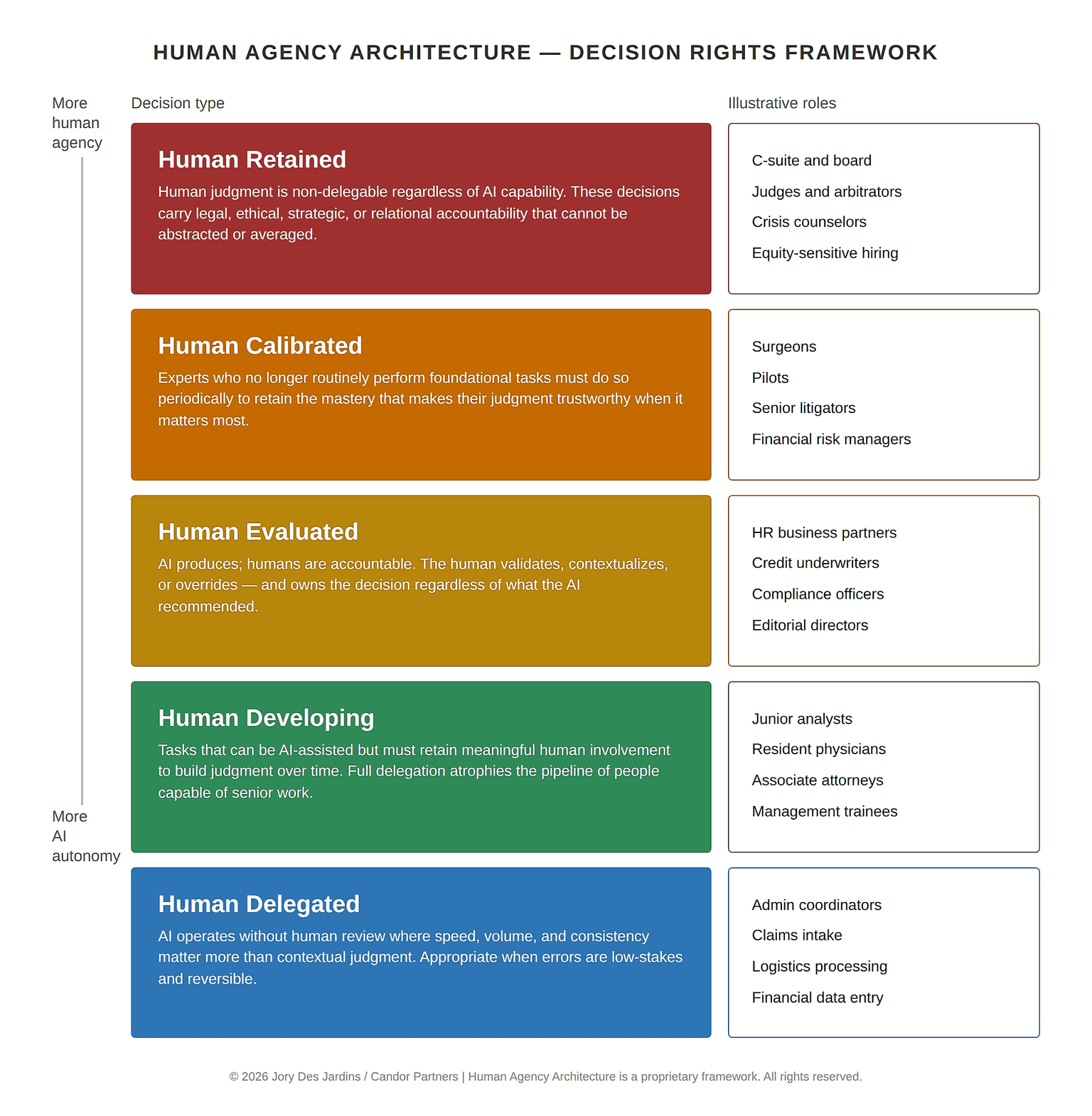
One of several frameworks upon which HAA is based, answering what to delegate to AI vs humans.
How it works
Book your package. After booking, you’ll schedule three sessions over two to three weeks.
Complete the intake. Tell me about the role or function, the person who owns it, and what’s driving the change.
Send your materials 48 hours before Session 1. This includes the current job description, the AI tools in use, and any headcount or budget constraints.
Session 1: Map the work (60 min). We sort the role’s tasks into what AI handles, what stays with people, and the developmental work that has to be protected.
Session 2: Redesign the role (60 min). We draft the new role (or function) and decide how the work should be engaged: full-time, fractional, contract or a blend.
Between sessions: I review your draft worksheet and send you written feedback.
Session 3: Finalize (60 min). We pressure-test the design and agree on the memo.
Receive your Role Application Worksheet and one-page memo within [5] business days.
Need an invoice for reimbursement? Ask after booking.
About Jory Des Jardins
I’ve spent my career where a new technology meets the people expected to absorb it.
In 2005 I co-founded BlogHer, when blogging was still new and social media norms untrusted and untested. We built frameworks for trustworthy engagement, which I've done with emerging tech ever since. I’ve led global marketing teams at AWS and ConsenSys (blockchain), and in 2024 I co-founded Optionality, a community for experienced professionals exploring new models for work and meaningful careers. I started my career in traditional media (Time Inc, The New York Times Syndicate, Penguin), writing for national publications such as Fast Company and Inc.
Today, through my advisory practice Candor Partners, I work with leaders on a problem I call structural lag: Organizations deploy AI faster than their people and institutions are ready to absorb it. Human Agency Architecture (HAA) is the framework I built to close that gap. It gives leaders a practical way to decide what AI should handle, what people must keep deciding, and how to protect the judgment and development their organizations depend on.
I also convene the AI Operators Exchange, a private working group of senior enterprise operators, and I advise AI organizations on Narrative Positioning and GTM.
Read and connect