Beyond Evals: Designing Improvement Flywheels for AI Products
Aishwarya Naresh Reganti
AI Founder & Advisor to F500s | Ex-AWS
Kiriti Badam
Applied AI @ OpenAI Codex | Ex-Google
.png&w=768&q=75)

Move beyond one-time evals to continuous improvement flywheels for AI products
Check out our free AI Evals Certification (5000+ learners)!
Built AI systems but stuck with noisy, expensive, or useless evals? Learn to turn offline evals, online evals, and production monitoring into continuous improvement signals. LLM judges alone won’t fix your product.
Live cohorts use a flipped-classroom format: async lectures + twice-weekly office hour sessions.
Current Offers:
🎁 Full Stack AI Bundle — $2,950 early bird
Become a full-stack AI builder by year-end.
Get this self-paced course with the bundle using this link.
Problem First AI + the Agent-Native Operator workshop
Advanced self-paced courses: Harness Engineering and Beyond Evals
Hands-on Portfolio Build Labs with selected partners to build your resume + $800–$1,000 in Partner Credits (Deepgram, Arize, NVIDIA, Cursor, Lyzr, Grain, Cartesia, Vapi, Mem0, Composio, Exa).
What you’ll learn
Evals aren't your product moat. A continuous improvement flywheel is.
Learn why evals is often reduced to LLM judges, and why that breaks real AI products.
Understand evaluation as a lifecycle practice, not a one time pre deployment check.
Build an intuition for continuously improving AI products through a connected evals and monitoring loop.
Learn how to build reference datasets before your product ships.
Identify key stakeholders (product, engineering, SMEs) who can help build an accurate behaviour estimate
Design improvement setups that evolve as the product evolves, including when to add or retire evals.
Understand how evaluation strategies differ across RAG systems, tool calling workflows, and multi turn systems.
Learn which categories of evals matter for different system behaviors and failure modes.
Learn when to use LLM judges, when not to, and how to avoid overly biasing on them.
Learn which production signals matter, both explicit and implicit, and how to use them for improvement.
Understand how behavior drifts in production and how monitoring helps surface it early.
Close the loop by feeding production signals back into evals and datasets, and learn how this data flywheel becomes a product moat.
Learn directly from Aishwarya & Kiriti
.png&w=384&q=75)
Aishwarya Naresh Reganti
AI Founder & Advisor to F500s | Ex-AWS





Kiriti Badam
Applied AI @ OpenAI Codex | Ex-Google


Who this course is for
Software/AI Engineers, Strategists, Data Professionals, Solution Architects and Consultants looking for systematic evaluation practices
Business Leaders and Product Managers seeking to gain the technical understanding of AI Product Lifecycle and intentional iteration
Founders & teams stuck at systematic evaluations and monitoring, unsure how to turn signals into real product improvements.
Prerequisites
A good understanding of AI system design
You should have built small AI applications before and be familiar with concepts like RAG, MCP, and tool use.
Working knowledge of Python/Coding (Optional)
The course includes optional Python assignments, you're free to use coding agents, but basic coding skills are recommended
What's included
Maven Guarantee
Your purchase is backed by the Maven Guarantee.
Course syllabus
Unit 1
Start here: Welcome to Maven
Welcome to Beyond Evals: Designing Improvement Flywheels for AI Products
[Please Read] Course Structure, Components & Time Commitment
FAQs
Unit 2
Start Here: Introduction, Setup & Our Favorite AI Tools
Week 1 Content: Foundations of AI Evaluation
Assignment 1
Wall of Love for our #1 Enterprise AI Course
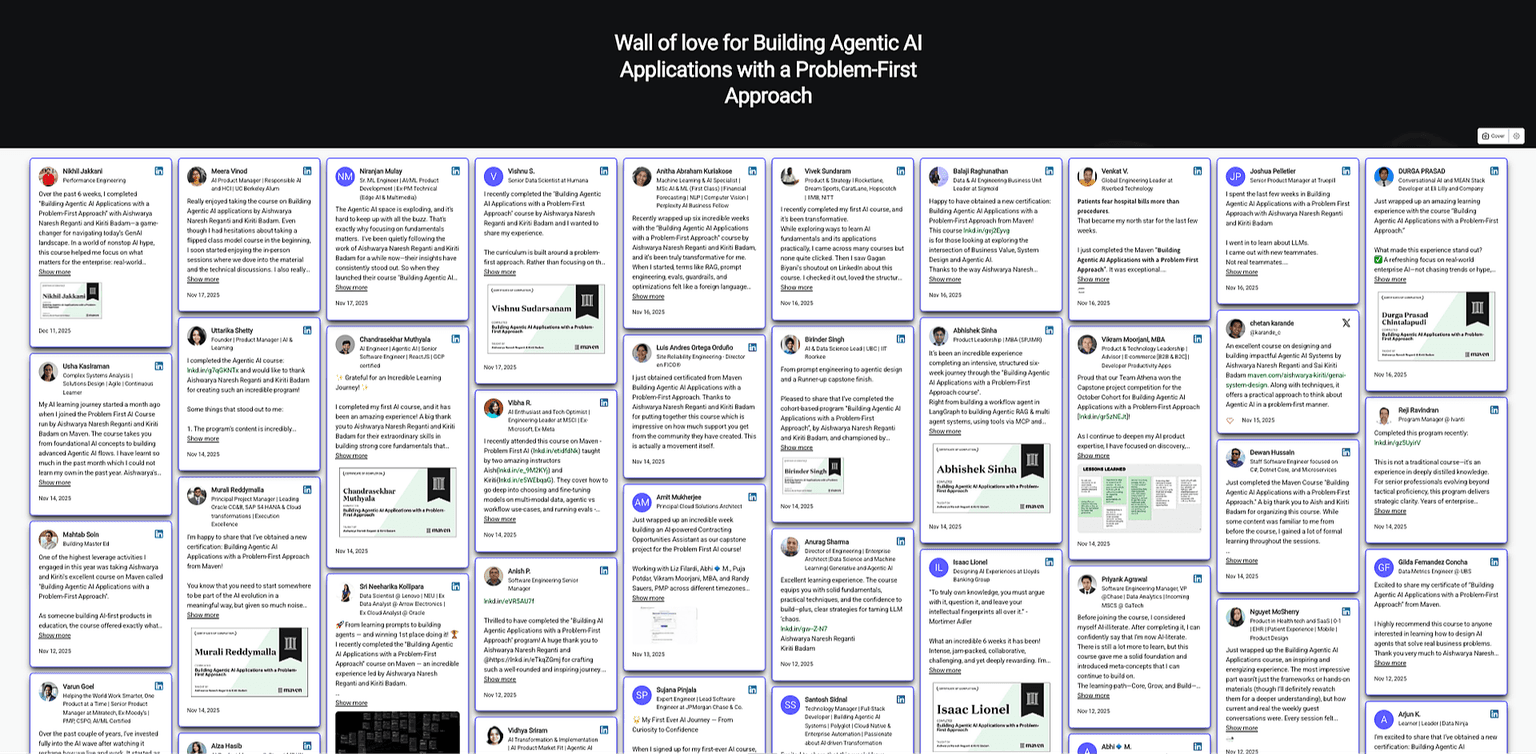
Link: bit.ly/3MYmBOF
Frequently asked questions
Maven for Teams
Reimbursement
Get your company to pay
Everything L&D needs: email template, receipts, and certificate of completion.
Get reimbursedPrivate cohort
Run a cohort for your org
A dedicated cohort with a custom schedule and curriculum, tailored to your team.
Book a private cohort$2,000
USD