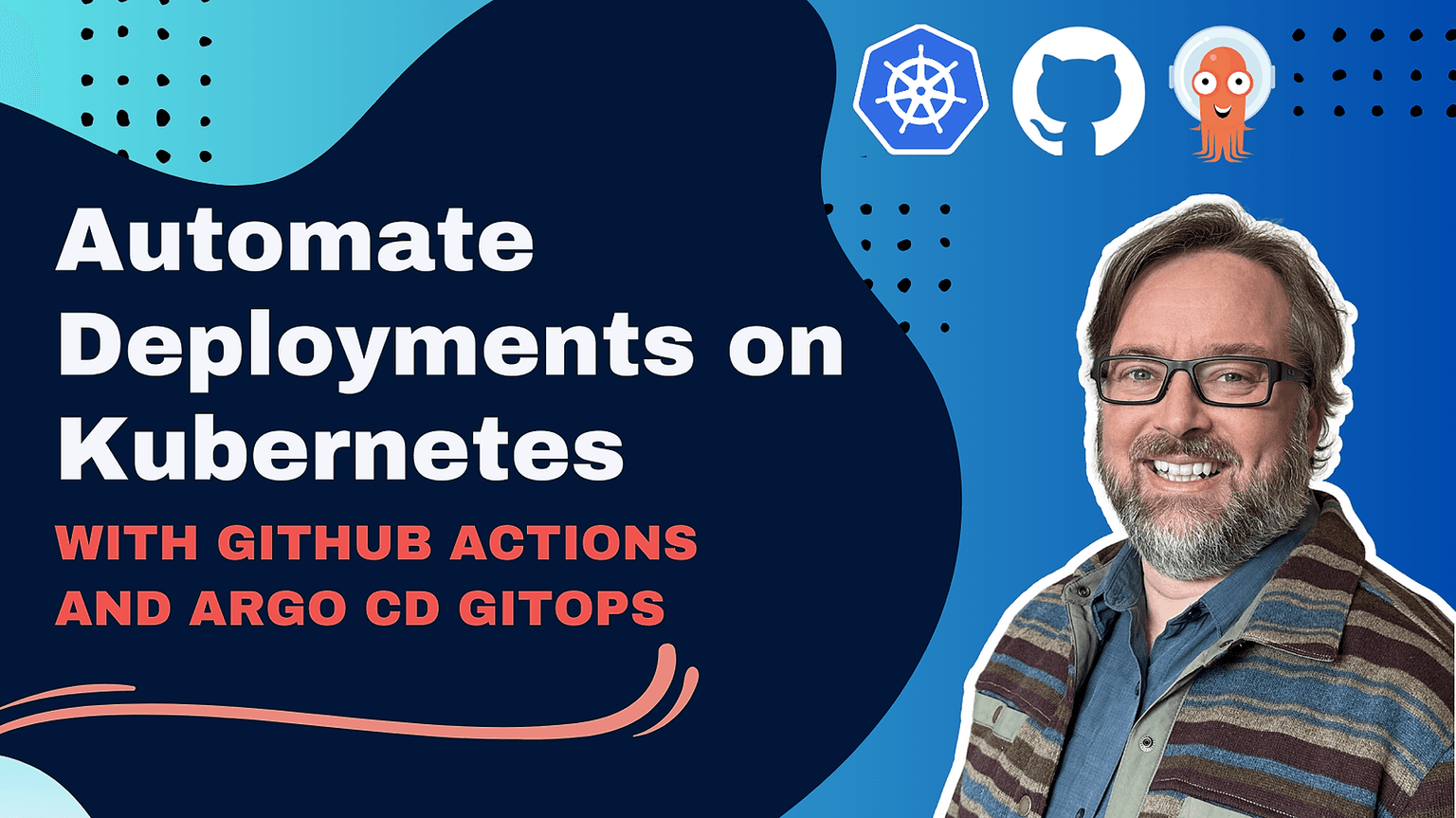
Hero image

Automate Your Deployments on Kubernetes with GitHub Actions and Argo GitOps

Mature DevOps needs automation. Skip the pain of inventing workflows and implement my real-world templates for build-test-deploy pipelines.

This course is no longer available.

Explore other courses

Course overview

Rescue your team's confidence in production updates with workflows and GitOps

Raise your production success and lower your stress by empowering your team with self-service automations and deployment dashboards. You'll apply my Cloud Native DevOps automation design constructed from my years of successful implementations for multiple organizations.

This course is for:

01

DevOps engineers who want to automate their testing and deployment workflows with GitHub

02

Build engineers who struggle with moving off legacy CI/CD tools to GitHub Actions

03

Software engineers who are sick of the lack of automation and deployment status in their software lifecycle

What's in it for you?

Ship code faster and with greater visibility and reliability

Building, testing, and deploying your apps to Kubernetes should be easier! Discover how GitHub Actions and Argo CD can get your time back.

Advance your GitHub Actions experience and implement container lifecycle automation

You'll use real-world templates to start automated container builds, CVE scans, testing, linting, and more. Security best practices are also provided.

Discover how others are solving their DevOps and automation needs

With small group cohort-based learning, you can share and collaborate with other DevOps teams on workflow ideas and how they approach solving business problems with automation.

Customize the pieces in class to fit your requirements

You'll add my templates to your own GitHub repos to start seeing benefits immediately. Combine best-of-breed tools into a simple and low-maintenance design.

Achieve full control and awareness of your deployments with GitOps

Implement Argo CD for your own GitOps-based infrastructure-as-code design across multiple environments. Provide the team with the detailed deployment dashboard they've been looking for.

Course schedule

Total 12 hrs: 6 hrs/week for 2 weeks

  • Week 1, Mon & Wed

    12:00pm - 2:00pm US ET (UTC-4)

    Live workshops: slides, demos, and small group discussion.

  • Week 1, Fri

    12:00pm - 2:00pm US ET (UTC-4)

    Optional co-working workshop to customize what you're learning to fit your requirements.

  • Week 2, Mon & Wed

    12:00pm - 2:00pm US ET (UTC-4)

    Live workshops: slides, demos, and small group discussion.

  • Week 2, Fri

    12:00pm - 2:00pm US ET (UTC-4)

    Optional co-working workshop to customize what you're learning to fit your requirements.

Course syllabus

6 live sessions • 11 lessons • 6 projects

Week 1

Jul 10—Jul 16

    Jul

    10

    Workshop 1: GHA

    Mon 7/104:00 PM—5:30 PM (UTC)

    Jul

    12

    Workshop 2: scale GHA

    Wed 7/124:00 PM—5:30 PM (UTC)

    Jul

    14

    Q&A 1: implementing GHA

    Fri 7/144:00 PM—5:30 PM (UTC)

    Course prep (homework before we start)

    To save us time in class, I'd like you to do some basic GitHub setup and learn some basic GitHub Actions concepts. Please digest these resources, and finish the two projects before we start. We'll review in class.

    If you already know GitHub Actions basics, you can skip the first video if you like. If you understand common CI workflows and how to implement them in GHA then you can also skip the second video.

    • ✍️

      #1: Setup your GitHub class org and repos

      Submit by Jul 10
    • 📄

      GitHub Actions basics

    • 📄

      CI diagrams & GitHub Actions CI examples walkthrough

    • 📄

      CI examples repository

    • ✍️

      #2: Add a basic GHA workflow to our app

      Submit by Jul 10
    • 📄

      Extra Credit: Understanding the Workflow file

    Workshop 1: Add GitHub Actions to our sample apps

    In class: We'll add a basic Docker build workflow, and iterate to make it super-fancy. We'll also add linting, learn some more advanced GitHub Actions features, and you'll get extra credit for after class.

    1 item

    Extra Credit: Practice more Actions

    These optional activities build on the learnings of Workshop 1 and Workshop 2. They are not required but will expand and deepen your learning of GitHub Actions.

    1 item

    Prep for Workshop 2 (Do before Wednesday class)

    Wednesday will mostly be about "Reusable Workflows" as a strategy for building out GitHub Actions (GHA) throughout your org, across what might be dozens or hundreds of repos and possibly many more workflows.

    • First, prep for class by watching the video in this module about why we want to use Reusable Workflows.
    • Second, follow the project steps in this module for creating a new repo in your org to store these new workflows.
    2 items

    Migrate to reusable Docker build workflow

    Now that we've had a workshop on how Reusable Workflows work, you'll need to migrate your repos to the more advanced Docker Build Reusable Workflow. Once finished, you can do any optional Extra Credit from Wednesday.

    2 items

    Workshop 2: Consolidate workflows to reusable repo

    In class: Now that we're getting the idea of how to design workflows, let's create reusable workflows in a central repository, learn about inputs, and how to call workflows from different repositories. We'll then start adding more workflows to more repositories.

    1 item

Week 2

Jul 17—Jul 21

    Jul

    17

    Workshop 3: Argo CD setup

    Mon 7/174:00 PM—5:30 PM (UTC)

    Jul

    19

    Workshop 4: app deploys on Argo CD

    Wed 7/194:00 PM—5:30 PM (UTC)

    Jul

    21

    Q&A 2: implementing Argo CD

    Fri 7/214:00 PM—5:30 PM (UTC)

    Workshop 3: Deploy Argo CD to Kubernetes

    We'll learn about Argo CD setup architecture and configuration. You'll have homework after class Monday to deploy Argo CD to Kubernetes.

    4 items

    Workshop 4: Deploy Wordsmith using Argo CD

    We'll point Argo CD to a new repository that describes our app deployment design and explore multiple ways to design our deployment workflows.

    0 items

    Extra Credit: Practice more Argo CD

    These optional activities build on the learnings of Workshop 3 and Workshop 4. They are not required but will expand and deepen your learning of Argo CD and GitOps designs.


    https://autodeploy.bretfisher.com/w3-extra

    https://autodeploy.bretfisher.com/w4-extra


    There are also some references to read for specific topics I think are worth looking at after covering the in-class content:


    https://autodeploy.bretfisher.com/w3-references

    https://autodeploy.bretfisher.com/w4-references

    0 items

What people are saying

        Bret gives us ready-made plans to work with, which helped me get started quickly. I learned a lot about GitHub Actions deployments into Docker and K8s with Argo GitOps. I got to talk to other DevOps people and ask questions of Bret. If you're like me and want to get better at DevOps, I totally recommend this cohort style hands on practical course.
Anton Evseev

Anton Evseev

Middle DevOps Engineer
        I truly enjoyed the interaction within the cohort and open dialog w/Bret. I really learned a lot about ArgoCD that will help with my team's implementation.
David Barringer

David Barringer

Director of Platform Engineering
        Bret's course is an exemplary piece of educational material. It's well-structured, comprehensive, and makes the potentially complex topic of CI/CD accessible to learners at various levels of understanding. This is not merely a course; it is an investment in enhancing your skills and knowledge in the rapidly evolving field of DevOps.
Vladimir Mikhalev

Vladimir Mikhalev

Senior DevOps Engineer
        This course is great because I knew it's not just about learning Github Actions or ArgoCD. We can find a lot of documentation and videos about them on the internet, but here Bret conveys his experiences from real world scenarios.
Payam Saderi

Payam Saderi

DevOps Engineer
        Bret is a charismatic trainer who is easy to follow and he's always willing to answer questions. The course takes you from zero to hero in GitHub and Argo CD, where you learn from Bret's experience and pains of multiple setups and use cases. That's where the real value came from for me. Thoroughly enjoyed it and learned a lot. Thank you!
Stephen Bennett

Stephen Bennett

Head of DevOps
        Lots of courses are good - the rare and real advantage is the ability of the instructor to actually teach and the effectiveness of the presentations in conjunction with hands on assignments to get the material across. I've gotten more than I've gotten from almost any other class I've taken, online or in person.
William Sadler

William Sadler

Enterprise Data Scientist specializing in Machine Learning, AI, and Advanced Analytics
        It was a great course, Bret knows/loves the topic and teaches the class well, whether its straight teaching or fostering discussion.
Maxwell Flanders

Maxwell Flanders

Cloud Ops Engineer ||

Hi 👋 I'm Bret

Bret Fisher

Bret Fisher

Container pro. DevOps advisor.

Thanks for considering my course. I'm a DevOps, Docker, and Kubernetes trainer, consultant, speaker, and Open Source volunteer. For 25+ years I have built and operated distributed systems.


Since 2017, my courses, live workshops, and conference talks on containers and DevOps have reached more than 350,000 people worldwide. The first course I made was a Docker course on Udemy and it quickly grew to be #1 in the topic. In total, I've published four large courses, two of which continue to hold the position of Best Seller courses. Fun fact, even Docker, Inc. uses my Docker Mastery course to train their new-hires.


I'm also a practitioner. For the past 12 years, I have consulted and advised companies big and small, digging into DevOps projects and leading teams to "containerize" their apps and systems, improve their speed of deployment, resiliency, metrics, and awareness.


Efficiency and effectiveness are pet peeves of mine, so it makes sense that I love the scope of automating workflows. Much of my focus with organizations over the last five years has been automating their container pipelines.


I've come to understand it's not enough to simply learn a tool, it's necessary to learn how multiple tools work together. In all this time teaching containers, I find one of the hardest parts is understanding the end-to-end workflow for getting software out of developer hands and into production servers.


I see firsthand the positive impact on team performance and service reliability that an automated software lifecycle can have.


I'm a Docker Captain, which is a "distinction that Docker awards select members of the community who are both experts in their field and are passionate about sharing their Docker knowledge with others." It's definitely an honor to be a Captain; currently there are only 66 in the world. I am also a Digital Ocean Navigator and a Traefik Ambassador. And, because I'm an Eagle Scout, I like to leave any DevOps platform I find better than I found it (a Scout motto)🤚.


I also host a weekly YouTube Live show and a podcast with Cloud Native experts.


This evolution from speaker, consultant, and instructor of self-paced online courses to cohort workshops is an exciting one for me. The small, highly engaged format of training can be quite effective for many people and I hope it will be for you too.


Made with ❤️ in Virginia Beach, USA


Questions? Ping me.

Twitter: @bretfisher

Email: bret@bretfisher.com


Learning is exceptional with cohorts

Learning is exceptional with cohorts

Active hands-on learning

This course builds on live workshops and hands-on projects

Interactive and project-based

You’ll be interacting with other learners through breakout rooms and project teams

Learn with a cohort of peers

Join a community of like-minded people who want to learn and grow alongside you

Frequently Asked Questions