Evaluating Your Creativity - Building 21st Century Skills
Welcome to a transformative bootcamp designed to unleash your creative potential. A 2-week bootcamp with live sessions on two Saturdays.
This course is no longer available.
Explore other coursesCourse overview
20+ hours of content to embrace your creativity and to become more creative:
— You will immerse yourself in over 60 invigorating exercises carefully curated to assess and enhance your creative thinking capabilities.
— You will embark on an exciting journey of self-discovery as you conduct an in-depth audit of your creative self for optimal creative flow.
— You will create an actionable roadmap that integrates creativity seamlessly into your professional and personal goals.
— You will identify your unique creative ability, separate yourself from others, and make your weaknesses into strengths, and strengths into superpowers.
— Led by an award-winning and internationally recognized author, facilitator, and professor on creativity & innovation.
— Gain access to a community of like-minded creatives & innovators to grow together.
— Prepare to be changed through this empowering adventure as your creative journey commences right now!
— School of Creativity and Innovation has designated scholarships for those in need and who wish to take this bootcamp. Eligibility is based off of the application you must fill out.
Who is this course for
01
Innovators, entrepreneurs, and changemakers Motivated goal-oriented individuals who want to create their future.
02
Business managers, strategists, and UX designers that want to level up their skills and make strengths into superpowers.
03
Content creators, who are looking to up their game to make their work stand out from the crowd.
What you’ll get out of this course
You Will Become More Creative
Through this interactive bootcamp, expert guidance, and feedback you will hone your creative vision so you can maximize your potential.
Level Up Your Content Creation Skills
Through your audit, you will develop techniques, challenge your hidden assumptions about your creativity ability, explore unconventional perspectives, and build personalized strategies to enter your flow state.
Identify the Connection of Creativity to Your Life
Through introspective sessions, self-discovery exercises, and empowering live sessions you will tap into your unique strengths and talents that you previously did not know you possessed.
Build Your Creative Problem-solving Skills
You will develop creative problem-solving skills that will allow you to solve problems faster, better, and with more ease so your work will be recognized. You will establish a systematic approach to access your flow state by gauging your baseline creative ability.
Overcome Barriers Hindering Growth and Break Free from Being Stuck.
You will build a transformative mindset, share strategies with a support group, discuss common challenges, and engage in hands-on activities designed to encourage creative problem-solving.
Relate Learning to Your Personal and Professional Goals
Examine the concepts and characteristics of creativity as they apply to your personal and professional experiences. This will allow you continually build your creative thinking muscle today, tomorrow, and in the future.
Certification and Credentials
You will receive a credential to put on your LinkedIn and resume. With the completion of two School of Creativity and Innovation bootcamps you will be certified.
What’s included

Live sessions
Learn directly from Steve Diasio Ph.D. in a real-time, interactive format.
Lifetime access
Go back to course content and recordings whenever you need to.
Community of peers
Stay accountable and share insights with like-minded professionals.
Certificate of completion
Share your new skills with your employer or on LinkedIn.
Maven Guarantee
This course is backed by the Maven Guarantee. Students are eligible for a full refund up until the halfway point of the course.
Course syllabus
25 lessons • 14 projects
Week 1
- Content - learn by readings and tutorial videos
- Practice - learn by doing in the book and projects
- Share - learn through others by sharing your work and commenting on others work. Be positive and encouraging. We are on this together.
- Module 1 Demystifying Creativity! Grounding What is Creativity?
- Module 2 Finding Your Flow: Evidence for the Creative Person
- Module 3 Assessing Your Creative Environment: Building A Creative System
- Module 4 Assessing Your Creative Process: Building Your Creative Skills
- Module 5 Assessing Creative Products and Services: What Makes Then Unique
- We will be meeting 1x a week. (All will be recorded and shared)
- First (Kickoff) and Second (Midway) Saturday of the Bootcamp (Bootcamp is 2weeks)
- Saturdays 12:00 pm - 1:00 pm EST — 9:00 am -10:00PT
- Click this link to be taken to the virtual meeting (insert link)
- 📄
Welcome to Evaluate Your Creativity Video
- 📄
How to Complete the Evaluating Your Creativity Book
- ✍️
Start Here -Project Set Up: Introduce Yourself and Download the Evaluating Your Creativity Workbook
Submit by Jan 2 - 📄
Evaluating Your Creativity Book
- Identify the characteristics of creativity, the creative environment, the creative person, and the creative product.
- Discuss the importance of creativity to your current and/or future career.
- Develop creative problem-solving skills using the basic elements of the creative process.
- Synthesize the concepts and characteristics of creativity to evaluate ideas and creative elements.
- Examine the concepts and characteristics of creativity as they apply to your personal experiences with the creative environment, the creative person, and the creative product.
- Relevancy: Relevancy means actually solving the problem. As in, it was relevant to the problem at hand and provided an actual solution to it. A solution without relevancy is no solution at all.
- Novelty: Novelty is harder to judge, but it’s when you are able to solve a problem in an original way. A way that isn’t what’s expected or has been done before.
- 📄
Ground Creativity and What Makes Us Human?
- 📄
The Great Hoax of Creativity the Other Dirty C Word
- 📄
The Creative Life Podcast David Burkus talks about the common myths of creativity
- ✍️
Project 1: Myths About Creativity
Submit by Jan 3 - ✍️
Project 2: Reflection and Key Takeaways #1
Submit by Jan 3 - ✍️
Project 3: Complete Section Prologue The Creativity Audit Section 1
Submit by Jan 3 - 📄
Evaluating Your Creativity Book
Welcome Module
Hello and Welcome to Evaluating Your Creativity!
Watch:
Welcome to Evaluating Your Creativity Video
I am happy and grateful that you signed up for this course. It will be a fun and exciting bootcamp. Different than any other you have ever taken.
This bootcamp is designed to introduce you to creative thinking and to help you become more aware of your creativity through a four-pillar framework. Like anything in life, the more you put into it, the more you will get out.
We all have some experience with creativity. We had it as kids and somehow have lost that skill. This course is meant to help reconnect with that past and to learn about the foundations of your creative ability so you can build that creative muscle as you would to become better at any skill. If we view ourselves as creative already, then we will learn how to not be so critical, to turn down that critic in our head, or the self-sabotaging that inhibits us to level up.
This is one of many bootcamps offered at the School of Creativity and Innovation. More are being launched as you read this.
Watch:
How to Complete the Evaluating Your Creativity Book?
Here is the Book:
Digital Copy of the Evaluating Your Creativity Book
The bootcamp has three main components for learning.
Your learning journey will include:
The bootcamp is broken down into modules where you will find the steps to complete this training. Within each module, there are content, exercises, and reflection. Exercises and assessments are embedded in the digital workbook for this bootcamp. The workbook is titled Evaluating Your Creativity. The workbook is included as part of your enrollment in this bootcamp, which takes time to complete. Please make time in your week to complete the exercises and review the content and projects. All modules will open over the first couple of days. You are to manage your own time to complete them over the two-week course. Everyone has different schedules so some people will work ahead and some will follow a week 1 and week 2 approach to completing the bootcamp. It's up to you and your learning needs.
The bootcamp is made up of five modules and four corresponding workbook exercises. The modules are as follows:
The workbook Evaluating Your Creativity: Assessment and Exercise (digital) (9781649504845) can be downloaded here. We recommend you review Pages 1-6 at this time.
How often do we meet over the two weeks?
When do we meet virtually?
What time do we meet virtually?
Where is the link to meet virtually?
Complete the Projects, Assessments, and Exercises Below
How to Stay Connected: I am available to help guide you through the time we have together. I'm committed to you. I've set up a GroupMe for our bootcamp. It's basically a group chat. This will be the fastest way to contact me.
You're invited to my new group 'Maven Evaluating Your Creative Cohort' on Group Chat. Click here to join: (add link)
I look forward to taking this journey with you!
Your Co-Pilot on this journey,
Steve
Module 1 Demystifying Creativity! Grounding What is Creativity?
What this Module is About:
Creativity is an essential skill and arguably one of the central focuses of what humans do. With the rapid change in society and business, creativity is innate in all people and can be nurtured, however, translating this to how we as individuals can unlock our creative ability poses its own challenges. New and better ideas are constantly needed for almost every aspect of our professional and personal lives. The goal of this bootcamp is to help you recognize, develop, and act upon the creativity that you already possess so you can meet the goals and desires you seek.
We will accomplish this using a series of methods.
By the end of this module you should be able to:
Watch: Ground Creativity and What Makes Us Human?
Why Study or Learn About Creativity? and How it will help you in Your Future Job or in Life?
According to the recent World Economic Forum’s Future of Jobs Report
" proficiency in new technologies is only one part of the 2022 skills equation, however, as ‘human’ skills such as creativity, originality and initiative, critical thinking, persuasion, and negotiation will likewise retain or increase their value, as will attention to detail, resilience, flexibility, and complex problem-solving. Emotional intelligence, leadership, and social influence, as well as service orientation, also see an outsized increase in demand relative to their current prominence."
Moreover, growing evidence suggests businesses and organizations are looking for creative people regardless of their industry, role, or profession. A recent IBM study of 1,500 CEOs revealed that creativity is the single most important skill for leaders. In a workforce preparedness study conducted by the Conference Board, 97% of employers said that creativity is of increasing importance.
The Educational System Does Not Support Creativity
WEF report states that "many of today’s education systems are already disconnected from the skills needed to function in today’s labor markets".
It goes on to underline how schools tend to focus primarily on developing our cognitive skills – or skills within more traditional subjects – rather than fostering skills like problem-solving, creativity, or collaboration from an early age. We have focused on teaching to the test and learning factual knowledge but the skills needed to adapt to an increasingly complex and changing work environment.
Why Build Our Creative Thinking Muscle?
The demand for creativity and innovation courses has accelerated in recent years, reflecting their disillusionment with a world created by others. We are at a time when we question organizations and institutions and if they have the best interest in mind for their employees. Job for life doesn't exist as it did for our grandparents. Instead of relying on others to give you a paycheck, millennials, Gen Z's want to shape their own future and not hope there are jobs or careers that others define. Creativity and Innovation break that cycle so students and individuals can define careers and paths that they define not what others define for them.
What it Means to be Creative: Ability to Solve Problems with Relevance and Novelty
When many people think of creativity, they think of artists, graphic designers, writers, painters, etc. We have all heard stories of genius and creative people. We praise companies like Apple, Tesla, and Facebook because of their creativity.
But that’s not what it means to be creative, because creativity doesn’t mean artistry or being tied to a specific industry, job, role, or position. Yes, an artist could be creative, but so could a software engineer, a mathematician, a salesperson, or a CEO. This means YOU. Yes, YOU! are CREATIVE. This class will help you explore that creativity and help you analyze how you can be more creative.
What Does Creativity Mean? What does it actually mean to be Creative?
Short History:
The concept of creativity has been of interest in the Western world for a long time. Initially, it was associated with religious creation, but during the Romantic era, the focus shifted toward individual creativity. However, individual creativity hasn't always been highly valued in society, as technical skill mastery was seen as more imitative than creative. The novel "My Name is Red" by Pamuk highlights that excellence in imitation requires a level of creativity that only experts can recognize. While creativity has been studied from various perspectives, psychology has played a significant role in current research.
There are many definitions of creativity, but they generally agree on its main features. Creativity is often examined in terms of the person, product, and process, and different theoretical lenses are used to study it. The social environment and context in which creativity occurs also receive varying emphasis. According to Sternberg and Lubart, creativity can be defined as the ability to produce work that is both novel and appropriate, considering the constraints of the task. Creativity is not solely about novelty, but about making the novelty emerge from an established system or context.
Creativity is often associated with thinking outside the box, where ideas or actions are evaluated against existing boundaries. It may involve stretching or even violating the system in an appropriate manner, either by changing its borders or creating a new system. While some define creativity as the production of something novel and valuable, using the term "appropriate" or "effective" helps distinguish it from innovation. Innovation refers to the introduction of a creative product or process with market value, contributing to economic performance. Creativity requires social confirmation, while innovation requires market viability.
Defining Creativity: (the definition we will use for the BootCamp)
Creativity can be defined in many ways (person, product, service, process, mindset, etc..) and we will explore them based on context and what we are viewing and how we are interpreting. For this class and to build a common understanding in relation to our jobs and work Stefan Mumaw suggests “Creativity is problem-solving with relevance and novelty.”
Let’s break that definition down into two parts:
Putting it together, creativity is about solving problems in an original way. This also highlights the importance of context (i.e. relevance and novelty) because without those requirements creativity out of context or having no relevance has limited or no value in solving the problem.
Back to Why Creativity is Important?
Using this definition of what creativity is, why is it the most important skill for professionals today?
It really comes down to commoditization. Anything (almost) that can be automated has been automated or soon will be automated, which cuts down on a lot of process-orientated tasks.
Example:
Use the example of the news industry. In the old days of newspapers, it took teams of people to set the layout of the paper, create the printing press, print the paper, and then deliver it to subscribers. Today, with most news dispersed electronically, virtually all of that process-driven work is automated.
What’s left? Journalists who can tell news stories that cut through the noise and connect with people. That takes creativity; i.e. a relevant and novel solution – what are the stories that aren’t being told already that people want to hear?
That same phenomenon is happening across every industry and every function. Software companies don’t just want someone who can write code, they want someone who can dream up new software to fix old problems.
Companies don't want business analysts or accountants who just crunch numbers; they want analysts who can think of creative solutions based on what the numbers are telling them. (You also saw in the jobs report some of these skills are becoming less important). It is also connected to the quality of life and job.
Do you really want to do the same thing over and only talk to your spreadsheets? (yes it's true people can be difficult but that is the future and it's here right now!!)
Myths of Creativity:
There is a long list of myths that we are trained to believe about creativity. This has influenced how we see our own creativity and how we see others.
Watch:
The Great Hoax of Creativity the Other Dirty C Word
Listen:
The Creative Life Podcast: Creativity, Innovation and Inspiring Ideas | James Taylor :
CL091: David Burkus on the myths of creativity
Complete:
Complete the Projects, Assessments, and Exercises Below
**Check out our new bootcamps coming soon on Maven**
Week 2
- Seek diverse inputs
- Defer judgment
- Go for quantity
- Make connections
- Seek Novelty
- Persons- people involved in the process. They bring their experience, knowledge, and imagination or are the end-user who is to enact the change.
- Process- the phases and methods individuals and teams use to develop creative ideas or solutions.
- Environment- the setting and factors outside the individuals that play a part in impacting the process and creative behavior of individuals.
- Product- the end tangible or intangible outcome that influences the change.
- 📄
Embracing Reflective Creativity Inspired by Leonardo Da Vinci
- 📄
FLOW BY MIHALY CSIKSZENTMIHALYI an ANIMATED SUMMARY
- 📄
Unpacking Flow - Deep Dive
- 📄
Convergent vs Divergent Thinking
- 📄
6 Steps To Increase Your Creativity In Everyday Life
- ✍️
Project 4: Evaluating Your Creativity: Assessment and Exercises Parts 2(The Creativity Self)
Submit by Jan 6 - ✍️
Project 5: Reflection and Key Takeaways #2
Submit by Jan 6 - 📄
Three Cognitive Tools to Adopt in Your Creative Practice
- 📄
Check-In and Reminder Video
Complete by Jan 6 - 📄
Evaluating Your Creativity Book
- First (Kickoff) and Second (Midway) Saturday of the Bootcamp (Bootcamp is 2weeks)
- Saturdays 12:00 pm - 1:00 pm EST — 9:00 am -10:00PT
- Click this link to be taken to the virtual meeting (insert link)
- 📄
The Importance of Creative Spaces and Environments
- ✍️
Project 6: Evaluating Your Creativity: Assessment and Exercises Parts 3(The Creativity Environment)
Submit by Jan 4 - ✍️
Project 7: Personal and Professional Roadmap Part 1
Submit by Jan 4 - ✍️
Project 8: Reflection and Key Takeaways #3
Submit by Jan 4 - 📄
Evaluating Your Creativity Book
Module 2 Finding Your Flow: Evidence for the Creative Person
“The best moments in our lives are not the passive, receptive, relaxing times… The best moments usually occur if a person’s body or mind is stretched to its limits in a voluntary effort to accomplish something difficult and worthwhile.”
-Mihaly Csikszentmihalyi
Watch:
Embracing Reflective Creativity Inspired by Leonardo Da Vinci
What is Creative Thinking?
While there is no unified theory of creativity, research highlights creativity can be learned and one can improve their mindset to be more creative. The cognitive view frames this mindset as creative thinking.
Creative thinking is the process that enables people to produce novel and useful responses to open-ended challenges (meaning the answer isn't so clear) and opportunities. It is a cognitive, metacognitive, and affective skill set that is based on a higher order of thinking.
What is Flow? and Why is it relevant?
Watch:
Flow by Mihaly Csikszentmihalyi: Book Review
Defining Flow:
According to Csikszentmihalyi (1990) (flow is) “A state in which people are so involved in an activity that nothing else seems to matter; the experience is so enjoyable that people will continue to do it even at great cost, for the sheer sake of doing it.”
Flow can be the state of this higher-order of thinking as Mihaly describes.
New Research on Flow: A Modern View of Flow: Unpacking Flow
Watch:
Moving our lives from Languishing to Flow
Breaking Creative Thinking Down:
Many approaches and thought processes have been developed but two common views of creative thinking are broken down: (must be a balance of both)
Divergent Thinking- a broad search for many diverse and novel alternatives. These are creative options without evaluating them. (Brainstorming)
Convergent Thinking- a focused and affirmative evaluation of novel alternatives. It is "applying judgment to determine which of the options we generated are the most appealing."
This is the part that we are narrowing down to select options, ideas, and solutions. (Evaluation)
Watch:
Convergent Thinking Versus Divergent Thinking
Connecting to Play:
The creative process is made up of cycles of divergence (where we entertain widely different ideas) as well as moments of convergence (where we align on a shared vision or path forward). While we often associate play with divergence, play can also bring optimism, unity, and even clarification to the process of converging and decision-making.
Problem-Solving and Idea Generation:
Idea generation is described as the process of creating, developing, and communicating abstract, concrete, or visual ideas.
Using both divergent and convergent thinking and following the key principles of:
Watch:
Three Cognitive Tools to Adopt in Your Creative Practice
Inputs to be Creative:
6-Steps to take to help you be more creative (on top of journaling)
Creativity Assumes Change:
Without change, there would be only the same. The same food, same service, same products. There would be no progress. A systems approach to understanding creativity identifies the factors that influence change.
A Systems Approach and The Four Factors Influencing Change are:
Watch:
Complete:
Complete the Projects, Assessments, and Exercises Below
**Check out our new bootcamps coming soon on Maven**
Module 3 Assessing Your Creative Environment: Building A Creative System
Bootcamp Marker:
At this point in the course you should have completed the Welcome Module, Module 1, Module 2, and this Module in preparation for our live session this Saturday. I look forward to hearing about the progress you have made.
Assessing Your Creative Environment:
Being and expanding your creativity is a powerful keystone habit you can acquire. If done correctly, you will show up better in every area of your life -- every area! Creativity does not happen in a vacuum. It must be nurtured. We will build that environment so creativity can be cared for.
Watch:
The Importance of Creative Spaces and Environments
Reminder: We will be meeting this Saturday (2nd Saturday for the midpoint)
Here is what you need to know and how to get there.
When do we meet virtually?
What time do we meet virtually?
Where is the link to meet virtually?
Complete:
Complete the Projects, Assessments, and Exercises Below
**Check out our new bootcamps coming soon on Maven**
Week 3
- Orientation: Understanding the problem and defining the desired outcome.
- Preparation: Gathering relevant information and conducting research.
- Analysis: Breaking down the problem and identifying its key components.
- Hypothesis: Generating potential ideas and solutions.
- Incubation: Allowing time for ideas to develop subconsciously.
- Synthesis: Combining and refining the generated ideas.
- Verification: Testing and evaluating the proposed solutions.
- Fact-finding: Gathering information, examining the problem, and understanding its context.
- Idea-finding: Generating a wide range of ideas and possibilities.
- Solution-finding: Evaluating and selecting the most promising solutions.
- Fact-finding: Exploring the problem, gathering data, and gaining a deep understanding.
- Problem-finding: Identifying and defining the core challenges and obstacles.
- Idea-finding: Generating a broad range of ideas and potential solutions.
- Solution-finding: Evaluating and refining ideas to identify the best solutions.
- Acceptance-finding: Securing acceptance and support for implementing the chosen solution.
- Breaking the process into manageable steps: To facilitate comprehension and application.
- Descriptive approach: Clarifying each step of the process and providing specific guidelines.
- Improved planning: Enhancing guidance on planning and decision-making throughout the process.
- Clarification: Gaining a clear understanding of the problem or challenge.
- Transformation: Generating and exploring a wide range of ideas and perspectives.
- Implementation: Formulating and executing a plan to implement the chosen solution.
- Exploring the vision: Understanding the desired outcome and exploring possibilities.
- Formulating challenges: Identifying and defining the specific challenges to be addressed.
- Exploring ideas: Generating diverse and novel ideas through divergent thinking.
- Formulating solutions: Evaluating and selecting the most promising solutions through convergent thinking.
- Exploring acceptance: Assessing the feasibility and acceptance of the chosen solutions.
- Formulating a plan: Develop a detailed plan for implementing the selected solution.
- 📄
Creativity in Practice in Life
Complete by Nov 16 - 📄
History of Creative Problem Solving
Complete by Nov 16 - 📄
Thinking Skills Model: An Evolution of CPS
Complete by Nov 16 - ✍️
Project 9: Evaluating Your Creativity: Assessment and Exercises Parts 4(The Creativity Process)
Submit by Nov 16 - ✍️
Project 10: Reflection and Key Takeaways #4
Submit by Nov 16 - 📄
Evaluating Your Creativity Book
- 📄
Uncover the Secrets in Your Innate Creative Abilities
Complete by Nov 20 - ✍️
Project 11: Evaluating Your Creativity: Parts 5(The Creativity Products and Services)
Submit by Nov 20 - ✍️
Project 12: Personal and Professional Roadmap Part 2
Submit by Nov 20 - ✍️
Project 13: Reflection and Key Takeaways #5
Submit by Nov 20 - 📄
Evaluating Your Creativity Book
- 📄
Final Thoughts From Steve Video
Complete by Nov 20
Module 4 Assessing Your Creative Process: Building Your Creative Skills
Creativity is not a momentary spark of inspiration but a process that unfolds over time. It involves diligent execution, reflection, evaluation, and continuous effort. The hard work put into realizing creative ideas is just as crucial as the initial burst of inspiration. Creativity is hard work. You must practice.
Watch:
Creativity in Practice and in Life
Exploring the Evolution of the Creative Problem-Solving Process
Introduction:
Creative problem-solving is a systematic approach to fostering innovative thinking and generating purposeful change. Over time, various models have been developed to guide individuals and organizations through the creative problem-solving process. In this lesson, we will delve into the history, key models, and the advantages and disadvantages of each approach. By understanding the evolution of the creative problem-solving process, we can enhance our ability to generate creative solutions. Let's embark on this engaging and persuasive exploration! Again, each one of these processes is a representation of the creative process. Our understanding evolves as we learn more about creativity which is still in the beginning stages of understanding. It's complex. If it was easy we would all be able to solve any problem we face with ease.
I. The Origins: Alex Osborn's Creative Problem-Solving Process
History of Creative Problem Solving
The Origins: Alex Osborn's Creative Problem-Solving Process holds a prominent place in the history of creative problem-solving methodologies. Alex Osborn, a co-founder of an American advertising agency, introduced the process in the 1950s. He initially presented a comprehensive seven-stage model in 1952, emphasizing the importance of generating innovative ideas and solutions. Osborn's work revolutionized the way people approached problem-solving by introducing the concept of brainstorming, which he believed could unlock the collective creativity of a group. Over time, Osborn refined his process, condensing it into three stages in 1967. His groundbreaking contributions laid the foundation for subsequent creativity frameworks and continue to inspire individuals and organizations to think creatively and find innovative solutions.
A. Osborn's Seven-Stage Process
Alex Osborn, a founding partner of an American advertising agency, is the originator of the creative problem-solving process. His initial model consisted of seven stages:
B. Refinement to Three Stages
Later, Osborn simplified his process into three stages:
II. The Osborn-Parnes Creative Problem-Solving Model
The Osborn-Parnes Creative Problem-Solving Model has a significant history that spans several decades. It originated with Alex Osborn, a renowned advertising executive, who introduced a seven-stage process in 1952. Osborn's groundbreaking work not only established the concept of creative problem-solving but also popularized brainstorming as a technique. Following Osborn's passing, Sidney Parnes continued to develop and refine the model, ultimately simplifying it to three stages in 1967. The Osborn-Parnes Creative Problem-Solving Model gained prominence in educational settings, enabling students to enhance their personal creativity. With its emphasis on fact-finding, idea-finding, and solution-finding, this model has become a fundamental framework for fostering creative thinking and problem-solving skills.
A. Five-Stage Process
Sidney Parnes collaborated with Alex Osborn and expanded the creative problem-solving process into a five-stage model:
III. Isaksen and Treffinger Creative Problem-Solving Model
The Isaksen and Treffinger Creative Problem-Solving Model has a rich history of evolution and refinement. Its initial version, Creative Problem Solving: The basic course, was introduced by Isaksen and Treffinger in 1985. Over the years, they continuously enhanced the model to make it more user-friendly and descriptive. They broke the process into manageable steps, provided clearer guidance, and added components such as task appraisal and process planning. By 2000, their CPS Version 6.1™ system comprised four components and eight stages, offering a comprehensive framework for creative problem-solving. The Isaksen and Treffinger Creative Problem-Solving Model has been widely embraced as an effective approach to fostering creativity and generating innovative solutions in various contexts.
A. Addition of "Mess-Finding" Stage
Isaksen and Treffinger contributed to the creative problem-solving process by introducing a preliminary stage called "Mess-Finding." This stage involves understanding the problem and its complexity before proceeding with idea generation and solution development.
B. Refinements and Usability Enhancements
Isaksen and Treffinger continued to refine the model, making it more usable and accessible:
IV. Creative Problem-Solving Thinking Skills Model (TSM)
Thinking Skills Model: An Evolution of Creative Problem Solving
The Creative Problem-Solving Thinking Skills Model (TSM) emerged as a recent development in the field of creative problem-solving. Developed by Puccio, Mance, and Murdock in 2011, the TSM has gained recognition for its practicality and effectiveness. The model consists of three key stages: Clarification, Transformation, and Implementation, each supported by specific steps. By exploring the vision, formulating challenges, generating ideas, formulating solutions, assessing acceptance, and formulating a plan, the TSM guides individuals and organizations through a structured problem-solving process. The TSM's integration of divergent and convergent thinking phases enhances creativity and decision-making. As a contemporary approach, the TSM empowers individuals to navigate complex problems and generate innovative solutions.
A. Introduction of the TSM
The Creative Problem-Solving Thinking Skills Model (TSM) developed by Puccio, Mance & Murdock emphasizes the development of specific thinking skills for fostering creativity and innovation. The TSM consists of three key stages:
B. Six Specific Steps
The TSM incorporates six specific steps that guide the creative problem-solving process:
V. The Big Bang Partnership's Creative Problem-Solving Journey
The Big Bang Partnership's Creative Problem-Solving Journey has evolved over the past 12 years, drawing from academic research, real-world experience, and a diverse range of organizations worldwide. Rooted in evidence-based methodologies, their approach incorporates over 300 curated techniques. The journey is designed to be facilitator and participant-friendly, delivering consistent and outstanding results. By leveraging a combination of classic CPS techniques and their own innovations, The Big Bang Partnership ensures a flexible and adaptable process. Divergent and convergent thinking activities are strategically integrated to foster creativity and productivity. With a focus on enjoyable and engaging experiences, their journey empowers individuals and organizations to unlock their creative potential and achieve innovative solutions.
This can be broken down in two ways.
A. Development of a Unique Approach
The Big Bang Partnership has created its own creative problem-solving journey based on academic research, real-world experience, and a vast collection of over 300 curated techniques. Their approach prioritizes facilitator and participant-friendliness, delivering productive and enjoyable experiences.
B. Integration of Divergent and Convergent Thinking
The Big Bang Partnership's model emphasizes the use of both divergent thinking (generating diverse ideas) and convergent thinking (evaluating and selecting options) at appropriate stages of the problem-solving process. This integration ensures a balanced approach to creative problem-solving.
Conclusion:
The creative problem-solving process has evolved over time, incorporating various models and techniques to foster innovative thinking. From Osborn's original seven-stage process to the refined models of Osborn-Parnes, Isaksen, and Treffinger, and the Creative Problem-Solving Thinking Skills Model, each approach brings its unique perspective and contributions. The Big Bang Partnership's journey offers a flexible and customized approach, integrating divergent and convergent thinking for optimal results. By understanding and applying these models, individuals, and organizations can unlock their creative potential and generate innovative solutions.
Complete:
Complete the Projects, Assessments, and Exercises Below
**Check out our new bootcamps coming soon on Maven**
Module 5 Assessing Creative Products and Services: What Makes Them Unique
Creativity is not limited to unconventional or disorganized ideas. It encompasses a range of forms and can manifest in various disciplines. Creative products and services can be well-organized, logical, and refined. Embracing creativity allows for the exploration of different perspectives and the development of innovative solutions.
Watch:
Uncover the Secrets in Your Innate Creative Abilities
Introduction:
Assessing creative products and services is a complex task that requires careful consideration of various factors. Different approaches and models have been developed over time to evaluate and measure the uniqueness and quality of creative outputs. These approaches are unique in their methodologies, criteria, and perspectives on assessing creativity. Let's explore some of these models and understand what sets them apart.
Expert Evaluation:
One common approach is to rely on expert evaluators who possess knowledge and expertise in the relevant domain. These experts assess creative products and services based on their own professional judgment and experience. They provide insights into the novelty, aesthetic appeal, technical proficiency, and overall quality of the creative work. Expert evaluation benefits from the depth of knowledge and subjective judgment of the evaluators, making it a valuable method for assessing creative outputs.
Peer Review:
Peer review involves having a group of peers or colleagues evaluate and critique creative products and services. Peers, who are typically individuals working in the same field, provide feedback based on their understanding of the domain. This approach adds a collaborative element, allowing for different perspectives and insights. Peer review promotes a sense of community and fosters improvement through constructive criticism, making it a valuable tool for assessing creative works.
User Feedback and Testing:
Involving the target audience or end-users in the assessment process provides valuable insights into the effectiveness and appeal of creative products and services. User feedback and testing methods, such as surveys, focus groups, and usability testing, gather data on user experiences, preferences, and satisfaction. This approach focuses on understanding the user's perspective and tailoring creative outputs to meet their needs. User feedback is crucial in evaluating the usability, functionality, and overall impact of creative solutions.
Quantitative Metrics and Algorithms:
In recent years, there has been a growing interest in developing quantitative metrics and algorithms to assess creative products and services. These metrics use data-driven approaches to measure various aspects of creativity, such as novelty, fluency, and originality. Machine learning algorithms and computational models analyze large datasets to identify patterns and evaluate creative outputs objectively. While quantitative metrics provide standardized and scalable assessment methods, they may not capture the full complexity and richness of creative works.
Rubrics and Criteria-Based Evaluation:
Rubrics and criteria-based evaluation frameworks provide structured guidelines for assessing creative products and services. These frameworks define specific criteria, such as originality, impact, relevance, and technical proficiency, and assign weightage or rating scales to each criterion. Evaluators use the rubrics to score and provide feedback based on the predefined criteria. Rubrics ensure consistency and transparency in the assessment process, enabling a fair and systematic evaluation of creative works.
Multidimensional Models:
Multidimensional models of creative assessment integrate multiple factors and perspectives to provide a comprehensive evaluation. These models consider various dimensions of creativity, such as novelty, usefulness, feasibility, and social impact. They take into account the context, audience, and purpose of the creative work. Multidimensional models recognize that creativity is multifaceted and cannot be reduced to a single criterion. By considering multiple dimensions, these models offer a holistic understanding of creative products and services.
What makes these approaches and models unique is their emphasis on different aspects of creativity, their methodologies, and the intended purpose of assessment. While expert evaluation focuses on domain expertise, peer review leverages collaboration and user feedback prioritizes the user's perspective. Quantitative metrics offer objectivity, rubrics provide structure, and multidimensional models consider a range of factors. These approaches and models complement each other and can be used in combination to create a more comprehensive and nuanced assessment of creative outputs.
Furthermore, the uniqueness of these approaches lies in their adaptability to different contexts and disciplines. Whether it's evaluating artworks, design solutions, musical compositions, or technological innovations, each approach offers specific advantages and
Complete:
Complete the Projects, Assessments, and Exercises Below
**Check out our new bootcamps coming soon on Maven**
Steve's Final Thoughts and Tips to Continue Your Creativity Thinking Building
Dear Friends and Creatives,
Watch:
Final Thoughts From Steve Video
I want to express my deep appreciation for each and every one of you. Your decision to embark on this creative thinking journey and enroll in this bootcamp demonstrates your courage and commitment to personal and professional growth. I am truly proud of your dedication.
Creativity is more relevant than ever, yet many still lack awareness or hold misconceptions about their true nature. As you move forward, you will undoubtedly face challenges when implementing your ideas. This is inevitable. However, remember that each of us has a role to play in effecting change within our business units, organizations, and society as a whole.
The tools and concepts we have explored in this bootcamp apply not only to your personal life but anywhere in your professional world. This includes startups, tech but also to large companies. They are not limited to the realm of creativity and innovation alone but can be applied across various disciplines. These tools are problem-solving tools that can address health issues, operational problems, HR challenges, accounting dilemmas, financial obstacles, and more. They can be used in your personal life. They are not discipline-specific. As research continues to expand, we will gain a deeper understanding of how to apply and adapt these tools to specific situations. This is the essence of truth and knowledge.
No doubt technology will continue to change and disrupt. Disruption can be intimidating, but it does not have to be fatal. As we have witnessed throughout this bootcamp, we are set to thrive with in an era of disruption, to have our competitive edge by embracing creativity and adapting to change. The concept of "creativity" is permeating every aspect of our lives and the organizations and institutions we engage with. We can no longer rely on a select group of individuals to hold power or assume that they know best. Personally and professionally require a breadth and depth of insights that extend beyond the boundaries of any single person. Commitment and buy-in must come from the top and the bottom, from inside and outside our network for know knowledge and support will aid us in our creative journey.
Committing to building your creativity is a marathon, not a sprint. It requires embracing the concepts we have covered in this bootcamp. You have been introduced to numerous tools, but they are just a sample. I encourage you to dig deeper and continue exploring on your own.
As you move forward, here are some tips to help you to plan the next steps in building a bigger and better creative self:
Broaden your knowledge:
One effective creative strategy is to explore seemingly unrelated topics and ideas. By forcing oneself to write about disparate subjects, creativity can be enhanced. This approach involves using unconventional connections, such as 1980s basketball strategies or ancient word processing software to describe everyday behaviors. Expanding one's knowledge in various domains, as suggested by psychologist Robert Epstein, can lead to better performance in psychology and life.
Sleep longer:
Sleep has a significant impact on mental performance, including creative thinking. Research from the University of Pennsylvania reveals that sleep debt accumulates, and consistently getting only six hours of sleep per night for two weeks impairs mental and physical performance to a level comparable to staying awake for 48 hours straight. Adequate sleep is crucial for maintaining cognitive functions, including creativity.
Enjoy sunshine and nature:
Spending time in nature and increasing exposure to sunlight can boost creativity. A study with backpackers found that participants showed a 50 percent increase in creative thinking after a four-day backpacking trip. This aligns with other research showing that being in natural environments can elevate creativity levels.
Embrace positive thinking:
Positive thinking can have a significant impact on creative thinking. Studies in positive psychology indicate that happiness broadens our thinking, making it easier to make creative connections between ideas. The Broaden and Build Theory suggests that being in a positive emotional state expands our cognitive scope, enhancing creativity. Conversely, sadness and depression tend to narrow and restrict thinking.
Create it without judgment:
Creativity requires hard work and commitment. The most effective approach is establishing a sustainable pace and consistently producing and sharing content. Embracing the process and adhering to a schedule is key to making creativity a reality. Creating one's creative work on a regular basis is essential for progress and growth.
Finally, I want to reiterate how proud I am of each and every one of you. The speed at which we covered the material may have been overwhelming at times, and you may have questioned yourself at times. That's okay. This journey is about questioning the assumptions we hold and the subjective experiences that shape our lives. I hope you found joy in the quest for knowledge throughout our time together. I certainly enjoyed embarking on this journey with all of you.
If there is any way I can be of assistance or serve as a resource, please do not hesitate to reach out. If you are considering implementing these concepts within your personal and professional lives, consider me a partner and a future collaborator who can provide training and consulting services. Create a project with you, do something social, but above all, know that my primary I want to see YOU reach your goals and desires. I create these bootcamps because of you. You are talented and hardworking. You inspire me and are the reason why I love my job as an educator. THANK YOU!
If you enjoyed this bootcamp please consider filling out a review and if you want to continue to build your toolkit of creativity, innovation, and leadership consider taking one of my other bootcamps.
Follow The School of Creativity and Innovation on social media.
YouTube: https://youtube.com/@SchoolCreativityInnovation
LinkedIn: Connect with me on LinkedIn Now!!!!!! Check this link
Instagram:
Threads:
Follow me on social so we can stay connected and build together.
Please spread the word!
**Check out our new bootcamps coming soon on Maven**
Grateful to be on this journey with you!
Bonus
- 📄
Great Innovations are Like Magic: What you learn in this Bootcamp!
Sample of Next Innovation Bootcamp: Your Next Quest Begins Now!
What students are saying
Embark on a life-changing journey to unlock your boundless creativity & join a thriving community who have experienced this transformation.

Janefar E.

Tina S.

Taylor B.

Lauren S.
Meet your instructor
Steve Diasio Ph.D.
Steve Diasio Ph.D.
Innovator, Professor, and Thought Leader
There are few things in life that are worth more than self improvement.
Having taught thousands of students on topics of creativity, innovation, and entrepreneurship, I have seen how transformational this framework is, if we are willing to invest in ourselves.
The purpose of this course is to share with you resources that have unlocked potential for thousands of other creatives.
If you want to level up your creative ability in your personal and professional lives this course is for you.
You can find more about Steve at www.stevediasio.com
Course schedule
4-6 hours per week
Saturday’s
12:00 pm - 1:00 pm EST 9:00 am -10:00PT
Each class has a short introduction and demo of the topics being covered then a learning and reflection session. Each session will have a debrief, Q&A, and no-pressure work share opportunities.
First and Second Saturday of the Bootcamp
12:00pm -1:30pm EST
1st Saturday Bootcamp Kickoff
2nd Saturday Bootcamp Mid-touchpoint
Weekly projects
4-6 hours per week — 20 hours of content
You are the captain of your ship. You will ultimately determine how much time you want to spend. We recommend mindfully working on the assessments and content. Each person is different.
We anticipate 4-6hrs of work per week for maximizing your flow.
20 hours of content included
Learning is better with cohorts
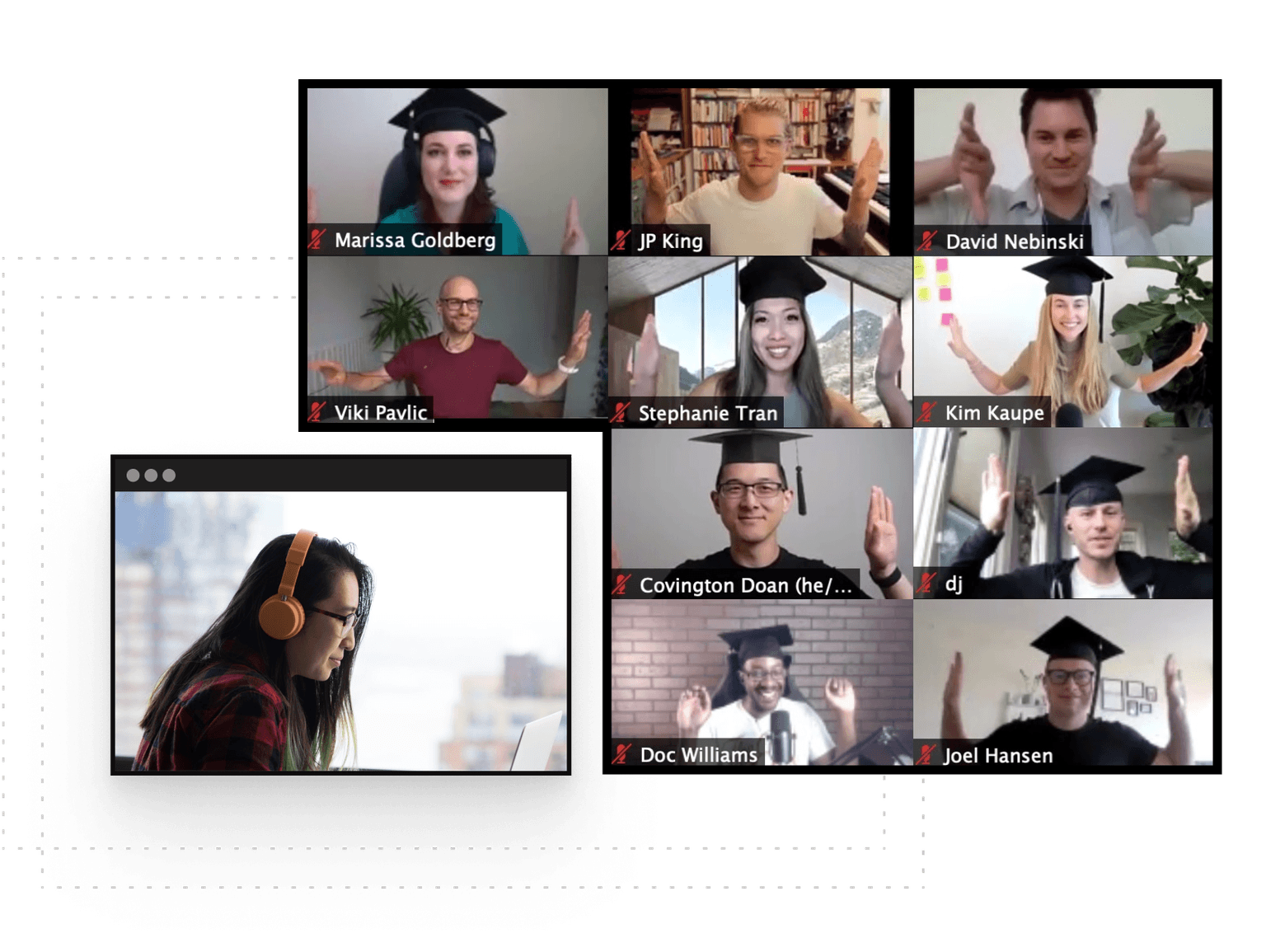
Active hands-on learning
This course builds on live workshops and hands-on projects
Interactive and project-based
You’ll be interacting with other learners through breakout rooms and project teams
Learn with a cohort of peers
Join a community of like-minded people who want to learn and grow alongside you