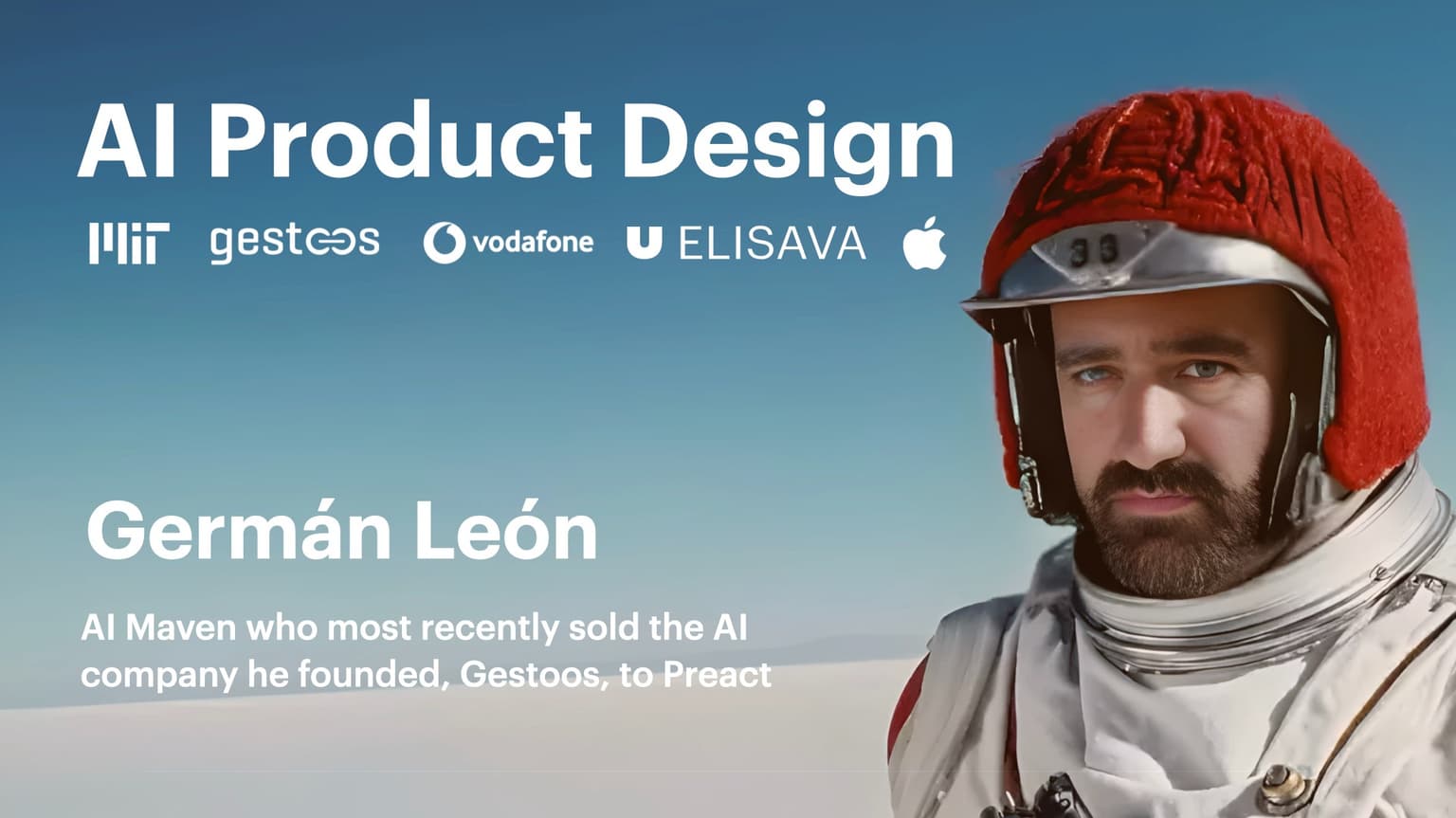
Hero image

Human AI Interaction - Designing Agency, Intelligence and Power

A four-week cohort course designed to equip participants with the skills to build AI-driven products that prioritize user experience.

This course is no longer available.

Explore other courses

Previously at

Vodafone
MIT research group
ELISAVA
Oblong Inc.
United Nations

Course overview

AI Product Design Boot Camp, learn No code AI-UX User-Centric Innovations.

This intensive three-week course equips participants with the skills to design AI-driven products that prioritize user experience. Through interactive lectures, hands-on projects, and rapid prototyping, students will learn to integrate AI technologies with user-centric design principles, from conception through testing and refinement, culminating in a market-ready AI product.

Who is this course for

01

UX and UI designers, along with product managers, who are looking to deepen their understanding of how AI influences the design process.

02

Entrepreneurs and founders of startups who want to leverage AI technologies to solve user problems and gain competitive advantage

03

Individuals with a background in technology who wish to expand their knowledge into AI-driven product design

What you’ll get out of this course

Design AI solutions that effectively meet user needs.

Designing AI solutions that meet user needs involves understanding user behavior, precise goal setting, and iterative development. Emphasize user-centric design, ethical considerations, and robust testing to ensure the AI delivers accurate, reliable, and beneficial outcomes.

Rapidly prototype and iterate AI products using AI/UX design methods.

Rapidly prototype and iterate AI products with the AI/UX design method, combining artificial intelligence and user experience principles. Streamline development, enhance user engagement, and ensure seamless integration by leveraging data-driven insights and agile testing.

Navigate ethical considerations in AI product design.

Navigating ethical considerations in AI product design involves ensuring fairness, transparency, and accountability. Mitigate biases, protect user privacy, and comply with regulations. They must also prioritize inclusivity, avoid harmful impacts, and engage stakeholders

Develop and pitch a comprehensive AI product.

By the end of this course, you'll have created an AI product design, ready as either a beta version or a prototype for an engineering briefing, using tried and proven methods.


What’s included

Germán León

Live sessions

Learn directly from Germán León in a real-time, interactive format.

Lifetime access

Go back to course content and recordings whenever you need to.

Community of peers

Stay accountable and share insights with like-minded professionals.

Certificate of completion

Share your new skills with your employer or on LinkedIn.

Maven Guarantee

This course is backed by the Maven Guarantee. Students are eligible for a full refund up until the halfway point of the course.

Course syllabus

5 live sessions • 12 lessons • 4 projects

Week 1

Mar 17—Mar 22

    Mar

    17

    Introduction to AI and Interaction Design Modules One and Two

    Tue 3/176:00 PM—8:15 PM (UTC)

    Module 1, Ai as Perception and power

    • Purpose:

      • Reframe AI from a technical system into something humans emotionally react to and project meaning onto.

    • Module description:

      • We explore why AI triggers fear, excitement, and intimacy, and how these emotions shape trust, adoption, and interaction.

      • We view AI as both a perception machine and a power structure, not just a tool.

    • Covers:

      • Why AI feels different from previous technologies.

      • Fear, desire, control, and authority

      • AI is not new, but our relationship with it is

    • Output:

      • A value proposition

    • 📄

      What Is Artificial Inteligence

    • 📄

      What is Interaction Design

    Module 2: Design and Development of Interactions

    • Goal

      Use AI to generate clear hypotheses about users and make assumptions explicit before real research.

      We create synthetic personas, simulate goals and fears, and map what we assume vs what we do not know. Synthetic users are used to surface blind spots, not to validate ideas. All outputs become questions to test with real users in Week 2.

    • 📄

      Creating Synthetic Personas

    • 📄

      Assumptions VS Unknowns

    • ✍️

      Build a Synthetic Persona and Test Your Value Proposition

      Submit by Jan 6

    Module 3: Preparing Real User Conversations

    • Overview:

      • Impact of human psychology on UX design.

      • Exploring human impulses and decision-making in the context of UX.

    • Topics:

      • Human-machine interaction and designing habit-forming products.

      • Cognitive ergonomics in UX design.

    • Activities:

      • Workshops on integrating empathy and ethics into UX design.

      • Exercises on designing accessible and user-centric interfaces.

    • 📄

      Preparing Real User Conversations

    Module 4: Reality Testing and Insight Extraction

    • Overview:

      • Practical approach to creating engaging UX with machine learning.

      • Design, test, and implement AI-driven UX solutions.

    • Topics:

      • User-centered technology, content strategy, interface development.

      • Using AI tools and resources to enhance UX design.

    • Activities:

      • Designing and testing AI-enhanced wireframes and UI prototypes.

      • Collaborative projects on creating responsive AI-driven UX designs.

    • 📄

      Reality testing and insight extraction

    • ✍️

      Reality Testing and Insight Extraction

      Submit by Jan 6

Week 2

Mar 23—Mar 29

    Mar

    23

    Fundamentals of Cognitive Science and Design Modulo Three y Four

    Mon 3/235:00 PM—7:15 PM (UTC)

Week 3

Mar 30—Apr 5

    Mar

    31

    User Experience Architectures Modules 5 y 6

    Tue 3/314:00 PM—6:15 PM (UTC)

    Module 5: Designing Human and AI Responsibilities

    • Overview:

      • Running usability tests and evaluating user interaction for AI solutions.

      • Iterative methodology for improving UX based on AI insights.

    • Topics:

      • A/B testing, heat maps, conversion funnels for UX evaluation.

      • Competitive usability tests and reporting for AI-driven projects.

    • Activities:

      • Conducting usability tests with real users.

      • Creating backlogs and prioritizing UX improvements based on AI data.

    • 📄

      What the Human Controls

    • 📄

      What the AI Is Responsible For

    Module 6: Designing Interaction Loops and Failure Modes

    • Overview:

      • Broad overview of AI applications relevant to UX design.

      • Designing, testing, and implementing AI algorithms in UX projects.

    • Topics:

      • Machine learning, search algorithms, Markov decision processes.

      • Constraint satisfaction, graphical models, and logic for UX solutions.

    • Activities:

      • Developing AI-driven UX solutions for specific problems.

      • Workshops on implementing AI algorithms in UX design scenarios.

    • 📄

      Core Interaction Loop

    • 📄

      Failure, Recovery, and Uncertainty

    • ✍️

      Define the Human-Ai Interaction Architecture

      Submit by Jan 6

Week 4

Apr 6—Apr 11

    Apr

    7

    Implementation of an AI Product Module Seven

    Tue 4/74:00 PM—6:15 PM (UTC)

    Apr

    10

    Optional: Demo Day

    Fri 4/104:00 PM—5:30 PM (UTC)
    Optional

    Module 7: Implementation of an AI Product

    • Overview:

      • Synthesizing all learning into a final AI-enhanced UX project.

      • Journey of discovery through learning by doing in UX design.

    • Topics:

      • Identifying UX opportunities, designing AI solutions, user-focused strategies.

      • Building and testing high-fidelity interactive UX prototypes.

    • Activities:

      • Ideation, validation, and strategy development for AI-UX projects.

      • Presenting final prototypes on demo day with peer and instructor feedback.

    • 📄

      Identifying UX opportunities, designing AI solutions, user-focused strategies

    • 📄

      Building and testing high-fidelity interactive UX prototypes.

    Final Week Wrap-up

    • Mentoring and Feedback:

      • Active mentoring sessions to optimize professional growth in UX.

      • Final feedback and evaluation of AI-UX projects.

    • ✍️

      Presenting final prototypes on demo day with peer and instructor feedback

      Submit by Jan 6

Bonus

    Super power your carrer using Linkedin Automations

    No module content yet

What people are saying

        Learning with Germán León in the AI Product Design Course has been a transformative experience. Germán's deep knowledge and passion for AI are genuinely infectious. He has a unique ability to make complex concepts accessible and engaging. His guidance has expanded my technical skills and inspired me to think creatively about AI.
Regina dos Santos

Regina dos Santos

Senior UX Designer
        I couldn't have asked for a better mentor than Germán León in the AI Product Design Course. His dedication to students' success is evident in every lecture and interaction. Germán's expertise in AI and his ability to foster critical thinking and creativity have empowered me to excel in my studies and beyond.
Carlos Morales

Carlos Morales

Executive Director
        Germán León's classes in the AI Product Design Course are nothing short of extraordinary. His approach combines theoretical depth with practical insights, making learning comprehensive and enjoyable. Germán's real-world experience and innovative thinking gave me invaluable skills and perspectives.
Arcadi Poch

Arcadi Poch

Creative Director
        Germán León's teaching in the AI Product Design Course is truly inspiring. His dynamic approach to AI education blends rigorous academic training with real-world applications, ensuring we are well-prepared for the industry. Germán's insights into the ethical and human aspects of AI have profoundly influenced my perspective on technology.
Stephanie Rodriguez

Stephanie Rodriguez

Machine Learning Engineer

Meet your instructor

Germán León

Germán León

AI Maven and CEO at Helvetica Digital

Germán León, a distinguished AI UX Maven and the visionary founder of Helvetica Digital, is backed by a formidable academic background. He holds a Master's Degree in Interaction Design from Umeå University in Sweden, a renowned institution in the field, and a degree from the prestigious Massachusetts Institute of Technology (MIT) in the USA, where he specialized in AI design. 


Germán's entrepreneurial journey reached a pinnacle with the successful sale of his brainchild, Gestoos, to Preact. Gestoos, an AI startup he founded, has been widely acclaimed for its advancements in Computer Vision and interaction. Featured in Forbes Magazine, Germán's journey and Gestoos' breakthrough in Artificial Intelligence for human-technology interaction have been spotlighted. Gestoos's proprietary developments in machine learning and applied AI have revolutionized how spaces and objects intelligently understand and anticipate human needs, aiming to embed the 'brains' (software) behind all the 'eyes' (cameras) around us, all while upholding privacy and intimacy as top priorities.


Prior to his groundbreaking work with Gestoos, Germán held key leadership positions at prominent companies. He served as the Managing Director at Oblong Europe, a company renowned for its association with the movie' Minority Report.' His career also includes a significant tenure at Vodafone Group, where he played a pivotal role in reshaping the company's mobile and Internet strategy. Germán's diverse experience and visionary leadership in the AI and UX domains have firmly established him as a luminary in the industry, driving forward innovations that seamlessly blend technology with human-centered design.

Course schedule

4-6 hours per week

  • Four Weeks

    1:00 pm - 2:00 pm EST

    You can learn and design your Artificial Intelligence Product Design in only Four weeks. We will also have office hours weekly to review the materials and answer any questions.

  • Dedicated Tutoring

    Every Monday

    We will have mentors to support you with your designs and Development of your product

  • Design your product during the course

    Proven Design Framework

    We will support you for four weeks while you learn and implement the design process and create a working prototype of your idea.

Learning is better with cohorts

Learning is better with cohorts

Active hands-on learning

This course builds on live workshops and hands-on projects

Interactive and project-based

You’ll be interacting with other learners through breakout rooms and project teams

Learn with a cohort of peers

Join a community of like-minded people who want to learn and grow alongside you

Frequently Asked Questions