
Become a Skills-Based Organization
Attract and retain your industry's top talent with a culture of growth and human flourishing. No one wants a job... they want a journey!
This course is no longer available.
Explore other coursesCourse overview
Become an ROI-Driving Learning Leader in 8 Weeks
Are you exhausted trying to prove the value of learning in your organization? Do you feel overwhelmed navigating the skills gap? This 8-week online course will empower you to become a strategic player who cultivates a thriving skills-based culture.
We'll step back and question why learning matters at all. You'll gain clarity on metrics that matter—like talent flow and growth culture audits—to demonstrate ROI and address pushback. We'll tackle the skills conundrum head-on, clarifying who defines skills and how to build skills inventories.
Each week, you'll explore contradictions that spark creative solutions. How do you put employees first while meeting business goals? How do you balance data with human-centric design? You'll prototype plans tailored to your organization and come away with an expanded portfolio to elevate your programs. Join us on this journey of inquiry and action to level up your skills and transform your organization into a powerhouse of motivated, skilled employees.
Who is this course for
01
L&D professionals seeking to evolve from order-takers to strategic players who can clearly demonstrate ROI and the value of learning program
02
Talent development leaders aiming to close skills gaps, build skills inventories, and cultivate motivated, growth-oriented cultures.
03
People managers seeking to build supportive teams that help grow employees' skills and careers.
What you’ll get out of this course
Activate Natural Learning in Daily Work
Apply cognitive science-based practices for generating insights and building skills through daily work. Forget periodic training, learn as you work through relevance realization.
Cultivate Forgotten Ways of Knowing
Some ways of learning have been lost in our culture's obsession with data and logic. Rediscover deeper aspects knowing that develop wisdom faster and accelerate career growth.
Engineer Career Journeys
Map employees' career stages within the company. Intentionally design practices and tools that motivate and support their progression through each stage.
Prototype Your Ideal Learning Ecology
Tailor a learning culture (we call it an ecology of practice) to your company's specific needs. Chart a path from current to ideal state and build a blueprint you can implement.
What’s included

Live sessions
Learn directly from Gabe Gloege in a real-time, interactive format.
Lifetime access
Go back to course content and recordings whenever you need to.
Community of peers
Stay accountable and share insights with like-minded professionals.
Certificate of completion
Share your new skills with your employer or on LinkedIn.
Maven Guarantee
This course is backed by the Maven Guarantee. Students are eligible for a full refund up until the halfway point of the course.
Course syllabus
8 live sessions • 34 lessons • 10 projects
Week 1
What are the necessary conditions for progressing one’s career?
How might we engineer those conditions to help employees advance their careers?
- 📄
1: The Ship Analogy
Complete by Mar 7 - 📄
2: Finding Direction and Steering
Complete by Mar 7 - 📄
3: Expanding and Deepening Networks
Complete by Mar 7 - 📄
4: Building and Sharing Skills
Complete by Mar 7 - ✍️
Evaluate and improve career programs
Submit by Mar 9 - 📄
(Optional) Jobs-to-Journeys Podcast: Career Development
Mar
7
Live Session 1 - An Odyssey of Career Growth
An Odyssey of Career Growth
The north star of most employees’ motivation to learn is “how will this help my career?” Harness this innate desire and employee engagement dramatically improves. If employees are a ship at sea, their career is a string of journeys to various ports. We’ll explore the necessary conditions—the compass, wind, and sails—that make for a successful journey.
Week 2
- What are the key stages of an employee’s career within an organization and how are they related?
- Why is the employee career journey disjointed and inconsistent and how can we fix that?
- Why does putting customers second ultimately help the customer?
- 📄
1: Hiring & Onboarding
Complete by Mar 14 - 📄
2: Developing & Promoting
Complete by Mar 14 - 📄
3: Mentoring & Exiting
Complete by Mar 14 - 📄
4: Resonant Arenas
Complete by Mar 14 - ✍️
Project: Map and Improve Your Arenas
Submit by Mar 16
Mar
14
Live Session 2 - The Six Arenas
The Six Arenas Of The Employee Journey
We’re going to dig into the cognitive science concept of “transjective agent-arena coupling.” An arena is where a game is played. A game has players, rules, and a goal. If you don’t know the game you’re playing, you’re not going to play it well. We’re going to explore the different stages of an employee’s career (within a company) as a series of different games, each with different goals and rules. And we’re going to design ways to make those games more obvious and engaging to employees… so they win more often.
Week 3
- 📄
1: Brain Hemispheres
Complete by Mar 18 - 📄
2: 4E Cognitive Science
Complete by Mar 18 - 📄
3: What is insight?
Complete by Mar 19 - 📄
4: Developing Wisdom
Complete by Mar 19 - ✍️
Project: Define Your Journey
Submit by Mar 20
Mar
21
Live Session 3 - Hitch A Ride On Your Day Job
How to hitch a ride on your day job
How does the human mind actually learn?
What does it mean to have insight?
How do insights accumulate into wisdom?
How might we activate this in our everyday work?
We’re going to dive into 4E cognitive science and understand how the human mind makes sense of the world by building an abstract model of relevant relationships and then constantly updating that model based on everyday experience. We’ll also explore how dialog and dialectic are fundamental to the production of insights. I’ll lay out a simple and pragmatic method for leveraging these natural cognitive processes in order to quickly build skills and increase insight by simply doing one’s everyday work.
Week 4
- 📺
1: Propositional and Procedural Knowing
Complete by Mar 25 - 📺
2: Perspectival and Participatory Knowing
Complete by Mar 25 - 📺
3: Comparisons with Other Frameworks
Complete by Mar 26 - ✍️
Project: Enhancing a Learning Experience
Submit by Mar 27 - 🎧
(Optional) Jobs-to-Journeys: The four lost ways of knowing
Mar
28
Live Session 4 - Four Lost Ways of Knowing
The Four Lost Ways Of Knowing
What does it mean to know something?
What does it mean to grow as a professional?
Is there more to learning than acquiring facts and mastering procedures?
Corporate learning is myopically obsessed with facts and reason as the essence of learning and growth, with a sprinkling of “how to” procedures. But there are deeper, more important and powerful ways of knowing that impact professional growth and wisdom. We’re going to unpack these and apply them to designing a learning culture.
Week 5
- 📄
1: The Black Box
Complete by Apr 1 - 📄
2: Mapping workflows and activities
Complete by Apr 1 - 📄
3: Creating a Skills Map
Complete by Apr 2 - 📄
4: How Skills and Activities Help Us See Clearly
Complete by Apr 2 - ✍️
Project: Build a Skills Map for Your Role
Submit by Apr 3
Apr
4
Live Session 5 - How to Build a Skills Inventory
How To Build A Skills Inventory
What are skills, really?
How do we define them?
How do we measure them?
How should we manage them?
We’ll step through a design process for defining roles—the boundaries of relevance for workplace learning—breaking them down into skills and activities, and how to identify the most important and impactful skills for any role. We’ll also explore ways to think about mastery and what it means to have fluency in a skill. In each of these the aim will be pragmatism—how can we break down skills into useful components without losing our focus or being overwhelmed by abstraction. This is at the heart of becoming a skills-based organization.
Week 6
- What are the necessary conditions for growing as a professional?
- How can we engineer those conditions in our organizations?
- At what levels do these conditions operate?
- 📄
1: Stop Yelling At Your Garden
Complete by Apr 8 - 📄
2: Strong Home
Complete by Apr 8 - 📄
3: Sharp Edge
Complete by Apr 9 - 📄
4: Steady Groove
Complete by Apr 9 - 📄
5: Three Levels of Company Culture
Complete by Apr 10 - 📄
(Optional) Jobs-to-Journeys: The garden metaphor
- ✍️
Project: Measuring Home, Edge, and Groove
Submit by Apr 11 - ✍️
Project: Improving HEG with Irene's help
Submit by Apr 12
Apr
11
Live Session 6 - Home, Edge, and Groove
Strong Home, Sharp Edge, Steady Groove
We often hear of “toxic cultures” where learning and growth are impossible. What makes those cultures so bad? We’ll explore the poisonous aspects of those environments, and their inversion (home, edge, and groove) that foster human flourishing and lead to career development and talent flow. We’ll also explore how they show up at multiple levels of the organization.
Week 7
- What is culture, really?
- Can we actually control, or at least influence, culture?
- 📄
1: Culture and Practices
Complete by Apr 15 - 📄
2: Culture and Frameworks
Complete by Apr 15 - 📄
3: Culture and Tools
Complete by Apr 16 - 📄
4: How to Change Culture
Complete by Apr 16 - ✍️
Project: Expand one practice
Submit by Apr 17 - ✍️
Project: Build your ecology of practices
Submit by Apr 17
Apr
18
Live Session 7 - How To Change Culture
How To Actually Change Culture
This is where we really dig into and design an ecology of practice. We’ll start with the three pillars of culture: frameworks, practices, and tools. We’ll understand each of them, drawing off the experience of your own companies. Then we’ll prototype a growth culture that might work for your own company. Finally we’ll brainstorm the practical and political approach to changing culture at your own company.
Week 8
- Is talent retention really that great?
- What would happen if we retained all our talent?
- Can you truly measure learning and growth?
- Is there really an ROI to talent development?
- 📄
1: Retention vs Flow
Complete by May 1 - 📄
2: How to Measure Learning
Complete by May 1 - 📄
3: Measuring Talent Flow
Complete by May 1 - ✍️
Project: Prototype Your Talent Flow Dashboard
Submit by Apr 30
Apr
25
Live Session 8 - Talent Flow
Talent Flow
At this point you’ll have an ecology of practice and a plan for implementing it. In this session we’ll explore what you should be optimizing for and how to measure if it’s actually working. This is talent flow. People don’t stay at an organization forever. They come and they go. But what’s the right pace of turnover and how can we monitor it and use that to regularly tweak our growth culture?
What students are saying
Meet your instructor
Gabe Gloege
Gabe Gloege
CultivateMe Co-founder, former Head of Learning
With over 20 years in workplace learning, Gabe Gloege has led learning departments in global corporations and been a learning team of one in startups. His experience helping teams and companies build learning cultures that drive employee engagement and attract top talent makes him uniquely qualified to help you prototype the ideal learning ecology for your organization.
Course schedule
3-4 hours per week
Asynchronous Course Material
30 minutes per module
Each module has ~20 minutes of video content to review before the live sessions. Videos are 5 minutes or less so you can watch them in the cracks of your busy schedule.
Live sessions on Thursdays
11:00am - 12:00pm EST
These will be highly interactive sessions where we discuss the course material, have paired dialog with cohort members, and refine your personalized learning culture plans. You'll deepen your understanding of these concepts and build relationships with other professionals.
Short projects with each module
20 minutes per module
With each module you will gradually design an ecology of practice for your own organization. By the end of the course you will have a master plan for a growth culture that is unique to your company.
Learning is a team sport
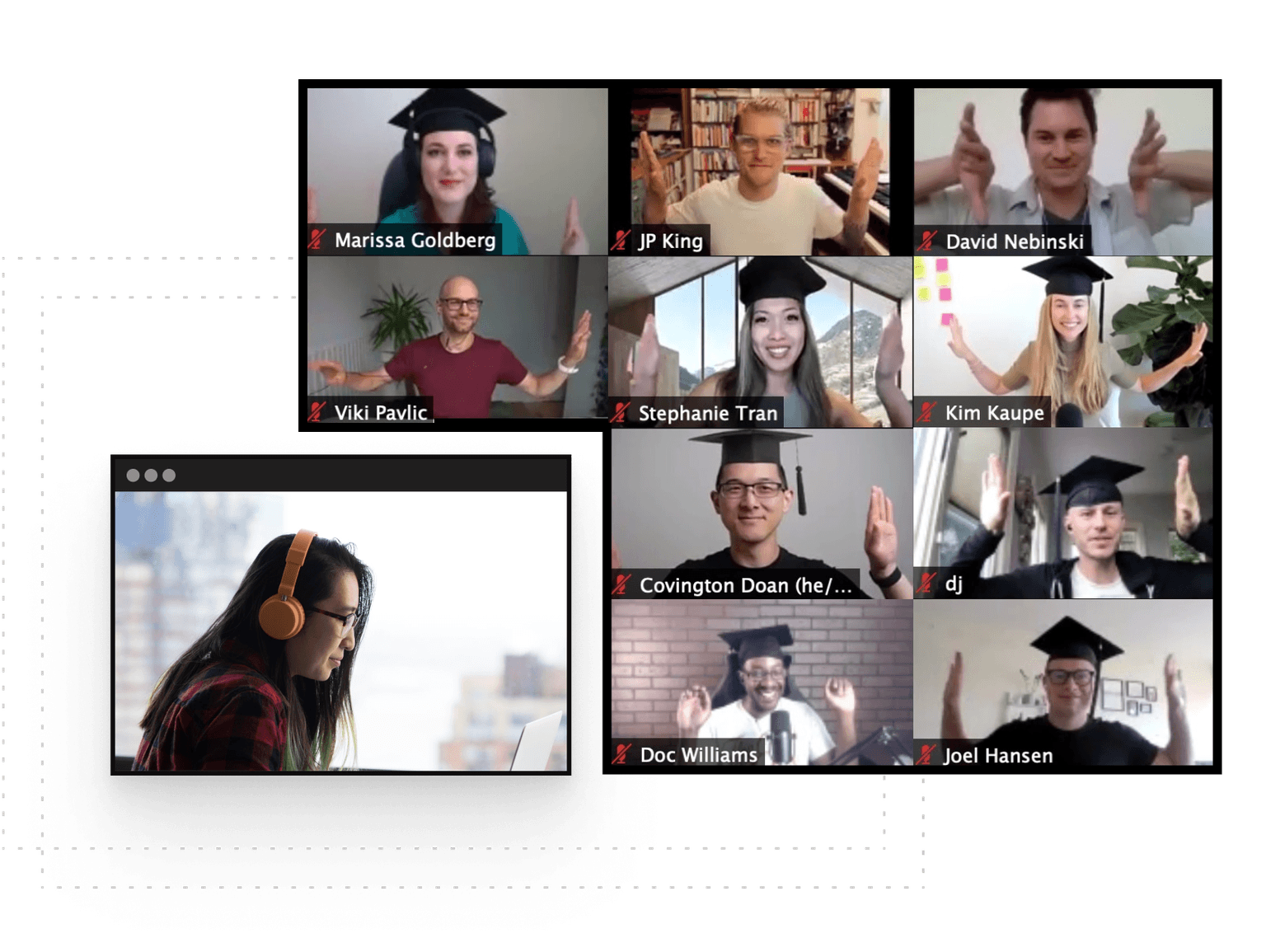
Active hands-on learning
This course builds on live workshops and hands-on projects
Interactive and project-based
You’ll be interacting with other learners through breakout rooms and project teams
Build your professional network
These will not just be faces on a screen. You're going to interact with every member of the cohort, teaching each other and growing together.