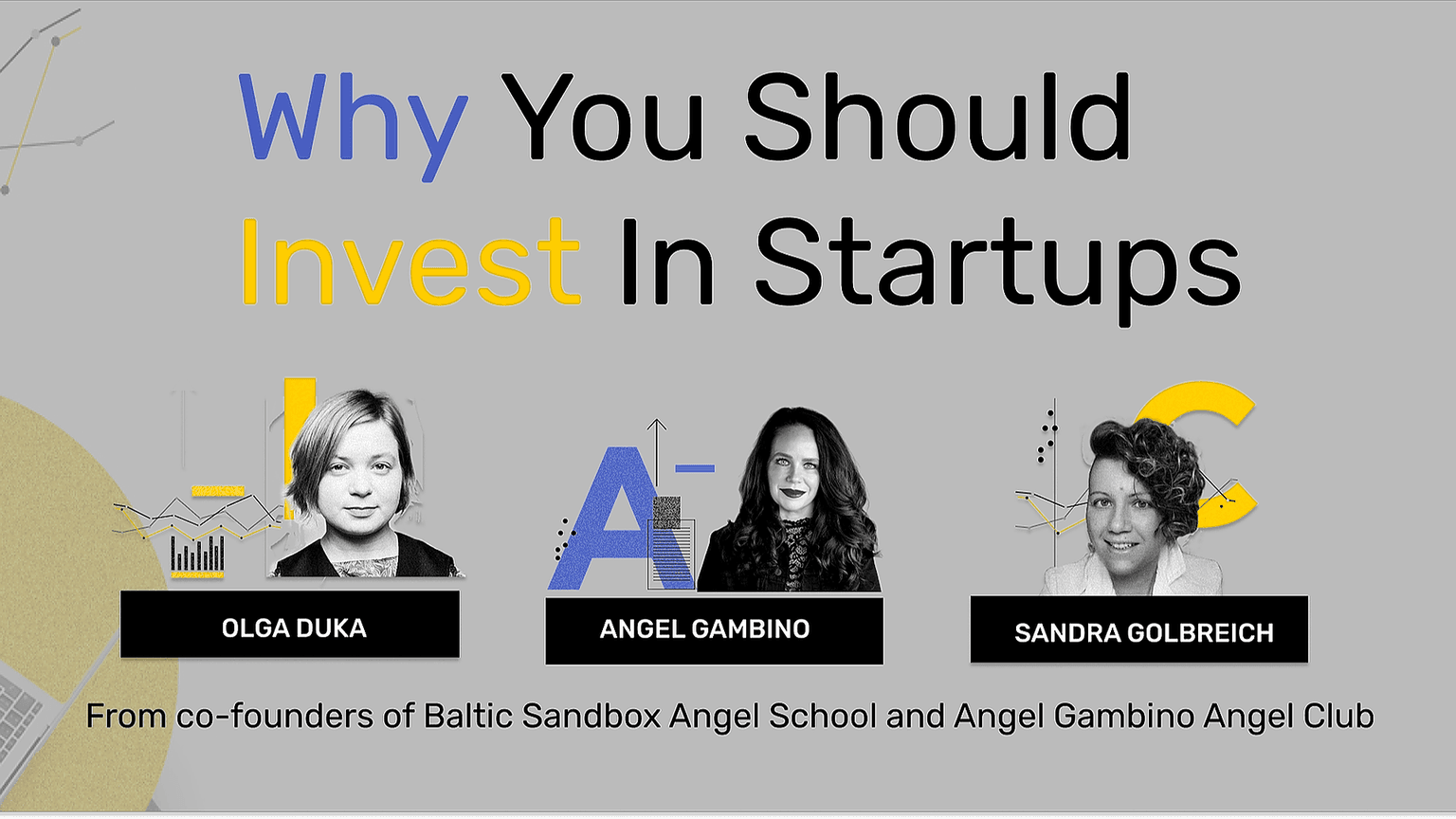
Understand the decision-making process and design your first investment strategy in 3 weeks.
This course is no longer available.
Explore other coursesCourse overview
Investing in startups is risky business, but it can be more financially rewarding than most other types of investment. Angel investing can also become a full time or part time profession.
This course is designed for investors who are considering early stage startup investing, but aren’t sure where to begin and for newbie angel investors who’ve made the first investments, but want to develop a more strategic approach and efficient process.
The primary takeaways from the course are a clearer sense of whether angel investing is right for you and a plan to invest at the level that feels right for you.
01
You are a founder who needs to understand investor logic and criteria better for your next fundraise, and expand your investor network.
02
You are a corporate employee looking to explore angel investing for a part of your income, but are unsure of where to begin.
03
You are an aspiring investor, who wants to learn the fundamentals of venture asset class and structure your way forward.
Materials
Risk Profile
Understanding your reasons to invest in startups, your skills and talents, risk perception, passions and preferences, and networks to define a fitting investment strategy.
Startup Assessment
Learning the basic principles of startup assessment, practicing it repeatedly, gaining visibility and conducting your own research.
Due Diligence
Divide and conquer: find partners while understanding the mechanics of due diligence. Learn how to walk away from a risk that you personally are not willing to take.
Decision-Making
Creating a repeatable and coherent decision-making framework that works individually for you. Matching your skills, risk profile, financial capacity to an individual investment strategy that evolves over time.

Live sessions
Learn directly from Olga Duka in a real-time, interactive format.
Lifetime access
Go back to course content and recordings whenever you need to.
Community of peers
Stay accountable and share insights with like-minded professionals.
Certificate of completion
Share your new skills with your employer or on LinkedIn.
Maven Guarantee
This course is backed by the Maven Guarantee. Students are eligible for a full refund up until the halfway point of the course.
11 lessons • 6 projects
To play, you must understand the basic mechanics of the game. Let`s walk through a venture ecosystem landscape, to understand the startup risks, typical win and failure stories, the role and profile of angels, as well as a required competence and experience to become a successful angel investor over time.
Assessing the risks: what is the right fit for you? Going from “I am interested in startups” to “I understand that I may not see my money back in at least 5 years, or at all, and I am okay with that for X amount in the first year.”
Introduction to Angel Investing
Angel School - Why you should invest in startups - Workbook
Investment strategy checklist
Investment strategy, part 1
Ask us any questions.
Startup assessment is science and art, which you will master over time. Don`t worry over not being able to understand something, or not knowing how to assess certain angles to the business – it does take time and experience, and you are just getting started.
First steps forward? Understanding basic principles of assessment, practicing it repeatedly, gaining visibility and doing your own research. We will go through a couple of approaches to startup assessment and evaluation, hands-on.
What is startup and what is not? How to read a deck? What metrics mean and how to read them? Lessons learned from typical startup and investor mistakes. Reducing unnecessary risks: focus on your own field of competence, comfort zone and perception of risks. A hint: common sense works miracles.
Going from “I like this team for some reason, but I don`t know much about this market” to “I understand that this team in my view is sufficiently competent to build a business, I understand the market very well and can validate the problem-solution fit, I may not fully understand their product/marketing strategy, but the team has a verified experience to do their job.”
Startup Evaluation Basics
Startup evaluation checklist
Investment strategy, part 2
First rule of acquisition? The investment discipline. Defining your own profile, with its natural limitations, will help you build your first angel portfolio consciously, and cut down unnecessary risks.
Private markets present you with a high level of risk generally, so your job is two-fold: take the risks you understand and cut down the risks that you do not. What`s your reasons to invest in startups? What`s your personal skillset and superpowers? How and where can you personally find startups? How are startups going to find you? What`s your available liquidity to invest for one year? What`s your preferred time horizon for exits? What`s your network and where can you find good opportunities? Which areas of startup assessment you are okay not understanding, while being an investor? And what would be a deal breaker?
Going from “I want to invest in startups” to “I am going to invest in HR tech B2B startups in the US, together with 2-3 syndicates I am already connected to, with a limit of 25k in the first year, and I am okay with not understanding a certain area of a particular startup, as long as the bigger picture is there”.
Building Your Angel Profile
Angel profile checklist
Investment strategy, part 3
Angel Profile
Ask us any questions.
Two ideas: understanding due diligence and legal is indeed very important but you do not have to master it immediately – you can outsource this role until you need it, by joining a syndicate, angel club, hiring a lawyer or following a leading super-angel.
Yet, understanding the mechanics is important, and it may allow you to walk away from deals that you think are a higher risk that you personally are willing to take. It`s your money, remember?
We are going to dive into the intricacies of due diligence for startups - and for other investors. What’s the red flags to check in a team and on a cap table? What are the potential implications of previous investments conditions? What`s the reasonable checklist to go through in pre-seed, seed, or later stages - and what is the difference?
Going from “I am not a lawyer, what am I supposed to do?” to “Joining a leading angel in my sector and market, within my network, and follow some of their deals with legal taken care by them, while doing a reasonable checklist for myself, to expand my skills.”
Due Diligence for Startups and Investors
Due diligence checklist
Investment strategy, part 4
Assembling our jigsaw puzzle: how to create a personalized, repeatable, and coherent decision-making framework?
You have assessed your general risk tolerance, gained the basics of startup assessment and due diligence, narrowed down your best skills and experience, and chosen some of the parameters of your angel profile.
Lets match your risk profile, liquidity expectations, time horizon for investment returns, skillset and networks, various startup stages of investing and your personal preferences to strategies that work individually for you and see where is lands you.
And we are going to make one step further: create a personal investment strategy as of today, – and a blueprint you can use in a few months or years down the road.
Decision-Making Framework
Investment strategy checklist
Investment strategy, part 5
Ask us any questions.
4-8 hours per week
Tuesdays & Thursdays
11am – 12:30pm EST / 17pm –18:30pm CET
Plus we hold instructor office hours every Wednesday for 1 hour.
Weekly projects
1-4 hours per week
We will have pre-work items and in-session exercises, and instructor office hours, making the course as practical as possible.
Sarune Smalakyte
Martynas Kandzeras
Tauras Pėstininkas

Marta Rautenschild
GP @ Improve Ventures, Co-founder at BAS
Olga is a General Partner at Improve Ventures, an early stage VC, that invests in exceptional teams in Africa, Latam and SE/SEA.
She is an asset management professional and talent development specialist, working at the intersection of science, technology, culture and education for the last 15 years.
Previously, Olga was a co-founder and operator in multiple early-stage ventures in 10+ industries across 3 continents. She also worked extensively with accelerators, venture studios, angel networks, early-stage VCs, corporate investors and P/E.
She joined Business Angel School as a co-founder back in 2021 to expand the variety of programs and amplify the network effect.
Systematic Approach
Checklist, template and framework are our favourite key words.
Hand-on Training
Learning by doing, rinse, repeat.
Interactive workshops
Learn in a group, in small breakouts, peer-to-peer, and on your own.
Fun
We put fun in funding.